Isaac Asimov Presents Superquiz II
Isaac Asimov Presents Superquiz II uses three levels from Freshman to Ph.D. to challenge knowledge across diverse subjects and fosters a lifelong joy of learning.
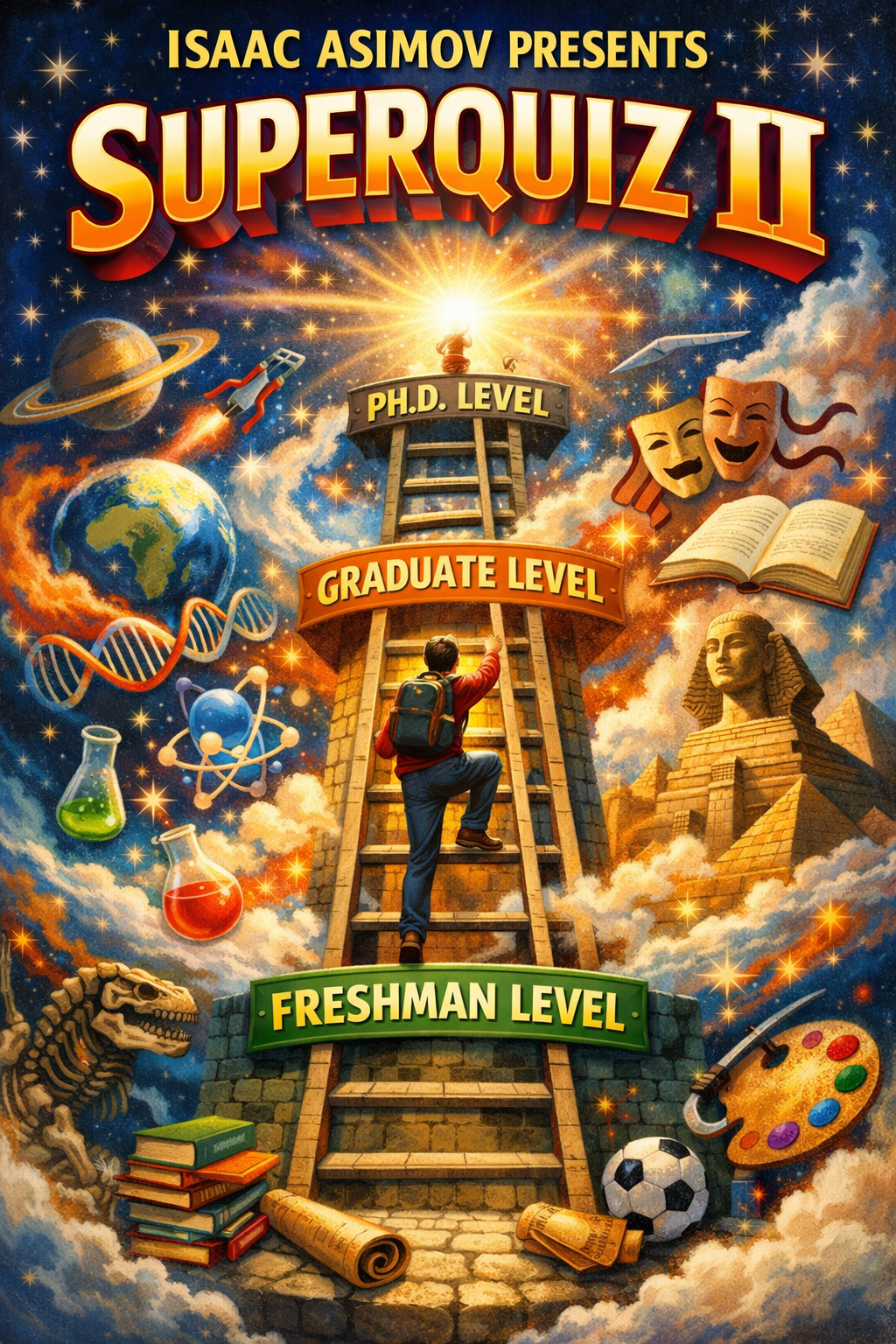
In the grand tradition of explaining the universe, a new adventure unfolds within the pages of a book that does not rely on faster than light travel or the positronic brains of robots. Instead, this journey, titled Isaac Asimov Presents Superquiz II, invites the reader to step into a vast architecture of human thought. It is a compendium that spans almost every domain of human understanding. The book is designed not merely for the passive consumption of facts, but as a vibrant educational tool intended to stimulate curiosity and encourage the exploration of subjects that lie far outside one’s usual comfort zone.
To understand the story of this book, one must view it as an intellectual pilgrimage. The narrative does not follow a single protagonist, but rather the reader themselves as they navigate a layered mosaic of topics. This journey is structured like an educational ladder, designed to turn learning into a game where the stakes are the expansion of one’s own mind. The philosophy behind this work is that games are powerful tools for reinforcing knowledge and building confidence across various disciplines. The plot of this adventure is the progressive movement from simple awareness to deep and critical synthesis.
The book is organized into hundreds of categories. Each represents a distinct field of human endeavor such as History, Geography, Mathematics, Science, Language, Literature, Arts, Culture, and Technology. Because the book is composed of these distinct thematic fields and levels of difficulty, we can view each stage of the journey as a series of mini stories in the quest for enlightenment.
The story of the Freshman Level is the first stage of the journey. This stage is one of accessibility and foundational truth. It is designed to be a gateway for all travelers, testing general common knowledge that most people have encountered in their daily lives. In this stage, the reader encounters straightforward facts that gauge basic awareness of the world around them. For example, one might be asked to identify the capital of Japan. A traveler might also be asked about oxygen, which is the specific gas that humans must breathe to survive. This level is not meant to intimidate, but to welcome the reader into the fold of the knowledgeable, providing the basic recall necessary to build a foundation for more complex ideas. It represents the simple joy of recognition and the starting point of any great intellectual pursuit.
The story of the Graduate Level begins as the traveler moves deeper into the book. This stage represents a bridge between simple facts and deep understanding. Here, the requirements for success change because it is no longer enough to simply recognize a name or a place. The reader must now demonstrate deeper recall and the ability to connect different concepts. The characters in this part of the story are more specialized, involving figures such as Johannes Kepler and his formulations of planetary motion. It might also involve specific lines spoken by Hamlet in the works of William Shakespeare. This level challenges the reader to look beyond the surface of a title or a plot and understand the historical and literary contexts that give these facts meaning. It is a story of connection, where the disparate threads of information begin to weave into a more coherent tapestry of specialized knowledge.
The story of the Ph.D. Level is the final and most challenging segment of the book. This is the peak of the intellectual mountain where the questions are no longer just about what or who, but why and how. The story here is one of synthesis and critical thinking. The traveler is asked to perform advanced scientific recall. This might include explaining the significance of the Hardy Weinberg equilibrium within the field of population genetics. The traveler might also engage in essay style discussions regarding the cultural influences of the Byzantine Empire on Eastern European art. This level encourages cross disciplinary associations, forcing the reader to pull from various fields to form a complete answer. It is the ultimate test of the reader’s intellectual stamina and represents the highest form of learning, which is the ability to use information to analyze the world.
In reviewing this intellectual adventure, it is clear that Superquiz II is a masterpiece of educational entertainment. While the direct authorship of Isaac Asimov on this title was minimal, he served primarily as a presenter, fact checker, and endorser of his collaborator’s work. Even so, the book is infused with his unmistakable ethos. Asimov spent his career arguing that the joy of learning is a universal human right, and this book reflects that belief by making even the most difficult concepts approachable through a conversational and playful tone. The book functions less as a traditional narrative and more as a companion for lifelong learning. It succeeds because it does not treat knowledge as a dry list of facts to be memorized, but as a series of intellectual adventures and puzzles to be solved. By arranging the material in a three tiered structure of increasing difficulty, the book allows readers of all backgrounds to track their own improvement and feel the thrill of discovery.
The legacy of Superquiz II lies in its ability to stimulate curiosity. Each question is a stepping stone that invites the reader to look further, perhaps by consulting an encyclopedia or another book to find the deeper story behind a trivia answer. It signals that being curious about everything, from ancient civilizations and the fundamental laws of physics to modern pop culture, is a worthy and noble pursuit. In the end, the book is a celebration of knowledge itself, proving that the more we know, the more we realize there is still to discover. It is a story with no final ending, only a continuous invitation to learn what we do not yet know.