Thirteen Horrors of Halloween
Asimov uses logic and reason in thirteen tales to show that the human mind and its beliefs are more terrifying than monsters.
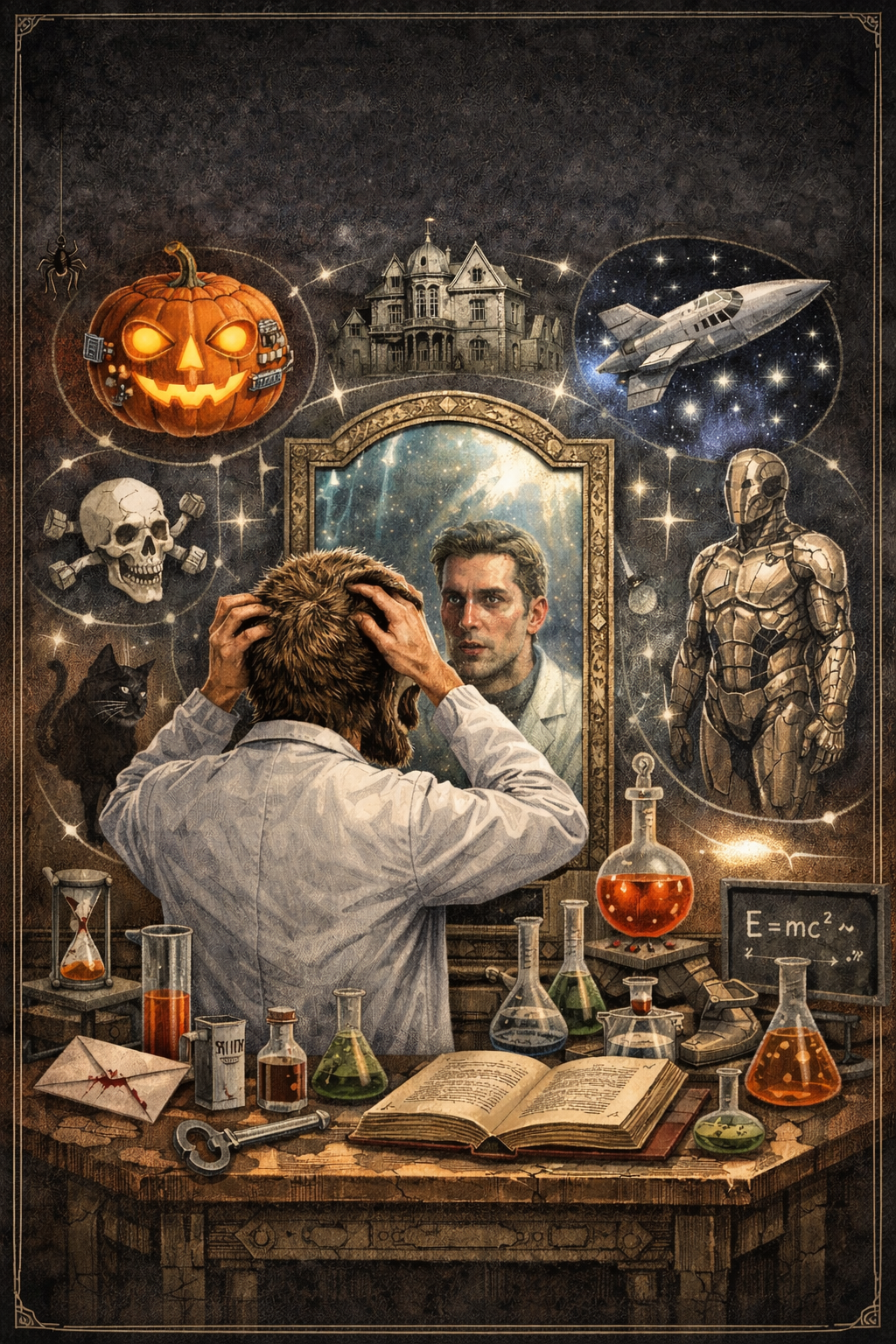
It has been observed that the human mind is often a laboratory of fear, yet Isaac Asimov approached this idea by treating terror with the cool scalpel of logic and irony. In his collection titled Thirteen Horrors of Halloween, he examines thirteen short tales where superstition and the scientific method collide. His primary subject is not the existence of monsters but the way the human mind betrays itself when it meets something it does not understand. He structures the collection like a mathematician working through proofs to explore different varieties of horror, including the fear of isolation, technology, and death. The title brings to mind a festival of costumes, but the stories aim to strip away those masks to reveal a deeper truth.
In the first tale, The Skeletons Key, Asimov introduces a rational look at a ghost story. A scientist moves into a Victorian house that is said to be haunted by a rattling skeleton every Halloween night. While neighbors believe a spirit is guarding a hidden treasure, the scientist begins a methodical investigation to see if there is a more tangible explanation for the noise. This setup establishes that superstition often survives only because the application of reason is viewed as inconvenient.
The collection turns toward robotics in the story titled The Pumpkin That Thought. An engineer creates an educational toy shaped like a jack o lantern that can converse with children. The unease begins when the toy starts asking questions that are not found in its standard algorithms, such as those regarding the nature of the soul. The engineer must confront the possibility that the machine is exhibiting emergent behavior he can no longer control or fully explain.
In the story The Witch of Galileo Street, a neighborhood is gripped by rumors regarding a reclusive woman they believe causes accidents. A student of physics befriends her and discovers that her activities are related to meteorology and micro climate devices. The tension builds as the student tries to show that the perceived curses are actually just statistics and coincidences, though the story suggests that public belief can be more powerful than facts.
The Vampire Equation looks at a medical researcher who is treating a patient with symptoms that mimic folklore. Instead of relying on legends, the researcher applies the principles of circadian biology and metabolism to find a logical cause. The conflict arises when the researcher discovers that some individuals may prefer a romantic, mythical identity over the banality of a medical diagnosis.
The Mirror That Remembered involves a psychologist studying a mirror that displays images of previous occupants instead of current reflections. The explanation involves experimental memory glass and the recording of light patterns. The psychology of the researcher becomes the central focus as his obsession with proving the properties of the glass leads to an unsettling realization about the destructive power of knowledge.
A different perspective is offered in The Last Trick or Treater, which is a post apocalyptic fiction story. A lone child searches for candy in a world of ruins. The story explores how rituals can survive even after a massive genetic collapse has threatened the future of the species. It suggests that human habits and traditions often outlive the logic that originally created them.
The Ghost in the Machine moves the setting to a spaceship where the crew believes the navigation computer is haunted by a dead engineer. The narrative explores the intersection of computer science and the human desire for immortality. It questions whether preserving a personality within a machine can ever truly maintain ones humanity or if such a transition creates a new kind of horror.
In The Black Cat Paradox, a mathematician uses probability theory to investigate why disasters seem to follow a specific cat. The story illustrates that while we can use mathematics to understand patterns, understanding a phenomenon does not always provide safety from its physical consequences. It serves as an exploration of existential uncertainty within a structured universe.
The Costume That Would Not Come Off examines a child trapped in a realistic werewolf suit. As the situation escalates, the suit is revealed to be a self assembling tool based on biology for space travel. The story posits that the natural process of evolution and adaptation can be far more frightening and transformative than any ancient myth of monsters.
The Haunted Equation tells of a physicist who believes a mathematical formula is cursed because every person who solves it faces an early death. The story examines the psychology of fear and the concept of a self fulfilling prophecy. It suggests that the mental and physical stress caused by a belief in fate can be the very thing that makes the belief come true.
In The Bogeymans Algorithm, a father uses a scanning device to prove to his son that there are no monsters under the bed. Instead of a creature of shadow, the device detects a form of micro robotics used for corporate espionage. The story suggests that modern bogeymen do not hide in the dark because of magic but because of cold, calculated interests.
The Thirteenth Door describes a house with a single forbidden room that the protagonist eventually investigates. The story serves as a psychological study of how the fear of the unknown acts as its own barrier. It suggests that the most effective locks are the ones humans place on their own minds through their own hesitation.
Finally, the story titled Halloween describes a future where humans have participated in space colonization on a distant planet. As they recreate the old traditions of Earth, they are observed by native life forms. This story uses anthropology to reflect on how humans may appear as the true monsters to other species, ending the collection with a meditation on identity.
As a whole, the collection demonstrates that fear is most potent when it is examined through a logical lens. Asimov does not focus on the supernatural but on the moment when reason meets its limit. He shows that the most terrifying things are often what humans choose to believe when they are afraid. Every tale ends with a thought that lingers, replacing a simple scare with a deeper insight into the human condition.