Visions of the Universe
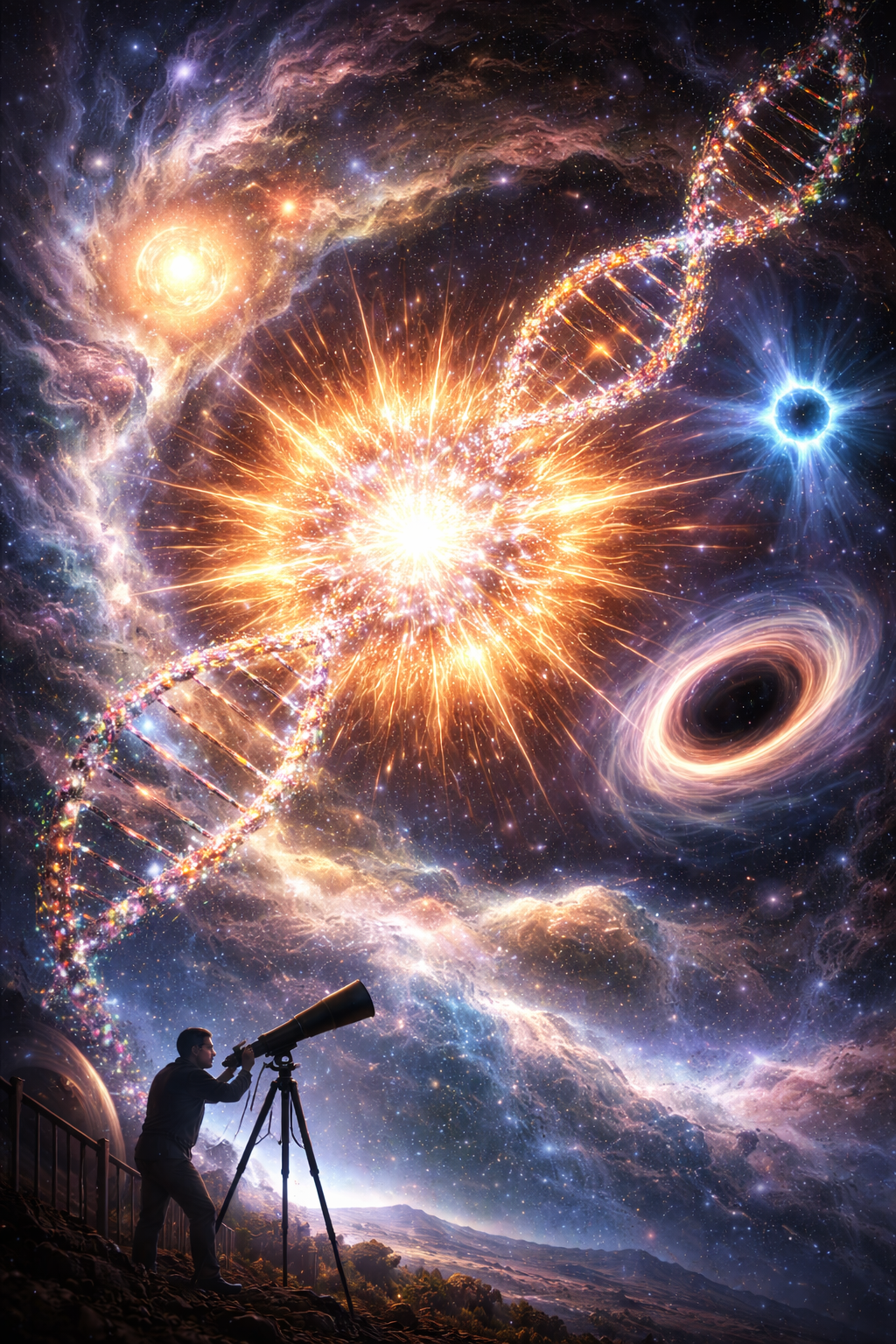
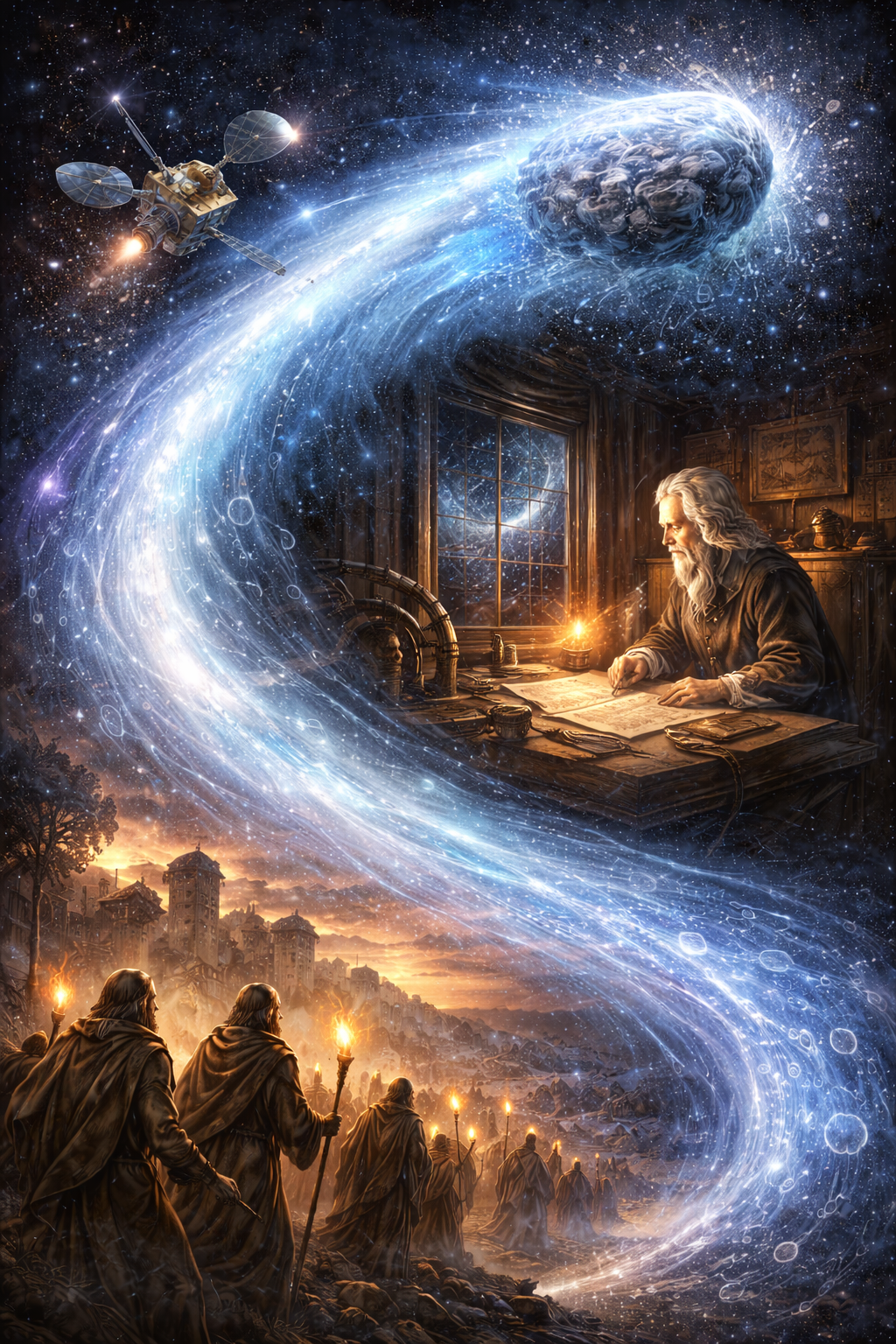
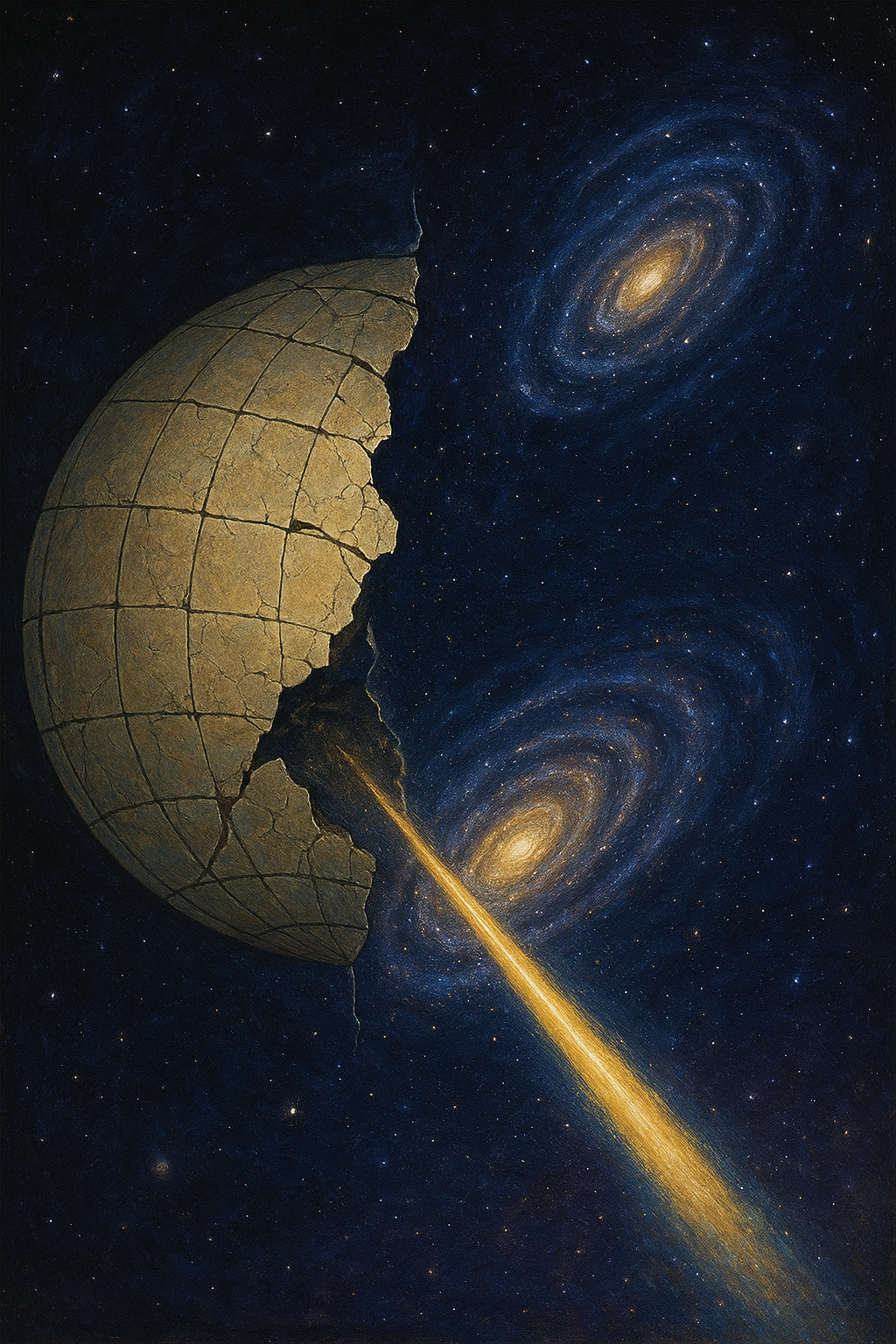
The story, Visions of the Universe, details humanity's logical journey from believing in a small, Earth-centered cosmos to comprehending a vast, expanding system governed by universal laws and filled with billions of galaxies.
Visions of the Universe
0:00
/952.877279
This intellectual journey, presented in Visions of the Universe, is laid out as a calm, logical progression, characteristic of Asimov's best expository works. The true subject of the book is not merely the cosmos itself, but the widening perspective of the human mind—a perspective that has grown, step by inexorable step, from the uncertain awe of the ancients to the data-driven clarity of modern science. The structure is set to reveal the necessary logic that transformed human ignorance into understanding.
- The Ancient Sky: The Necessary Constraints of Observation
The narrative opens upon the only universe humanity initially knew: the simple dome of lights seen with the unaided eye. This realm was defined by the perfect, unwavering rhythm of celestial motions—the rise and set of the Sun, the cyclical phases of the Moon, and the steady march of constellations. Civilizations, from the Babylonians seeking prediction to the Greeks seeking geometry, applied their best minds to these problems. Figures like Ptolemy wrestled with the challenge of explaining the "wandering" planets. Crucially, as Asimov shows, all these early models shared a foundational assumption: the Earth was motionless, central, and privileged. This early vision created a universe that was intimate and comforting, which was not born of foolishness, but rather from insufficient evidence. With only the human eye as an instrument, the cosmos simply seemed small and closed. - The Copernican Opening: The Power of Thought
The first great expansion did not require a new telescope, but a new way of thinking. Asimov stresses that Copernicus initiated an intellectual revolution. By moving the Sun to the center of planetary movement, he relieved astronomy of centuries of explaining complex planetary motions through "arbitrary epicycles". This decision, while simple in premise, immediately expanded the cosmos, although initially the stars were still fixed to a distant sphere. The true physical transformation came later, with Kepler's mathematical precision and Galileo's instrument, leading finally to Isaac Newton. Newton shattered the assumption that the heavens were governed by special, unique celestial laws. Instead, the same gravity that pulls objects on Earth also binds the celestial realm. The universe ceased to be a collection of disparate phenomena and became a single system, bound by universal rules. - The Stellar Universe: From Points to Furnaces
The story then shifts focus from planets to the stars themselves. In the 19th and early 20th centuries, stars were transformed from mere points of light into physical objects that could be measured and understood. Asimov demonstrates how each discovery logically necessitated the next. Advances in spectroscopy revealed stellar composition, while parallax measurements yielded the first accurate stellar distances. It was proven that our own Sun was not special, but merely one star among billions. Through the development of tools like the Hertzsprung–Russell diagram, astronomers could classify and impose order upon what appeared to be stellar chaos. The core principle established was that stars are not mysterious fire; they obey the same rational physics—nuclear fusion, temperature, and energy balance—that can be studied on Earth, making nature comprehensible across vast scales. - The Galaxy: Shrinking Our Island
Just as humanity absorbed the fact that our Sun was one star among billions, the next phase of comprehension required accepting that the Milky Way was not the entire universe. Asimov recounts the historical necessity of this change, marked by the work of Edwin Hubble, who used Cepheid variable stars to calculate the immense distance to the Andromeda Nebula. This calculation proved that Andromeda lay entirely outside the Milky Way. At this point, the cosmos once again leapt outward. Galaxies—spirals, ellipticals, and irregulars—became the new fundamental units of structure. The Milky Way, which once represented the totality of existence, simultaneously "shrank to insignificance". Asimov always views this humbling process not as human defeat, but as triumph: the mind proving its ability to grasp scales that nature never intended it to perceive. - Cosmology: The Inevitable Beginning
The final chapters move toward the grandest question: the behavior of the universe as a whole. Einstein's initial work allowed for a static, eternal cosmos. However, Asimov explains, scientific progress is driven by empirical necessity, and Hubble's discovery that galaxies were receding changed everything—space itself was expanding. This expansion carries with it an essential logical implication: it requires a denser state in the past. The Big Bang theory, therefore, arose not from mere philosophical speculation, but from the requirement that the observed expansion must have a finite beginning. The discovery of the cosmic microwave background and the process of element formation provided further necessary evidence, confirming that once the right tools were in hand, the universe had to reveal its history. - New Frontiers: Progress Through Unknowns
The intellectual journey concludes, characteristically, not with final answers, but with a clear acknowledgment of the vast frontiers that remain. Asimov details the nature of unresolved questions, such as the mysterious dark matter that shapes galactic motion, and dark energy, the repulsive force accelerating cosmic expansion. He contemplates the various possible fates of the universe. The absence of resolution here is framed as a marker of genuine progress. The universe is now spanning billions of light-years, defined by forces and phenomena the ancients could not have imagined. Our current lack of knowledge, Asimov points out, is not failure, but an ignorance that is at a higher level than before, marking a substantial intellectual achievement. - The Human Place: Decoding the Vastness
The book's ultimate review is focused on the species itself. Asimov returns the reader's gaze to the human condition: a tiny species on an irrelevant small planet. Yet, this tiny species has managed to comprehend curved spacetime, stellar furnaces, the birth of the universe, and the structure of galaxies. This ability is the true testament to intelligence, the force that counters cosmic indifference. Our tools—mathematics, telescopes, and detectors—are extensions of our senses. The final realization presented is that the universe is not a remote object we merely observe, but something we actively decode. Visions of the Universe is therefore the story of how the human mind continually proves that its capacity for comprehension will always expand to match the universe it seeks to understand.