Asimov's Guide to Halley's Comet
Asimov traces Halley’s Comet from ancient omen to scientific marvel, detailing its orbits, composition, and role in human history through logical inquiry and scientific prediction.
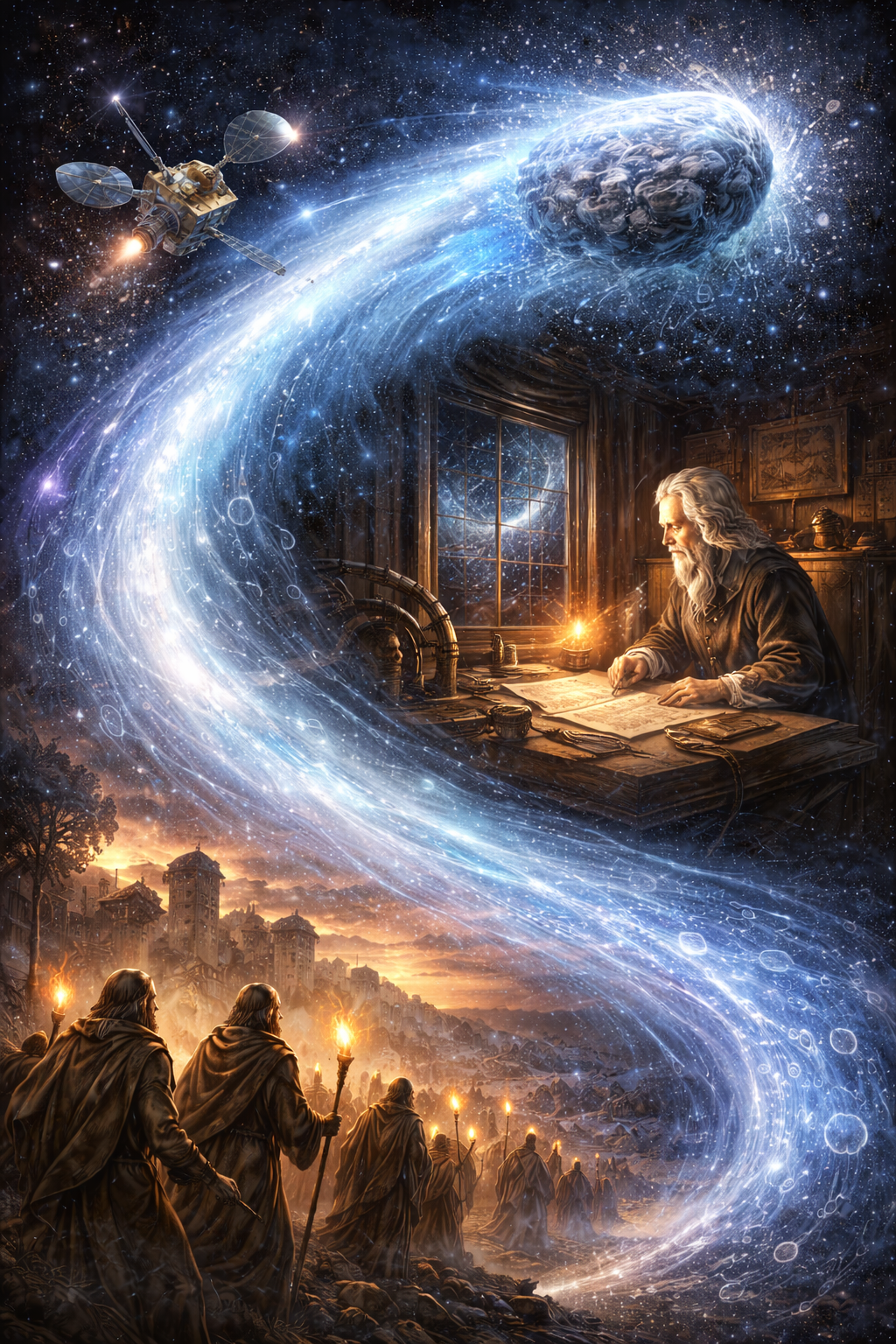
The book begins not as a dry collection of facts but as a grand journey through time and thought, presented in the clear and rational voice that defines the best of human inquiry. It treats the study of astronomy as a long and ongoing conversation between humanity and the stars. The central figure of this narrative is a visitor from the deep cold of space, an object that has moved from the realm of terrifying myths into the realm of predictable mathematics. This transition is the story of how our species learned to replace fear with logic.
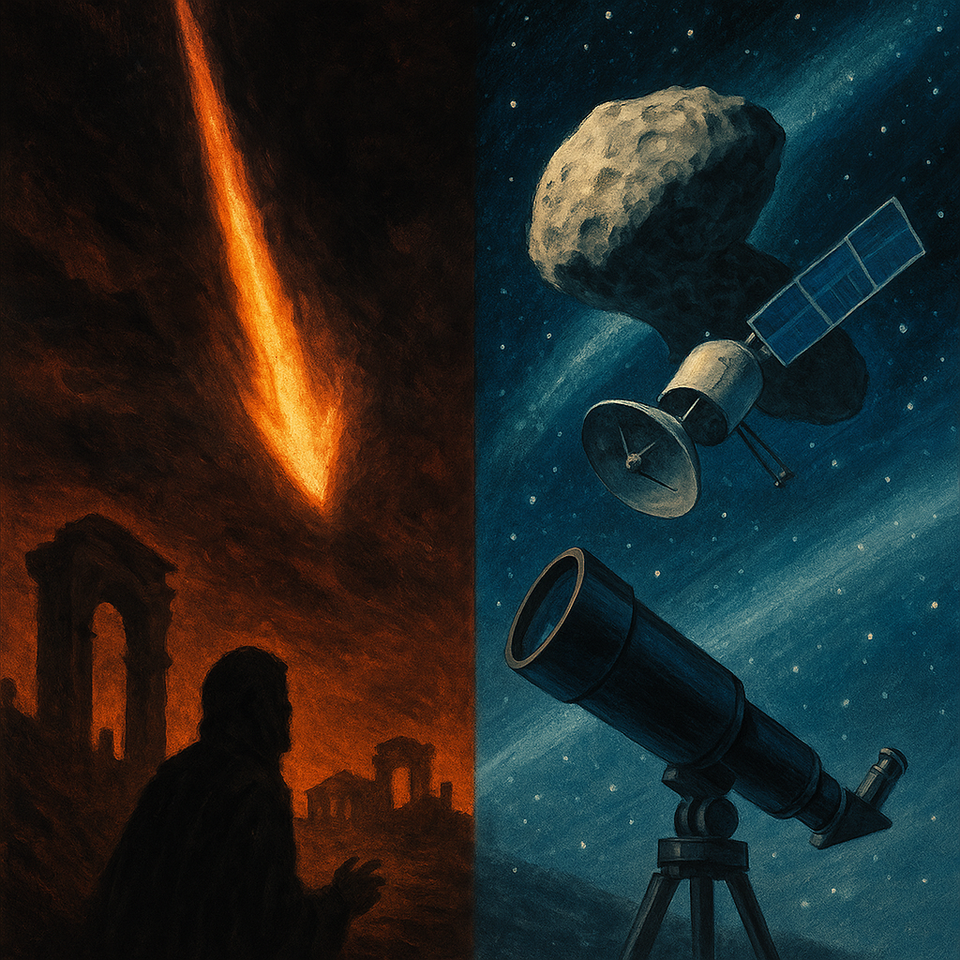
The first mini story is set in antiquity, a time when comets were viewed as powerful omens. Across various cultures, such as those in ancient China and Babylon, the appearance of a strange light in the sky was often seen as a warning of disaster or the death of a king. However, even in this era of superstition, a vital change was happening. Observers began to keep careful records of when these lights appeared and where they moved. These early people were doing the hard work of observation that would later make modern science possible. This part of the book teaches us that even before we have the answers, the act of looking closely at the truth is the most important first step.
The second story focuses on the massive shift in human thinking known as the Scientific Revolution. For many centuries, people believed that comets were just disturbances in the air, much like clouds or lightning. But as thinkers like Tycho Brahe and Johannes Kepler began to use the tools of measurement, they proved that comets actually exist in the space between the planets. This was a major event because it showed that the heavens were not perfect and unchanging. The universe was revealed to be a dynamic place where objects moved according to physical laws. This realization forced humanity to move away from comfortable certainty and toward a path of questioning and discovery.
The third and perhaps most pivotal story is that of Edmond Halley himself, who is described as an intellectual detective. He did not solve his mystery with a telescope alone, but by studying the historical records left by those who came before him. By comparing sightings from 1531, 1607, and 1682, and by applying the laws of motion and gravitation developed by Isaac Newton, he made a bold claim. He suggested that these were not different comets, but the same one returning on a regular schedule. When he predicted it would return in 1758, he provided one of the greatest proofs of the power of science. Although he died before it returned, the reappearance of the comet proved that the human mind could use logic to predict the future of the cosmos.
The fourth story explains the mechanics of how these visitors move through their orbits. This section describes orbital mechanics as a kind of cosmic choreography shaped by gravity. We follow the comet as it travels from the dark edges of the solar system toward the heat of the Sun. As the object gets closer, it accelerates and develops its famous tail. It is explained that this tail is not trailing behind like smoke from a train, but is actually pushed away from the Sun by solar radiation. This clear explanation reminds us that what looks like magic is usually just the result of forces we can eventually understand.
The fifth mini story looks at the physical nature of the comet itself. Over time, theories evolved from ideas of fiery clouds to the modern dirty snowball model. This model describes a comet as a mix of ice, dust, and frozen gases. Through the use of spectroscopy, scientists were able to look at the light from the tail and identify the chemical signatures of water and organic molecules. This turns the comet into a time capsule that has preserved the original materials of the solar system for billions of years. It is no longer an omen, but a piece of history that we can touch and measure.
The sixth story is a social history of the return in 1910, which shows how human nature can sometimes lag behind scientific progress. When newspapers suggested that the Earth might pass through poisonous gases in the comet tail, many people panicked. This led to a strange time when people sold comet pills and bottled air to those who were afraid. This story is told with a sense of humor, but it carries a serious message about the importance of knowing how the world works. It shows that fear often grows in the gaps where scientific knowledge is missing.
The seventh story takes us into the space age, which was a period of technological awakening. Instead of just watching from the ground, humanity developed the ability to send probes into space to meet the comet directly. Tools like digital photography and computer modeling allowed astronomers to see the solid nucleus and the jets of gas and dust that create the bright coma. The comet became a floating laboratory rather than just a sight to behold. This shows how our ability to learn is limited only by our ability to build new tools for observation.
The eighth story is a deep reflection on the origin of life. There is a theory that comets may have been the very messengers that brought water and the building blocks of life to the early Earth. This idea connects the cold void of space to the biology of our own bodies. It suggests a beautiful continuity in the universe, where the atoms inside us might have once traveled across the solar system inside a ball of ice. This part of the book shows how different areas of science, like chemistry and biology, are all part of the same big picture.
The ninth and final story covers the return in 1986, which was a landmark for international cooperation. Many nations worked together to send a fleet of spacecraft to study the comet. This return was a triumph of the scientific method because it relied on the accumulated knowledge of every scientist who had ever lived. It proved that science is a bridge that connects people across borders and across generations.
In review, the book is a masterpiece because it presents the history of a single object as the history of human progress. It is written in a style that is calm, logical, and easy to follow. The true subject is our own ability to understand the universe. The comet returns roughly every seventy six years, which means it acts as a connection between grandparents and grandchildren. Knowing when it will return is a form of immortality, a way to participate in a cycle that is much longer than a single human life. The book ends with an invitation to the next generation to keep asking questions. We no longer greet the visitor with dread, but with recognition, because we have finally learned to speak the language of the stars.