Asimov's New Guide to Science
Humanity’s intellectual journey moves from ancient myths to modern reason, building a cumulative understanding of the entire universe through observation, logical correction, and scientific discovery.
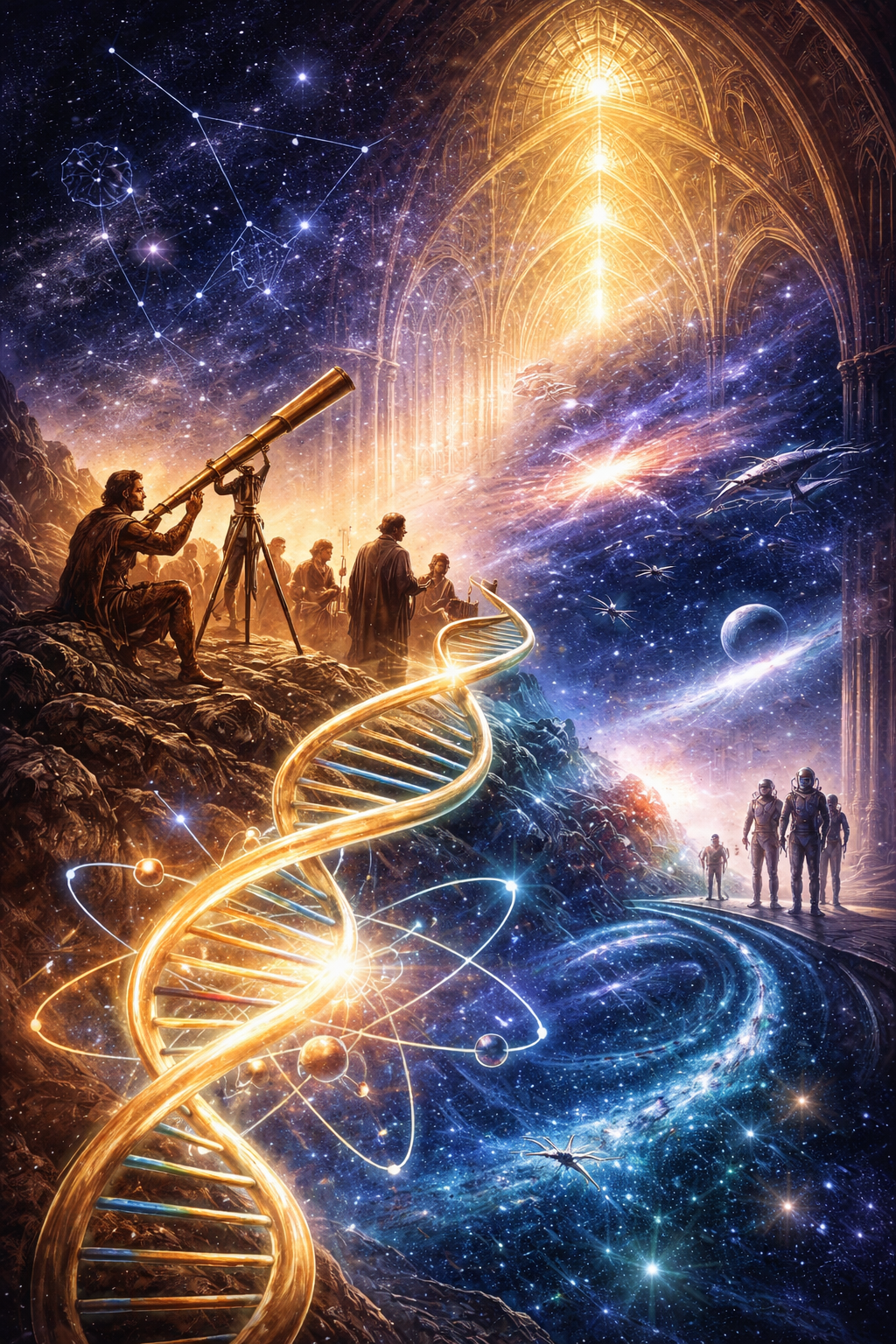
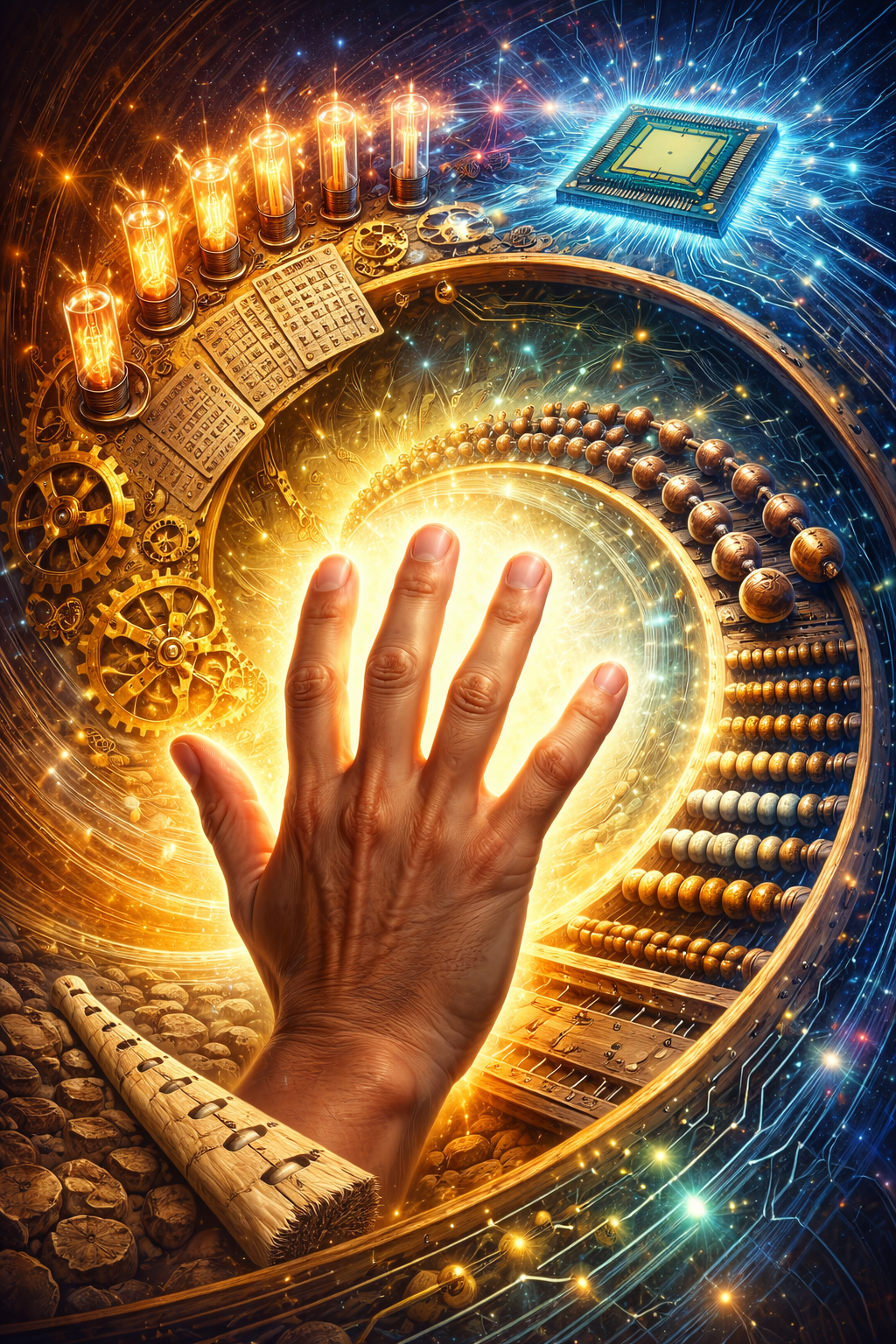
The story of science is not a list of names and dates to be memorized, but a long intellectual journey where humanity gradually wakes up to the structure of the universe. It is a narrative driven by curiosity, error, and the constant revision of what we think we know. In this journey, we see human beings learning to ask better questions about the reality surrounding them, moving from a state of wonder toward a state of deep logical understanding.
The tale begins with the first humans looking at the sky. They saw patterns that they could not yet explain, such as the rising sun, the changing moon, and the steady march of the seasons. To make sense of this chaos, ancient civilizations created myths. These myths were the first attempts at scientific explanation because they tried to impose order on the world through observation, even if they were guided more by imagination than by evidence. Astronomy became the first true scientific discipline because the movements of the heavens were too precise and predictable to be ignored. Over time, sky watchers in Babylon, Egypt, and Greece began to replace supernatural tales with the tools of geometry and prediction.
A major turning point occurred with the Greek philosophers. Thinkers like Aristotle tried to classify the natural world using logic, while others began to wonder if matter was made of invisible atoms. While many of their early conclusions were not correct, their insistence that nature followed specific rules became the foundation for all future reasoning. This part of the story teaches us that science advances by correction rather than by being perfect from the start. Each generation inherits the knowledge of the past and works to refine it, discarding errors while keeping what is true.
After a long period of stagnation during the Middle Ages, the story picks up speed during the Renaissance. This was a time when people began to value skepticism and observation over the simple acceptance of ancient authority. When observers realized that the Earth was not the center of the universe, it was a profound psychological shift. This heliocentric model showed that observation must always outrank tradition, marking a milestone in how humanity views its place in the cosmos.
With the Scientific Revolution, the modern method of inquiry was fully born. Measurement, mathematics, and experiment were united for the first time. The universe began to look like a vast mechanism governed by consistent principles that could be described with physics. This era was like humanity's adolescence, characterized by a bold and confident spirit that successfully explained everything from falling objects to the orbits of the planets.
While some were mapping the stars, others were exploring the secrets of matter. The story of chemistry began with alchemy, where early experimenters tried to find mystical transformations. Although they were searching for magic, they accidentally built a foundation of practical knowledge about how different substances behave. Eventually, matter was understood as various combinations of elements. The idea that everything is made of atoms moved from a philosophical guess to an experimental fact, and the periodic table revealed a hidden internal logic in nature.
As the narrative continues, we encounter the laws of energy conservation and thermodynamics. These principles acted as philosophical revelations, showing that energy cannot be created or destroyed but only transformed from one type to another. This idea unified many different phenomena, such as heat, light, and motion, under a few simple laws. Yet, these successes also brought new mysteries, such as entropy and the direction of time, proving that every answer in science usually leads to even deeper questions.
The discovery of electricity and magnetism moved the story into the technological age. Forces that once seemed like magic became measurable realities. The study of electromagnetic waves led to technologies that shrank the world, demonstrating how pure curiosity about the universe can lead to practical tools that reshape civilization. However, as the story reached the modern era, the certainty of older physics began to fail. The atom was found to have an internal structure, and quantum theory introduced the concept of probability into the heart of nature. At the same time, the theory of relativity merged space and time into a single framework, changing how we understand mass and motion.
These changes represent a maturation of the human mind. Science learned humility, moving away from absolute certainty toward models that approximate the truth with more and more precision. Our view of the cosmos also expanded. We learned that our galaxy is just one of many in an immense cosmic ocean, and that the universe itself is expanding. Cosmology became a rigorous science that looks back into deep time to understand the very beginning of existence.
The story of life is just as revolutionary as the story of the stars. Biology moved from simple classification to an investigation of how life actually works. The theory of evolution provided a unifying explanation for the diversity of living things, showing how complexity arises through gradual change over many years. The discovery of cells and genetics revealed that life follows chemical rules, and DNA was identified as the molecular language that carries instructions from one generation to the next. This bridged the gap between chemistry and biology, showing that living systems follow the same physical laws as nonliving matter.
This understanding of life led to great advances in medicine. Diseases that were once thought to be curses were linked to microorganisms and biochemical processes. Scientific knowledge translated into human welfare through tools like antibiotics and vaccination. Simultaneously, Earth science changed our view of our planet from a static stage to a dynamic system. Plate tectonics showed that the Earth is active and changing, and we realized that humanity exists within a very delicate environmental balance.
The overarching theme of this entire journey is that science is a cumulative effort. While individual geniuses are important, progress depends on a community of thinkers building on shared knowledge. Mistakes are not viewed as failures but as necessary steps toward clarity. The scientific enterprise is like a long conversation across many centuries where each person helps refine our collective understanding.
As we look toward the future, the story remains unfinished. Space exploration is turning other planets into destinations, and we are starting to ask if life exists elsewhere in the universe. While technology brings new challenges regarding sustainability and resources, the scientific method provides a way to find solutions through rational thinking and ethical awareness. Science is like an unfinished cathedral where every new discovery opens up new hallways to explore. The greatest achievement is not just the facts we have gathered, but the method we have developed for correcting our own misunderstandings.
In the end, science is a profoundly human activity. It comes from our deep desire to understand where we belong and to replace fear with comprehension. The journey from myth to the molecule is a story of intellectual courage. It shows that while the universe is vast and surprising, it is accessible to human reason. Through this reason, we are not just observers of the universe, but active participants in the unfolding story of existence.