Change Seventy one Glimpses of the Future
Asimov’s Change Seventy one Glimpses of the Future presents seventy-one logical glimpses into the future, exploring technological, biological, and societal shifts to advocate for informed, ethical human participation
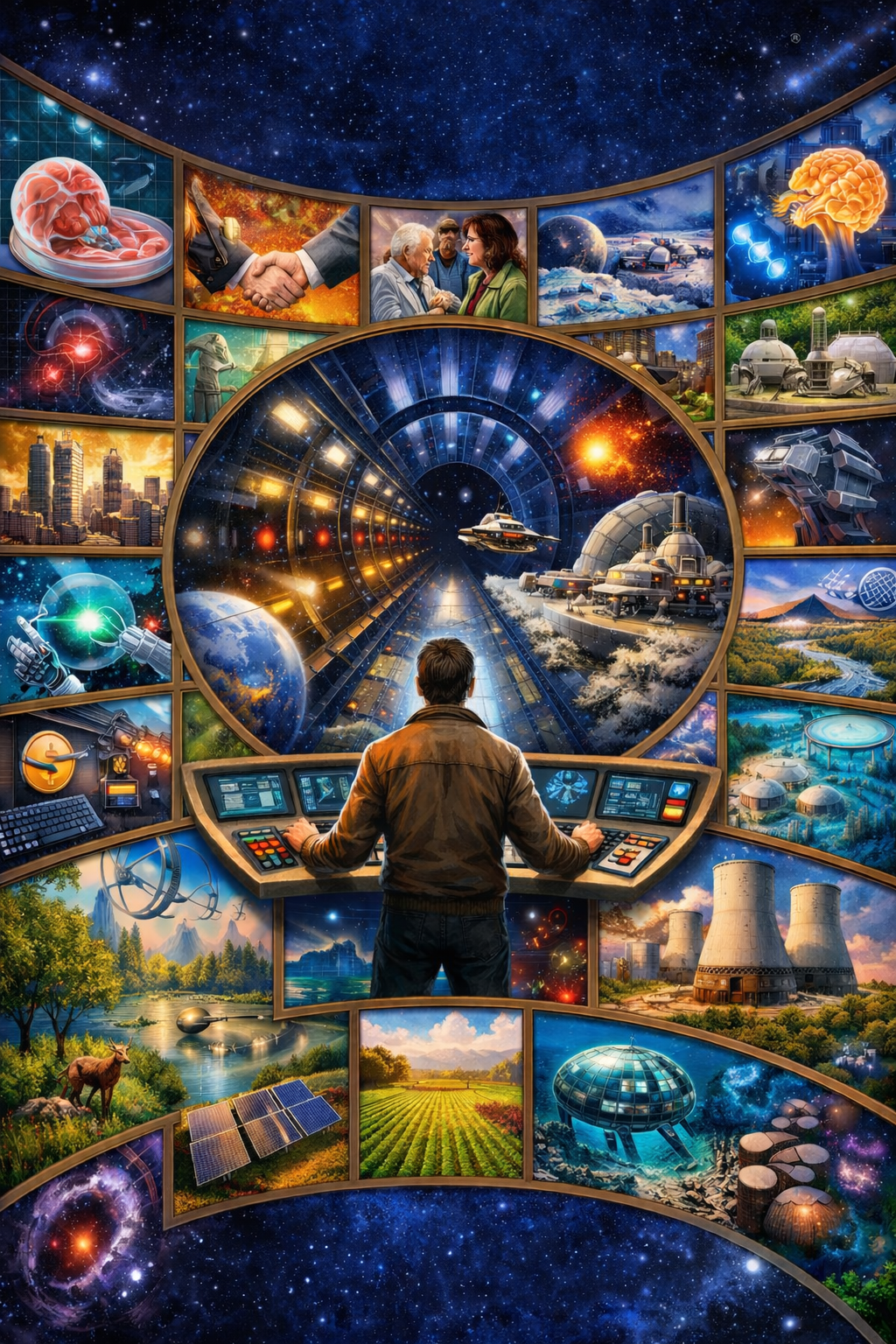
In the quiet of a library or the focused atmosphere of a laboratory, one might look at the world and see only a blur of events; however, Isaac Asimov, in his work Change! Seventy one Glimpses of the Future, invites us to look closer, through sevent one distinct windows, to see a mosaic of the future. This collection is not a single narrative with a beginning and an end in the traditional sense, but rather a logical progression of thought that explores how humanity moves from the present into the unknown. Asimov approaches the concept of the future not as a destination, but as a continuous process driven by scientific and cultural forces. He argues that while change is the only constant, much of it is not unpredictable if we understand the forces already in motion.
The journey begins with an exploration of the nature of futurism itself. Asimov explains that predicting the future is not a mystical or magical art, but rather a disciplined extension or extrapolation of what we already know to be true today. He emphasizes that a good prediction arises from a clear grasp of scientific principles and an appreciation for the "inertia" of society, which often resists rapid shifts. He warns that most people think too simply or linearly, whereas the most profound changes often occur when different fields of human knowledge interact in ways we did not originally expect. This sets the stage for the glimpses that follow, moving from the way we live together to the way we might eventually live among the stars.
As we look at the shifting structures of society, the story of the future becomes one of necessary adaptation. Asimov observes that as birthrates fall in developed nations and populations grow older, the very fabric of our families and our work must change. He envisions a world where education does not end in youth but becomes a lifelong pursuit because technology moves so quickly that traditional schooling cannot keep up. This leads to a reconsideration of the question of money and value. In a world where machines can perform the heavy lifting and the complex calculations of labor more efficiently than humans, the traditional ways we earn and spend money may become obsolete. This requires us to redefine what "work" actually means for a human being and how society provides compensation in an automated world.
The story then moves inward, to the biological and technological transformations of the human form. Asimov explores a future where medicine is no longer just about healing the sick, but about treating biology as a programmable science, much like chemistry or physics. He considers the possibility of growing "spare parts" from a person's own cells a field now known as Regenerative medicine long before such concepts were household terms. Beyond the body, he looks at the potential of the human mind and how it might interface with our tools. He examines whether technology could one day allow for direct neural communication or if Artificial intelligence will become a necessary partner for humanity to solve the complex problems of a global civilization. He warns, however, that our tools are only as good as our ethics; without wisdom and cognitive maturity, our technological power might only serve to magnify our mistakes.
Turning toward the environment and energy, the narrative of Change! becomes one of survival and stewardship. Asimov dismisses the idea of returning to the energy sources of the past, such as coal, and instead points toward Nuclear power and other advanced concepts as the only way to sustainably meet the needs of a growing world. He views the environment not as something to be conquered, but as a system that we must learn to work with. He predicts that future generations will look back on the environmental mismanagement of the twentieth century as a grave error that they will be tasked with fixing through better science and more responsible habits regarding weather patterns and ecosystem health.
Finally, the glimpses turn toward space as the final frontier. Asimov treats space travel not as a fantasy, but as a logical extension of human curiosity and economic necessity. He discusses the practicalities of living on other worlds, from the energy requirements to the psychological toll of extraterrestrial settlements. He even muses on the grander scale of the universe, considering the nature of a Black hole and the possibility of a "cosmic subway" that might allow humanity to travel across the vast distances of Spacetime more quickly than we ever thought possible. These ideas are framed not as wild guesses, but as possibilities that sit at the edge of what our current understanding of physics allows.
In reviewing this collection, it is clear that Asimov’s goal is to move us away from fear of the unknown and toward a disciplined understanding of possibility. He does not offer a utopian vision where all problems are solved by buttons, nor a dystopian one where we are inevitably destroyed by our own inventions. Instead, he presents a future that is shaped by the choices we make today. His voice is one of "rigorous skepticism" combined with a deep seated optimism in the power of human reason. He trusts that as long as humanity pursues knowledge responsibly, we can transform the challenges of the future into opportunities.
The story of Change Seventy one Glimpses of the Future is ultimately the story of humanity's maturation. It suggests that while the tools we use will change and the places we live may expand to other planets, the core of our journey remains our drive to explore and understand the universe. Asimov’s seventy one glimpses serve as a reminder that the future is not something that simply happens to us; it is something we participate in creating through our curiosity, our ethical choices, and our commitment to logic.
To understand this concept of change, one might think of a navigator on a ship. While the navigator cannot control the wind or the waves the demographic shifts and scientific laws—they can understand them, adjust their sails, and use the forces of nature to steer the vessel toward a chosen destination rather than drifting aimlessly.