Creations The Quest For Origins in Story and Science
Asimov masterfully curated a logical dialogue between science, myth, and fiction in this anthology to explore cosmic, planetary, biological, and human origins.
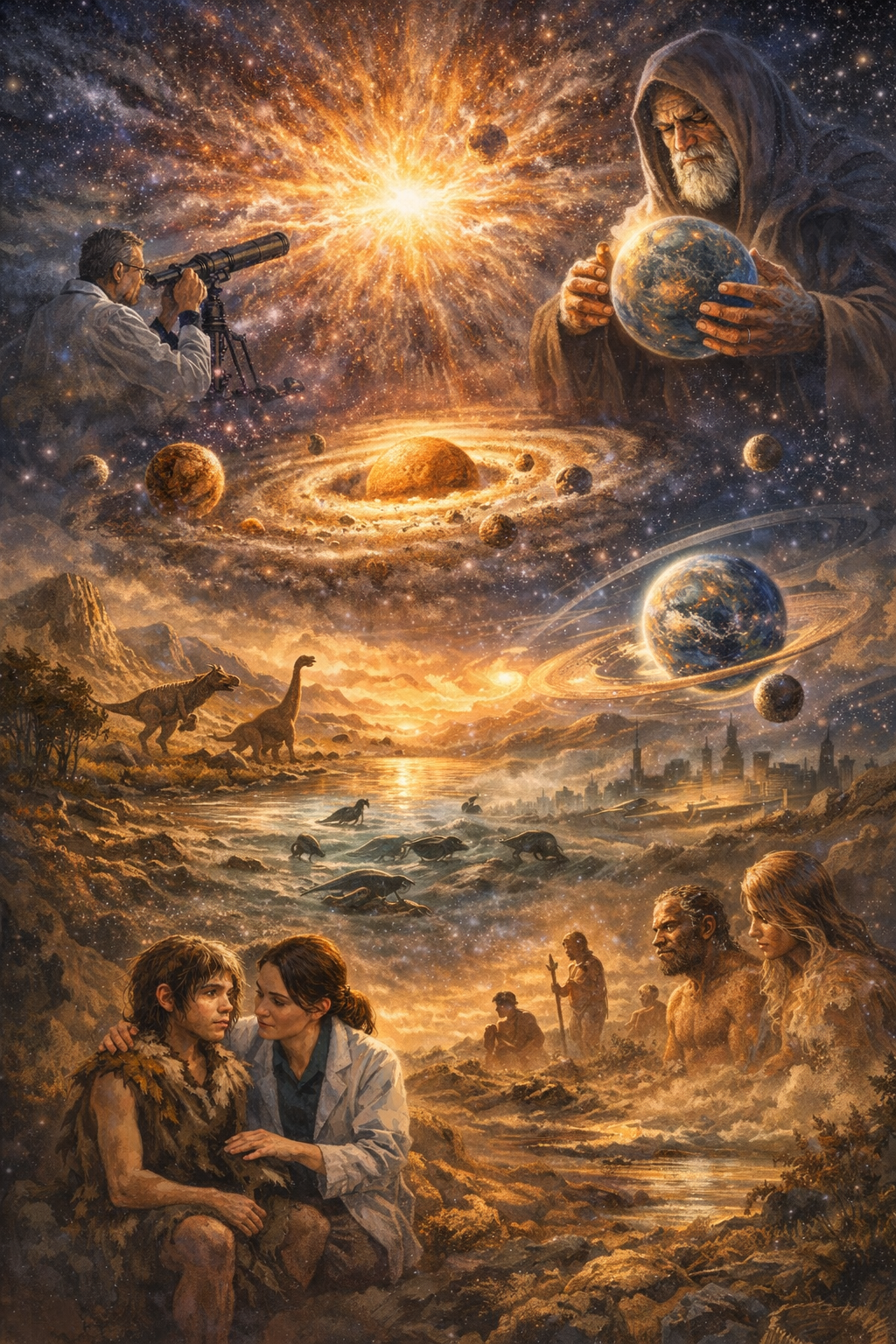
The story of everything begins with an anthology titled Creations The Quest For Origins in Story and Science, a work co edited by Isaac Asimov that is designed to investigate the origins of our existence. This book is not a single narrative but a collection of different voices organized into four parts: the Universe, the Solar System, Earth and Life, and finally Humankind. Asimov uses this structure to guide the reader through a logical progression from the largest scales of space down to the specific history of our species.
The first part of the journey explores the Origin of the universe. It starts with James E. Gunn’s piece called Imagine, which prepares the reader to think about the start of everything beyond everyday experience. This is followed by the traditional Genesis account, which provides a historical and religious baseline for how the Western world has viewed creation. To bring in the scientific perspective, Steven Weinberg explains the Big Bang in his work The First Three Minutes, showing how the fundamental laws of Physics began to operate.
As the anthology moves deeper into cosmic origins, it uses fiction to examine the philosophical side of creation. Stanisław Lem’s Project Genesis and Clifford D. Simak’s The Creator use storytelling to think about the nature of a maker and the act of starting a world. Gregory Benford contributes Exposures and Laurence Manning provides The Living Galaxy, both of which mix scientific ideas with the imagination to look at the universe as something potentially alive or vast. Brian Aldiss’s Non Isotropic and ancient poems like the Hindu Rg Veda show that these questions have been asked by every culture throughout history. Asimov concludes this section with his essay The Crucial Asymmetry, where he explains why the imbalance between Matter and Antimatter was necessary for the universe to develop complexity.
The focus then shifts to our immediate celestial neighborhood, the Solar System. James E. Gunn returns with Kindergarten, a story that uses a narrative to make the formation of planets feel fresh and curious. A. E. van Vogt’s The Seesaw uses a dramatic narrative to spark questions about how the solar system began. George Zebrowski’s Heathen God looks at these origins from a more mythic and reflective perspective. To ground these stories in reality, Carl Sagan’s essay The Sun’s Family explains the Protoplanetary disk and the Orbital dynamics that led to the planets we see today. This combination shows how science and storytelling work together to explain our home in space.
The third part of the anthology turns toward our own planet and the beginning of Life. It begins again with Genesis to show the ancient views on living creatures. Arthur C. Clarke’s Experiment and Raymond Z. Gallun’s Seeds of the Dusk use fiction to show life starting through either deliberate experiments or natural processes. Asimov adds a very personal and strong essay titled The Threat of Creationism, where he argues that understanding Evolution is vital for a scientific education. Carl Sagan also contributes The Cosmic Connection, which looks at the possibility of life existing in the wider context of Astrobiology.
The final stage of the book looks at the origin of humans. After starting with the Genesis account of human creation, the book uses several stories to explore what it means to be a person. Eric Frank Russell’s First Person Singular, H. G. Wells’s The Grisly Folk, and Theodore L. Thomas’s The Doctor look at our ancestors and the potential for different types of Evolution. Asimov’s story The Ugly Little Boy features a Neanderthal child and uses Time travel to help us think about our shared heritage. Richard McKenna’s Mine Own Ways and Ian Watson’s A Letter from God use narrative to explore our identity and the deep questions that science alone might not fully answer.
The structure of the book is intended to create a conversation between many different points of view. Asimov provides introductions and notes to help the reader understand how each piece fits into the larger history of human thought. The book does not give one single answer but instead invites the reader to think about where we came from using both logic and imagination. It serves as a model for how we can explore the most difficult questions about our existence.