Fantastic Creatures An Anthology of Fantasy and Science Fiction
This anthology, edited by Isaac Asimov, contrasts ancient mythical beasts like dragons and vampires with strange creatures of modern science fiction, often found in space.
The collection, Fantastic Creatures An Anthology of Fantasy and Science Fiction, serves as an insightful exploration into the nature of wonder, bridging the ancient fear of mythical beasts with the calculated anxieties of modern and future science. The editor, Isaac Asimov, sets the stage by reflecting on how human curiosity once populated a fantastic, unmapped Earth, imagining centaurs and dragons. However, as reality driven first by geographical exploration and later by space probes and detailed planetary scans has revealed the solar system to be largely inanimate, the focus of the fantastic shifts to alien biology and the complexities of human existence itself. This anthology captures this shift, presenting tales where the fantastic is either a core component of future civilization or an exotic, perilous threat encountered beyond Earth.
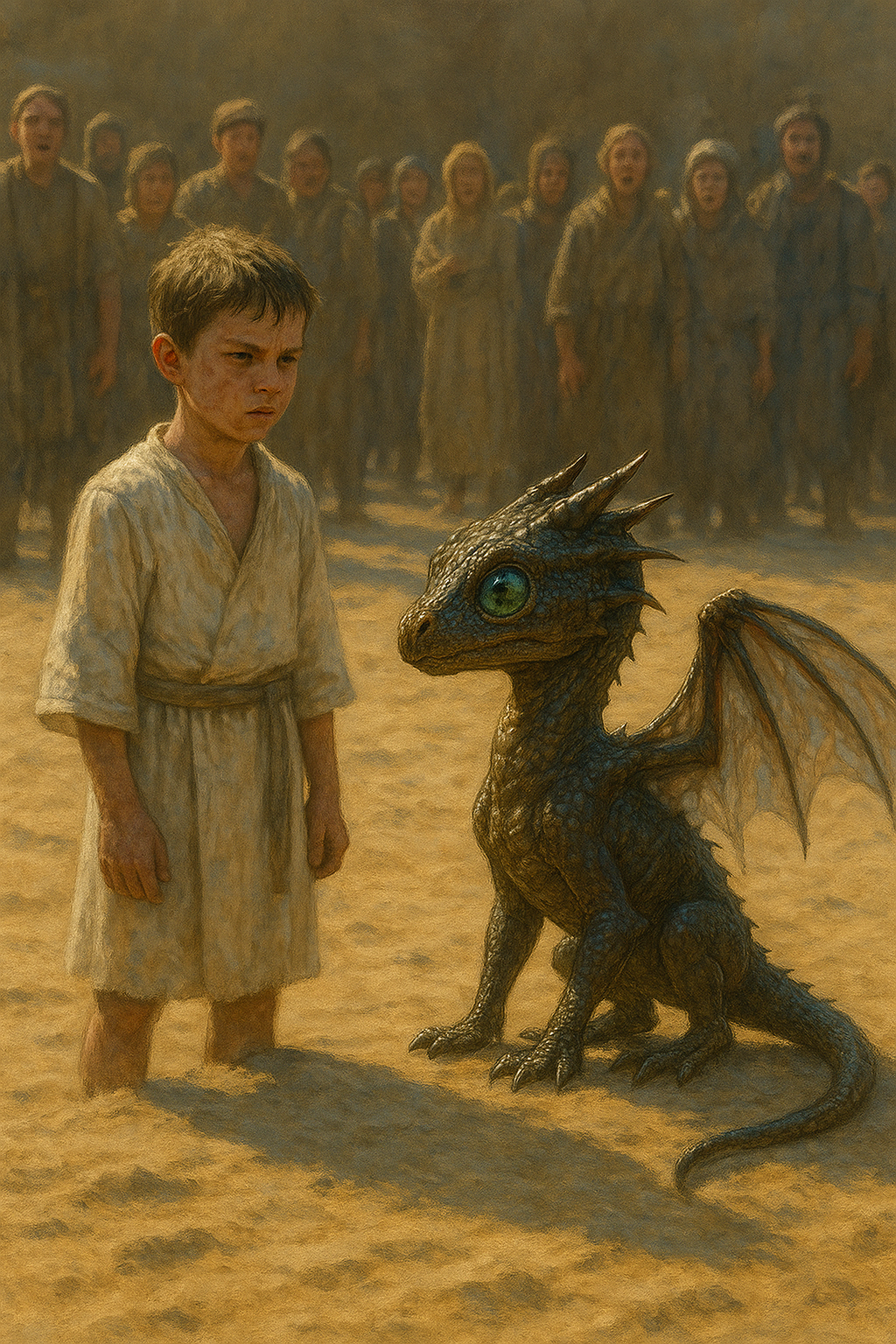
The Smallest Dragonboy by Ann McCaffrey
This tale transports the reader to Pern, a world maintained by its unique social structure centered on the telepathic bond between humans and dragons. The narrative centers on a defining moment in the life of Keevan, the smallest and youngest candidate hoping to participate in the Impression, the ritualistic selection by a hatchling dragon. Keevan faces constant doubt and teasing regarding his size, particularly from the older, more intimidating candidates. The deep tension hinges on the impending hatching, where baby dragons choose their lifetime companions, setting the stage for who will become a dragonrider and fight the destructive alien organism known as Thread. The core concept explored is the idea that true worthiness is determined not by physical size or age, but by internal qualities like [courage] and honesty a realization hoped for by Keevan's foster mother and ultimately sought by the dragons through the sacred [Hatching Ground] rite. The story expertly builds towards Keevan proving his capability under extreme duress, highlighting the importance of the dragon/rider bond in Pernese society, which relies on the dragons' ability to fly effortlessly over the land of Pern. The narrative suggests a future where necessity mandates that merit, rather than mere physical stature, triumphs in fulfilling the rigorous demands of military defense.
The Botticelli Horror by Lloyd Biggle, Jr.
Here, the dangers of extraterrestrial life and unchecked galactic commerce are starkly illuminated. Customs Investigator John Allen and his scientific consultant, Dr. Hilks, investigate a tragedy in a small Kansas town caused by an escaped alien carnival creature. The creature, known as the Venusian [Night Cloak], is terrifyingly capable: it flies, and digests organic victims with shocking speed and total consumption, leaving almost no trace except sometimes their shoes, due to a highly potent corrosive potency. The creature also possesses an advanced mimicking ability. The investigation focuses on tracing the Night Cloak's illegal importation and spread, highlighting the bureaucratic and scientific struggle to contain an alien biological threat that defies terrestrial logic. The military eventually steps in, recognizing the creature as a national catastrophe. The core mystery involves identifying the creature, realizing it is not a snail as initially thought, but a far more dangerous form a sprawling, flying entity that feeds aggressively on organic life and resists traditional weaponry. The technical solution eventually hinges on exploiting the creature’s unique behavior and the material it breaks out of its display case to consume.
Kid Cardula by Jack Ritchie
This tale presents a contemporary fantasy built around the timeless folklore of vampirism. The story is told through the perspective of Manny, a boxing manager, who discovers Cardula, a talented fighter with superhuman strength. Cardula's immediate success in the [prize ring] is hampered only by his strict adherence to fighting exclusively in the evening due to debilitating photophobia (an inability to endure sunlight). Manny exploits Cardula's unique talent, building a successful career that brings in much-needed money. Throughout his tenure, Cardula exhibits unusual physical traits outsize teeth and resistance to pain. The narrative tension is sustained by Cardula's secrecy and the mysterious circumstances surrounding his few social interactions, including strange "mosquito bites" found on a woman he helped. The story leads logically to Cardula's decision to quit the boxing world for reasons of aristocratic family pride, though his parting gift to Manny and the sudden, uncanny appearance of Cardula's physical traits on Alfie Bogan, the sparring partner, solidifies the supernatural nature of the boxer and establishes a dark, self-perpetuating cycle in Manny’s stable.
The Man From P.I.G. by Harry Harrison
Harrison presents an interstellar security story centered on genetic manipulation and unconventional warfare. Governor Haydin calls for assistance after mysterious, destructive events occur on the planet Trowbri, often ascribed to "ghosts" on the Ghost Plateau. The response comes in the unexpected form of Bron Wurber, an agent of the Porcine Interstellar Guard (P.I.G.), a force relying on highly intelligent, massive, and selectively bred mutant pigs. Bron's expertise in animal husbandry and galactic politics allows him to deduce that the ghosts are actually Sulbani aliens using high-tech methods like magnostriction (contracting magnetic fields) and supersonic wavelengths to destroy human installations and cause psychological distress in animals, effectively fencing off areas. The core action builds toward Bron and Haydin utilizing the boar's genetically enhanced aggression and size to physically dismantle a Sulbani hovercraft, leading to the discovery of a secret uranium mining operation and the identification of a human collaborator. The narrative argues that under the stress of rapid interstellar expansion, the Patrol must rely on self-supporting, non-traditional units to control the massive cube of space that needs monitoring.
Flight Over XP-637 by Craig Sayre
This narrative offers an outsider's view of human society, presenting Earth (XP-637) as a strange and violent planet. Uthorita, a reptilian scientist from Giate, supervises a team using molecular trans-alteration via a recombination chamber to transform themselves into Earth's native creatures for behavioral study. This method, while yielding crucial data, is extremely dangerous given the planet’s violent nature. The immediate tension arises from a serious injury sustained by Enever, an assistant transformed into a migrant duck. Uthorita reviews a garbled transmission from Enever detailing a chaotic, hostile flight environment, where human craft fly in precise V-formations and face massive destruction (implied to be war or aggressive maneuvers). The scientific team is baffled by the aggressive, death-oriented culture of the dominant life forms (humans). The story leads to Uthorita’s realization that their approach has been too detached; they have studied the hunted, and must find a way to study the hunter the human to understand the source of the persistent [violence] on the planet. The scientists face the possibility that their entire project might be shut down due to the extreme risks involved in studying Earth’s formidable inhabitants.
The Bees From Borneo by Will H. Gray
Will H. Gray offers a terrifying vision of biological catastrophe stemming from scientific recklessness. Silas Donaghy, a master beekeeper and biologist, successfully conducts cross-breeding experiments, initially producing a superior strain of honey bee from a Borneo queen. However, these new bees are aggressive "robbers" and deadly killers, threatening national stability due to their potent sting and ability to survive by consuming sugar and flesh. Driven to madness after his son dies from a sting, Silas intentionally disperses the queens via hydrogen balloons, turning the local problem into a nationwide plague. The story focuses on the societal breakdown as the hymenopterous insect population explodes, leading to economic ruin (farm mortgages become worthless) and the collapse of essential public services. Scientists struggle to create an antitoxin, experimenting with formic acid. Silas, in a brief moment of sanity, recognizes that the solution lies in introducing competing drones from the harmless old stock whose offspring cannot survive the winter, thus countering the effects of his original, impetuous mistake and ending the plague he started.
The Anglers of Arz by Roger Dee
This story is another deep dive into the moral obligations of exploration under Terran Regulations. The Terran crew of the Marco Four observes a shocking ecological ritual on the remote planet Arz: humanlike Arzian "fishers" are routinely slaughtered by giant winged lizards. Investigator Farrell is baffled by the passive behavior of the natives who cannot swim or use boats. Fellow crewman Gibson, fixated on finding a lost city, discovers it submerged underwater. The key revelation is that the dominant, technologically advanced species on Arz is an octopoid race. These octopods maintain the islands as a game preserve, breeding the fishers as live bait to attract and hunt the winged lizards. Farrell is momentarily caught up in the "show," realizing he was an unwitting participant in this alien "angling in reverse". The crew quickly decides that colonization is impossible, as the octopods' sophisticated culture places Arz far above the necessary level for Terran interference, validating the importance of strict [Terran Regulations]. The story effectively uses the inversion of roles, turning the human observer into the observed and the prey.
The Game of Rat and Dragon by Cordwainer Smith
Set far in the future, this story delves into the extreme measures required for successful interstellar skip travel. Humanity travels using planoforming, a process that risks catastrophic psychic contact with hostile entities in deep space, known to humans as Dragons and visualized by telepaths as gigantic Rats. To survive, humans rely on pinlighters like Underhill, telepathic specialists whose minds are linked via telepathic amplifiers (pin-sets) to genetically enhanced cats, called Partners. The Partners provide the incredible speed and quick reaction time faster than the human mind needed to trigger photonuclear bombs (pinlights) that dissipate the Dragons/Rats in milliseconds before they can inflict permanent psychological damage. Underhill, linked with his beloved Partner, Lady May, completes a dangerous jump. The narrative highlights the intense, physically damaging strain of this work on humans, and the unique, necessary reliance on the cats, whose feral instinct and quickness surpass human capability in this deadly space battle. The complex future society thus rests on an emotional and technical symbiotic relationship between Man and Partner.
The anthology, taken as a whole, underscores the Asimovian tradition of using science fiction to explore humanity's place in the universe, emphasizing that whether the threat is biological, military, or psychic, survival depends on intellect, regulation, and sometimes, the unexpected utility of fantastic or genetically enhanced creatures. Each story uses clear, logical progressions even when dealing with the supernatural or highly technical concepts to build toward a rational, albeit often terrifying, conclusion, demonstrating the vast and unpredictable nature of life beyond Earth, and even life created by Earthlings.