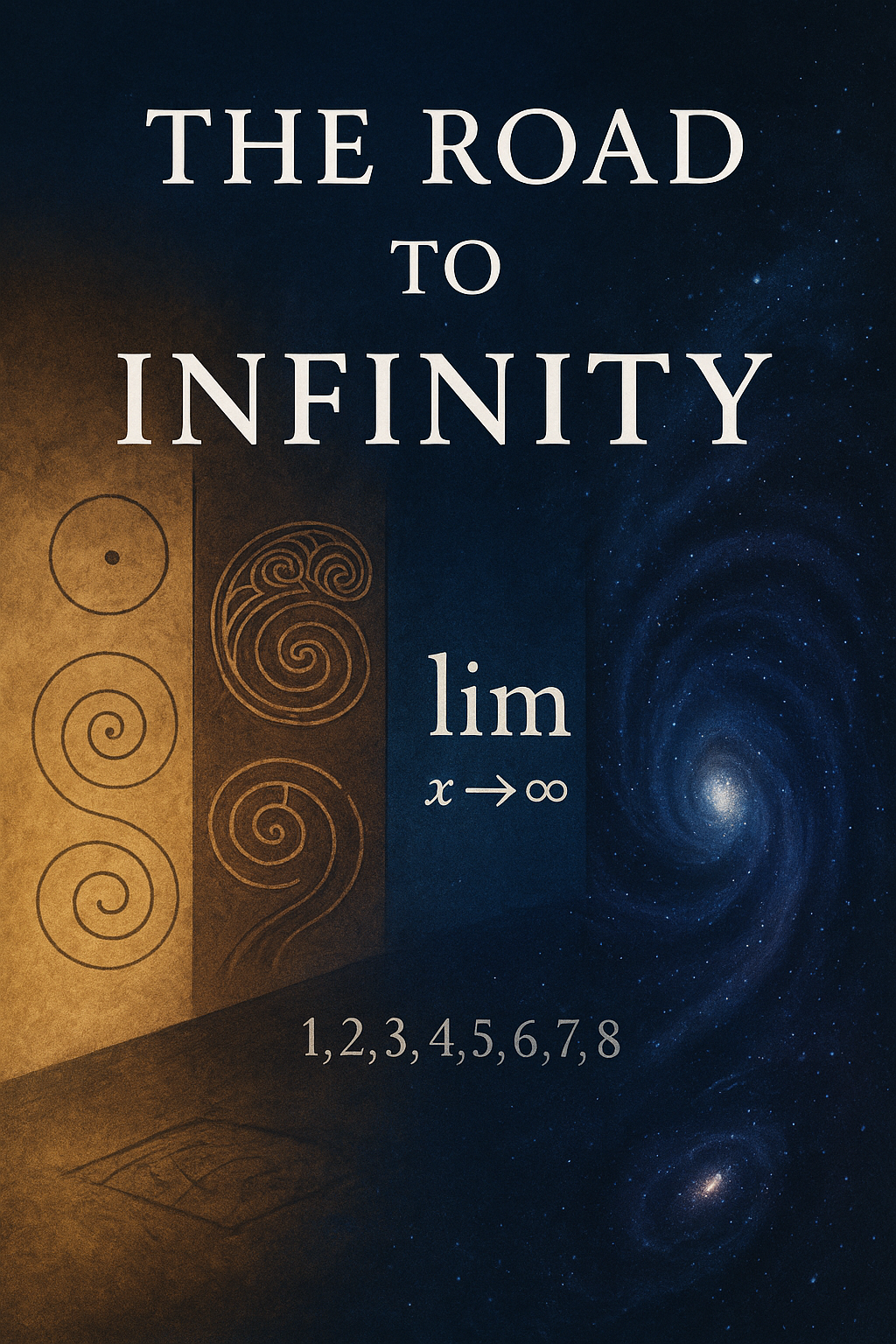
History of Mathematics (a chart)
Human mathematical thought evolved from concrete counting across global civilizations into abstract logical structures, unifying algebra, calculus, and computing to reveal nature's hidden cosmic patterns.
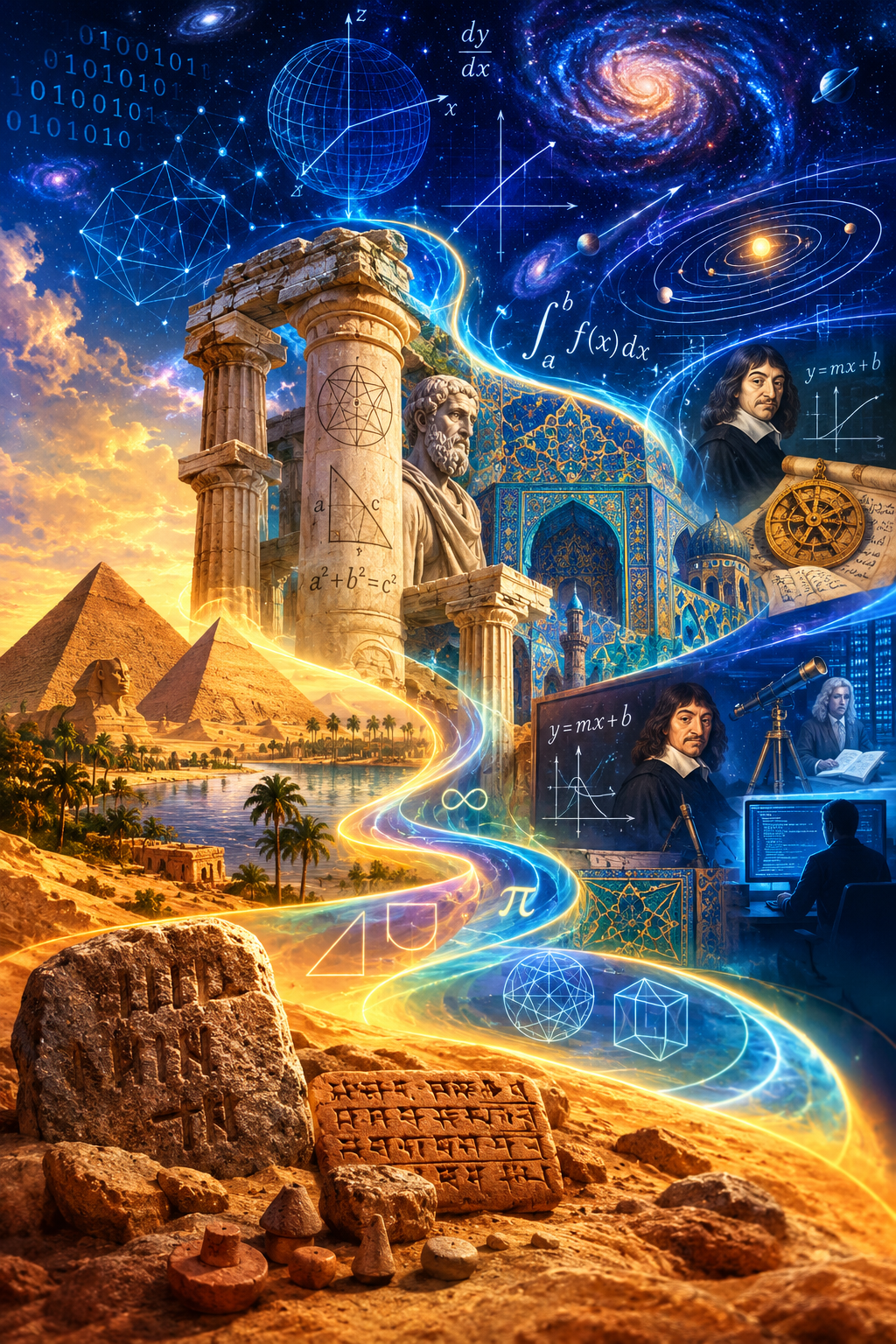
The narrative begins before mathematics existed as a formal discipline, arising from humanity's basic practical need to distinguish quantities. The earliest breakthrough occurred when the human mind realized that numbers could exist as abstract concepts independent of physical objects, recognizing that a pair of sheep and a pair of stones shared the common property of the number two. This initial step into abstraction expanded alongside early human civilizations in Mesopotamia and Egypt, where practical challenges like dividing land after Nile floods, building structures, managing commerce, and tracking time drove the creation of numerical notation and procedures.
As the narrative progresses, a major shift occurred with Greek thinkers who moved beyond practical application to ask why methods worked. This established mathematics as a deductive system where conclusions had to be logically demonstrated from basic principles and postulates. Overcoming intellectual challenges such as the discovery of incommensurable quantities, Greek scholars constructed organized logical structures, exemplified by Euclid's Elements, while thinkers like Archimedes and Apollonius explored geometric curves and physical measurements.
The story demonstrates that mathematical progress was not isolated to a single culture, but developed across multiple interconnected civilizations. Chinese scholars created practical algorithms and counting rod systems, while Indian mathematicians established the decimal positional numeral system and defined zero as an active number in calculation. Scholars in the Islamic world synthesized, translated, and expanded these Greek and Indian traditions, formalizing algebra and algorithmic procedures before transmitting these tools to Renaissance Europe.
In its later stages, the historical journey accelerated through unifying concepts. Descartes connected algebra and geometry using coordinates, creating analytic geometry, and Newton and Leibniz independently developed calculus to describe continuous change and planetary motion. Over the modern era, mathematics increasingly shifted from measuring concrete objects to analyzing abstract structures, probability, non-Euclidean spaces, and logical systems that eventually enabled automated computing.
In terms of a review, the primary strength of History of Mathematics (a chart) lies in its ability to compress centuries of thought into a unified, continuous narrative of human progress. Rather than presenting mathematical formulas as disconnected facts, the book reveals a two way movement where practical reality inspires abstract mathematical tools, which in turn reveal deeper, hidden patterns within the universe.