Think About Space Where Have We Been and Where Are We Going
From ancient stargazing to modern rocketry, humanity's journey into space reflects scientific progress, technological innovation, and our ongoing choice to establish a permanent cosmic presence.
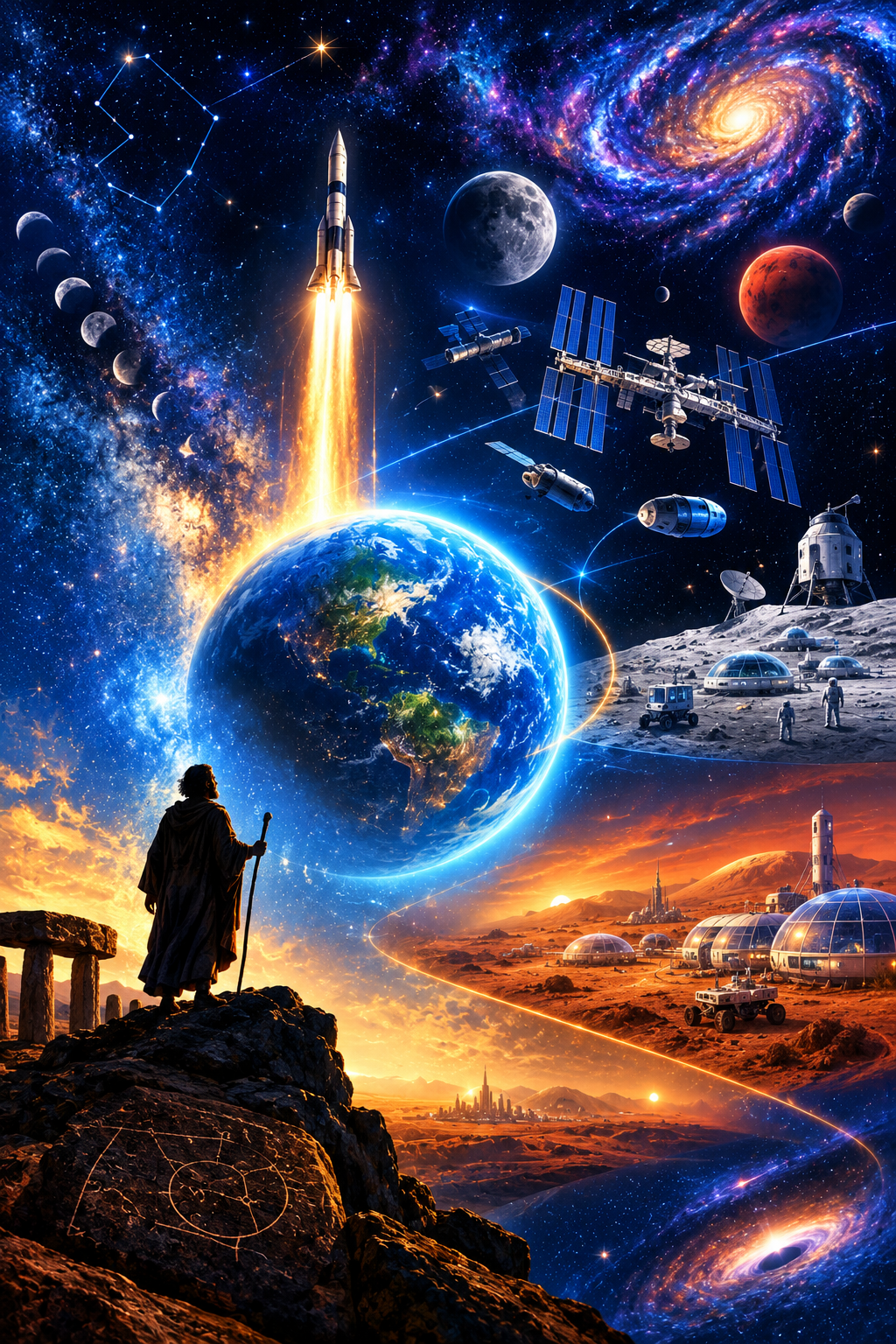
Long before human beings possessed the technology to leave Earth, they spent millennia looking upward into the night sky. To ancient observers, the glowing stars, changing Moon, and wandering planets were beautiful, mysterious, and divine, serving as an agricultural calendar, a guide for travelers, and a wellspring of myth. Physical existence was strictly confined to the terrestrial cradle, yet human imagination was already embarking on journeys across the cosmos. This ancient relationship forms the opening beat of the story told in Think About Space: Where Have We Been and Where Are We Going?, a 1989 work co-authored by Isaac Asimov and Frank White as part of the Think series. The book chronicles humanity’s long journey from passive sky-watching to physical space travel, exploring why we venture into the void, where we stand today, and what possibilities await us tomorrow. Reading this narrative with an understanding of Asimov's broader literary universe reveals a non-fiction counterpart to his epic sci-fi sagas: a clear, step-by-step account of how a single-planet species begins its transformation into a spacefaring civilization.
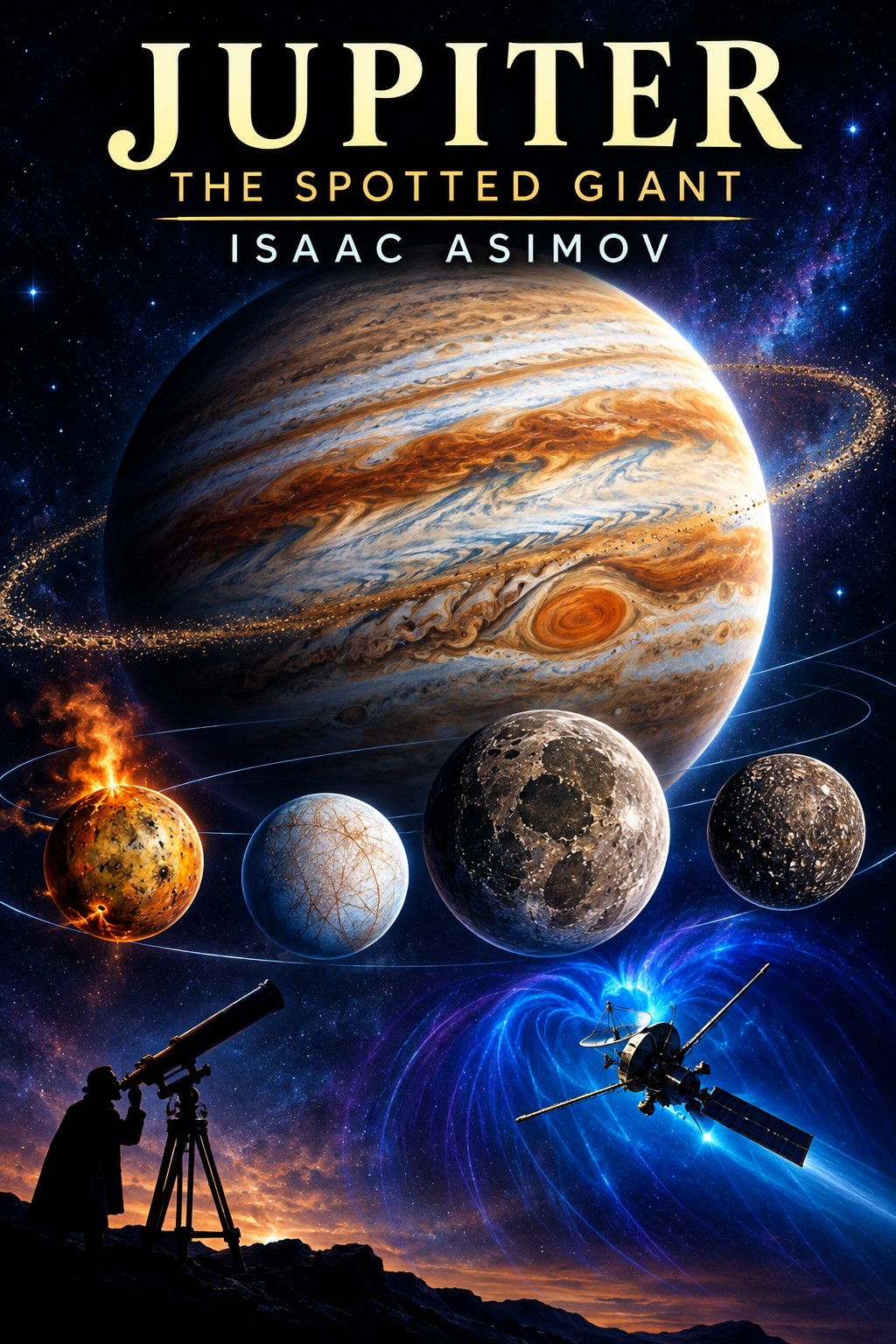
The story begins its logical progression with the scientific revolution, which fundamentally shattered the illusion that Earth was a closed, isolated world. For centuries, humans could observe the heavens but had no physical means to reach them. The invention of the telescope changed everything by magnifying human vision. When astronomers looked through lenses, the Moon revealed rugged craters and mountains, while Jupiter displayed orbiting moons of its own. Space was no longer a distant, mystical backdrop; it was a physical universe governed by universal natural laws that could be investigated through reason and science. Yet understanding that space was physical did not make reaching it easy, because humanity remained trapped at the bottom of an immense gravitational well. Every object on Earth is bound by gravity, and escaping it required moving from astronomical theory to practical rocket engineering.
The story moves forward as the dream of spaceflight transitioned from speculative fantasy into rocket science. The basic principle of rocketry—that gases expelled forcibly in one direction push a vehicle in the opposite direction—provided the key to breaking free from Earth. In the twentieth century, this technological development was dramatically accelerated by the geopolitical tension of the Cold War between the United States and the Soviet Union. The launch of Sputnik by the Soviet Union marked a historic boundary crossing, proving that a human-made object could achieve orbit around the planet. The space race reached its peak with the American Apollo program, an extraordinary engineering enterprise that propelled human beings across hundreds of thousands of kilometers to land on the Moon. When astronauts stepped onto the lunar surface, they achieved something unprecedented in human history. Yet the most profound impact of the Moon landing was the perspective it offered when looking back: Earth appeared suspended in the pitch-black void as a small, fragile world.
Here, the narrative introduces a compelling turning point that lies at the heart of Asimov and White's exploration. Once the Moon had been reached and the immediate political objective was met, the initial excitement faded, leaving behind a major dilemma: what comes next? Spaceflight is extraordinarily expensive, dangerous, and demanding of finite resources. Why should society continue to venture into space when the financial and physical costs are so high? The book logically lays out three compelling answers. First, space provides an enormous laboratory where experiments can be conducted under conditions impossible to replicate on Earth, unlocking clues about the origin of our solar system. Second, space programs drive rapid technological breakthroughs in microcomputing, materials science, satellite communications, navigation, and medicine that enrich life on Earth. Third, and perhaps most fundamental to human identity, exploration is an intrinsic drive; humans have always crossed ocean barriers, climbed mountains, and explored polar frontiers, and space represents our largest frontier yet.
The book then examines a critical distinction that elevates the narrative into a deeper philosophical review: reaching space is merely a technical hurdle, whereas living and working there represents an entirely new stage of civilization. A civilization that only visits space remains fundamentally Earthbound. To cross the threshold into a true spacefaring species, humanity must establish a permanent presence beyond Earth. The development of reusable vehicles like the Space Shuttle and the construction of orbital space stations mark the beginning of this transition. Space stations allow people to reside away from Earth for extended periods, providing a platform to study how prolonged weightlessness affects human health and how small communities function away from Earth.
As the story advances toward future frontiers, Asimov and White candidly outline the serious biological, technical, and psychological obstacles that stand in the way. The human body evolved under terrestrial gravity, and long-duration weightlessness causes muscle and bone loss, while cosmic radiation poses constant danger. Furthermore, confining small groups of people inside tight spacecraft for months or years presents delicate psychological and social challenges. Overcoming these barriers requires an understanding not just of engineering, but of human nature itself. Beyond orbit, the Moon could serve as a useful location for mining and scientific facilities, while Mars offers a solid planetary surface with a complex geological history as a prospective secondary home. However, as destinations stretch to the outer solar system and distant stars, travel times grow from days to years, making resupply, communication, and rescue exceptionally difficult.
In reviewing Think About Space, one sees how Asimov's characteristic clarity shines through the structure of the narrative. The authors deliberately contrast current engineering limits with the imaginative vision of science fiction, such as Star Trek. Science fiction often envisions the destination long before science discovers how to construct the vehicle. While some fictional ideas remain impossible, others inspire genuine research and push society to expand its boundaries. Ultimately, the book demonstrates that the future of space exploration is not an automated or predetermined sequence of events. It is a conscious human choice governed by public priorities, societal interest, and resource allocations.
In conclusion, Asimov and White have crafted a narrative that moves cleanly from ancient curiosity to modern observation, from observation to engineering, and from engineering toward open-ended human destiny. The book does not offer simple guarantees or detailed maps of tomorrow. Instead, it provides a logical framework for understanding where we have been and where we are going. By the end of the narrative, readers are left standing where humanity first began—gazing upward at the night sky. But the view has changed forever: the stars are no longer passive lights in the dark, but destinations for a species deciding whether to stay in its cradle or step out among the worlds.