How Did We Find Out About Genes
Asimov details how meticulous observation of garden peas and flies transformed heredity into scientific knowledge, revealing genes as the mathematical and chemical blueprints of life.
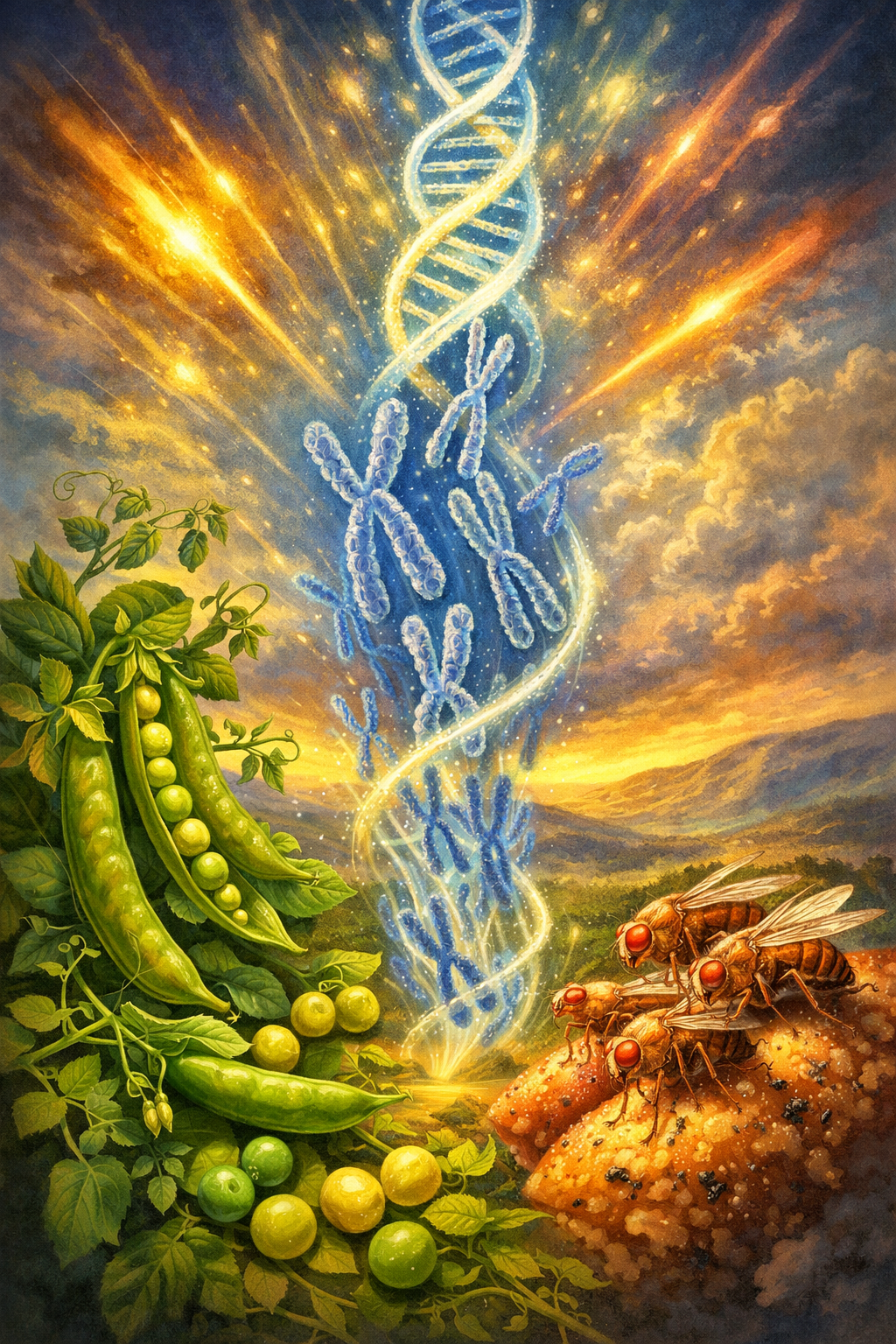
The story of how humanity discovered the secret of life is one of the most remarkable journeys in all of science. For a very long time, people simply accepted that children looked like their parents. This was seen as a clear fact of nature, yet no one understood how it actually worked. In humans, families are small and it takes a long time for children to grow up, so finding a logical pattern in these resemblances was very difficult. This created a great puzzle where the rules of heredity remained hidden for thousands of years, leaving people with only descriptions instead of a real mechanism.
The first mini story in this journey begins in a quiet monastery garden in the mid nineteenth century. A monk named Gregor Mendel decided to study the problem by looking at a much simpler system than human beings. He chose the garden pea because these plants could be easily manipulated and grown in very large numbers. By crossing different plants through painstaking experiments, he found that traits did not just blend together like paint in a bucket. Instead, he discovered that inheritance was governed by separate units. He found that some traits were dominant and others were recessive. Even if a trait seemed to disappear for one generation, his laws of segregation and independent assortment showed it could come back later exactly as it was before. This provided the first mathematical backbone for how life continues, though his work was ignored for many years until other scientists rediscovered it in the early twentieth century.
The second mini story describes the moment when these mathematical ideas gained a physical form. While botanists were confirming Mendel's rules, people using microscopes began to see the inner life of cells. They saw tiny thread like structures called chromosomes that appeared whenever a cell divided. A scientist named Walther Flemming noticed these structures remained consistent in number and form from one generation to the next. This led to the realization that the units Mendel had imagined were actually physical things carried on these chromosomes.
The third mini story takes us into the laboratory of Thomas Hunt Morgan and his students. They worked with the fruit fly because it was easy to breed in large quantities. Through their experiments, they showed that certain traits always seemed to stay together, a concept now called linkage. This work was essential because it tied the concept of genes directly to specific chromosomes. Because of these flies, the gene moved from being a clever mathematical guess to a tangible physical entity.
The fourth mini story focuses on the discovery that heredity is not always static. Science eventually found that traits could change, and these changes were named mutations. A scientist named Hermann Joseph Muller used X rays to prove that these changes could be caused artificially. By exposing flies to energy, he increased the rate of genetic change, proving that the hereditary material could be altered by the outside world. This was a pivotal discovery because these mutations provide the raw material that drives the process of evolution.
The fifth mini story is about the search for the chemical basis of the gene. For a long time, scientists thought proteins were the most likely candidates for carrying information because they were so complex. However, experiments by Oswald Avery and his colleagues proved that a substance called DNA was the real carrier of genetic instructions. This led to the discovery of the double helix structure, which showed exactly how information is stored and copied with such high fidelity. This chemical code allows cells to copy themselves and pass instructions to the next generation.
In the final part of the story, we see how all these pieces fit together to explain the history of life. Genes are the fundamental units of natural selection. Differences in this hereditary material produce differences in living things, and nature then selects which of those differences will survive. This discovery is a great victory for the human mind. By using meticulous observation and clear thinking, we turned a deep mystery into a science that explains the connection between every living thing on our planet. Asimov celebrates this legacy by showing that careful observation can lead us to understand the most profound workings of nature.