How Did We Find Out About Robots
Asimov traces robots from myths to modern computers, showing how human curiosity and scientific reasoning transform imagination into intelligent machines that help us understand ourselves.
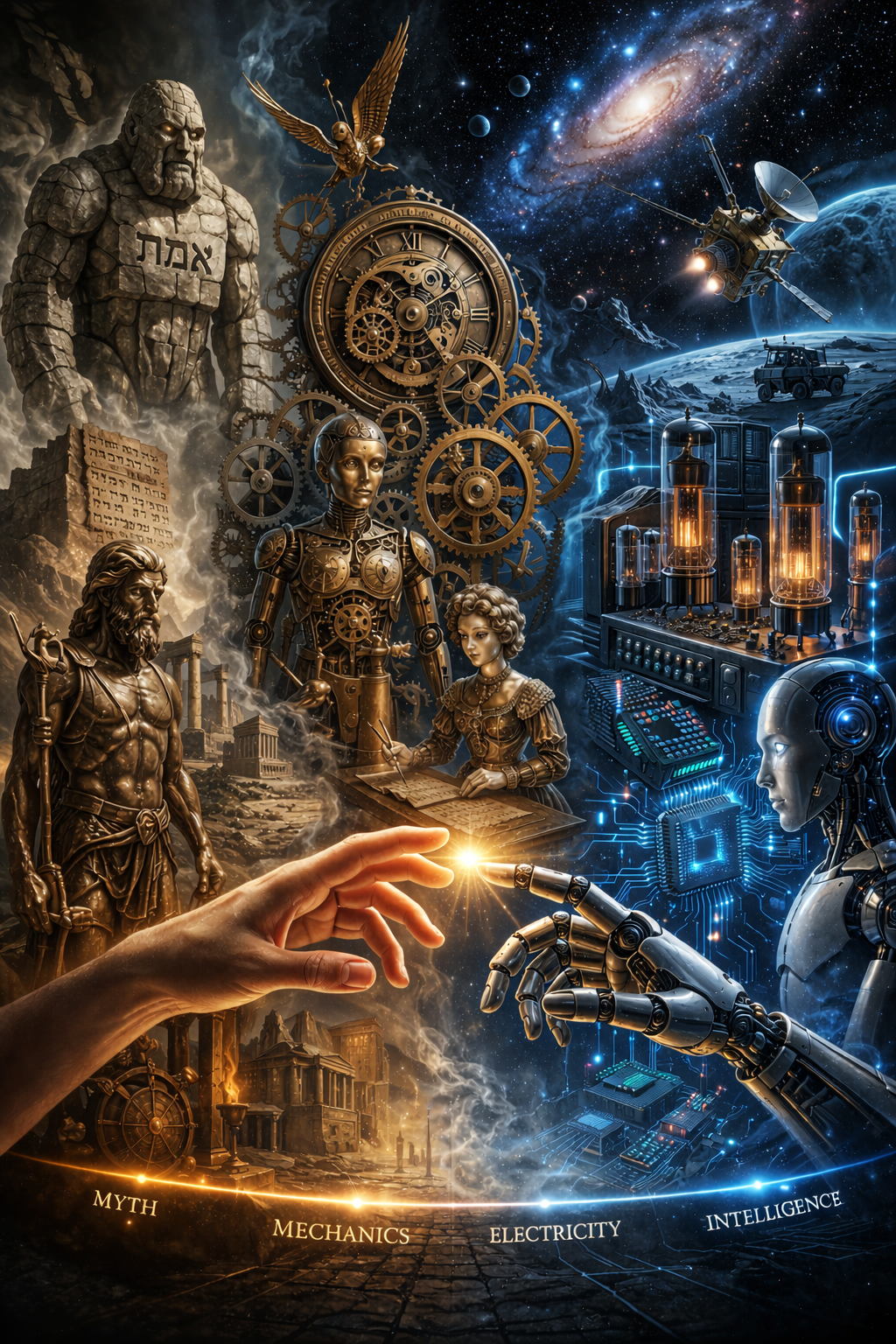
In the vast landscape of human knowledge, there are few journeys as fascinating as the one that leads from the ancient campfire to the silicon chip. This journey is exactly what Isaac Asimov invites us to join in the work How Did We Find Out About Robots. The book does not present the robot as a sudden modern miracle but rather as the culmination of a long patient walk through history. It is a story where curiosity serves as the beginning of all knowledge, and human understanding evolves step by step, much like the Scientific method itself. Asimov speaks with the calm explanatory voice that is his trademark, treating the reader not just as a student but as a fellow traveler through time.
The first story, The Dream of Artificial People, starts long before Electricity or computers were ever discovered. Humanity first imagined robots long before it could build them, populating ancient myths with artificial servants made by gods or magicians. We hear of Greek legends describing mechanical beings made by Hephaestus and Jewish folklore telling of the Golem, an artificial man given life by sacred words. These stories show that people have always dreamed of creating helpers in their own image, even when those early creations were magical rather than scientific.
The narrative transitions from myth to physical reality in the section titled Machines That Move by Themselves. Here Asimov introduces early Automata, which were mechanical devices from ancient and medieval times that moved through clever arrangements of Gears, weights, and Water pressure. Inventors in places like Greece, China, and the Islamic world built mechanical birds and statues that appeared alive. While these were not yet robots, they showed that motion could be controlled through Physical laws and helped people begin to understand Causality, or cause and effect.
In the section called The Age of Clockwork Intelligence, the story moves to Europe during the Renaissance and the Age of Enlightenment. Craftsmen created more complex dolls that could write or play music, leading people to wonder if thought itself could someday be mechanical. Philosophers began comparing the human body to a machine governed by predictable rules. This era introduced the concept of Determinism, the idea that complex behavior might come from simple mechanisms, which quietly laid the intellectual groundwork for robotics.
A major turning point arrives in Electricity Brings Machines to Life, which explores the era of the Industrial Revolution. Electricity allowed machines to respond instantly and repeatedly. Systems of Telegraphy demonstrated that signals could travel faster than humans, and early electrical devices hinted that machines might someday sense and react to their surroundings. These inventions suggested a future in which machines could act without direct human touch, showing that Robotics depends on many different scientific fields advancing at the same time.
The focus shifts from the machine body to the mind in the chapter Thinking About Thinking. Scientists began to study how people reason and whether those patterns could be reproduced artificially. Asimov describes how early pioneers transformed abstract mathematics into Computation through mechanical processes. This part of the journey highlights that intelligence might be a matter of Logic rather than mystery, making the idea of an intelligent machine scientifically possible.
The story enters the twentieth century in The Birth of Computers. Electronic Computer technology emerged from wartime research, using Vacuum tubes and Transistors to perform calculations faster than any human. Unlike older machines, computers could change their behavior based on the input they received. This adaptability is what Asimov identifies as the true beginning of robotics, where a machine is not merely moving but is guided by programmable intelligence.
In the section What Makes a Robot a Robot, the anatomy of these machines is clearly defined. Every robot needs Sensors to gather information, Central processing unit parts to interpret it, and Actuators to perform actions. Asimov explains how Feedback systems allow robots to correct their own mistakes by comparing their results with their goals. He uses the simple thermostat as an example of how advanced robotics grows from everyday technology.
Asimov also explores the rules of behavior in The Three Laws of Robotics. He discusses these laws as important thought experiments regarding Ethics and responsibility. The chapter raises questions about how humans and machines can cooperate safely and how we can ensure trust between them. Asimov remains optimistic, arguing that designing machines to be ethical is just as important as making them technologically advanced.
The practical use of these machines is covered in Robots at Work. Industrial robots perform dangerous or repetitive tasks with precision, acting as extensions of human capability. While machines provide strength and speed, humans provide the judgment and creativity, making the relationship collaborative. In the far reaches of Space exploration, robots in the story Robots Beyond Earth act as scouts for humanity. These automated probes explore other planets and send data back to us, acting as human built instruments that allow the universe to learn about itself.
The final section, The Future We Are Building, looks at what lies ahead. Asimov avoids making wild or frightening predictions, focusing instead on gradual progress guided by knowledge. He suggests that as we build more capable machines, we will better understand Consciousness and our own nature. By attempting to create thinking machines, people must confront deep questions about ethics and cooperation. The project of robotics is ultimately a way for people to learn more about themselves.
Looking at the whole work, How Did We Find Out About Robots is more of a journey through human curiosity than a technical manual. Each stage of the story shows our intellectual evolution from myth to mechanism and computation. Asimov’s style is patient and logical, acting as a teacher who trusts that understanding leads to wonder. The book’s greatest achievement is its quiet optimism. It teaches us that our best invention is not the robot but the Scientific method, which is our willingness to question and learn. The search for the robot is a search for understanding, leaving us with a future that is thoughtfully hopeful and a universe made comprehensible through reason.