Norby and the Lost Princess
Jeff Wells and Norby use temporal travel and deduction to locate Princess Rinda on planet Izz, resolving a political conspiracy and restoring the rightful monarchy.
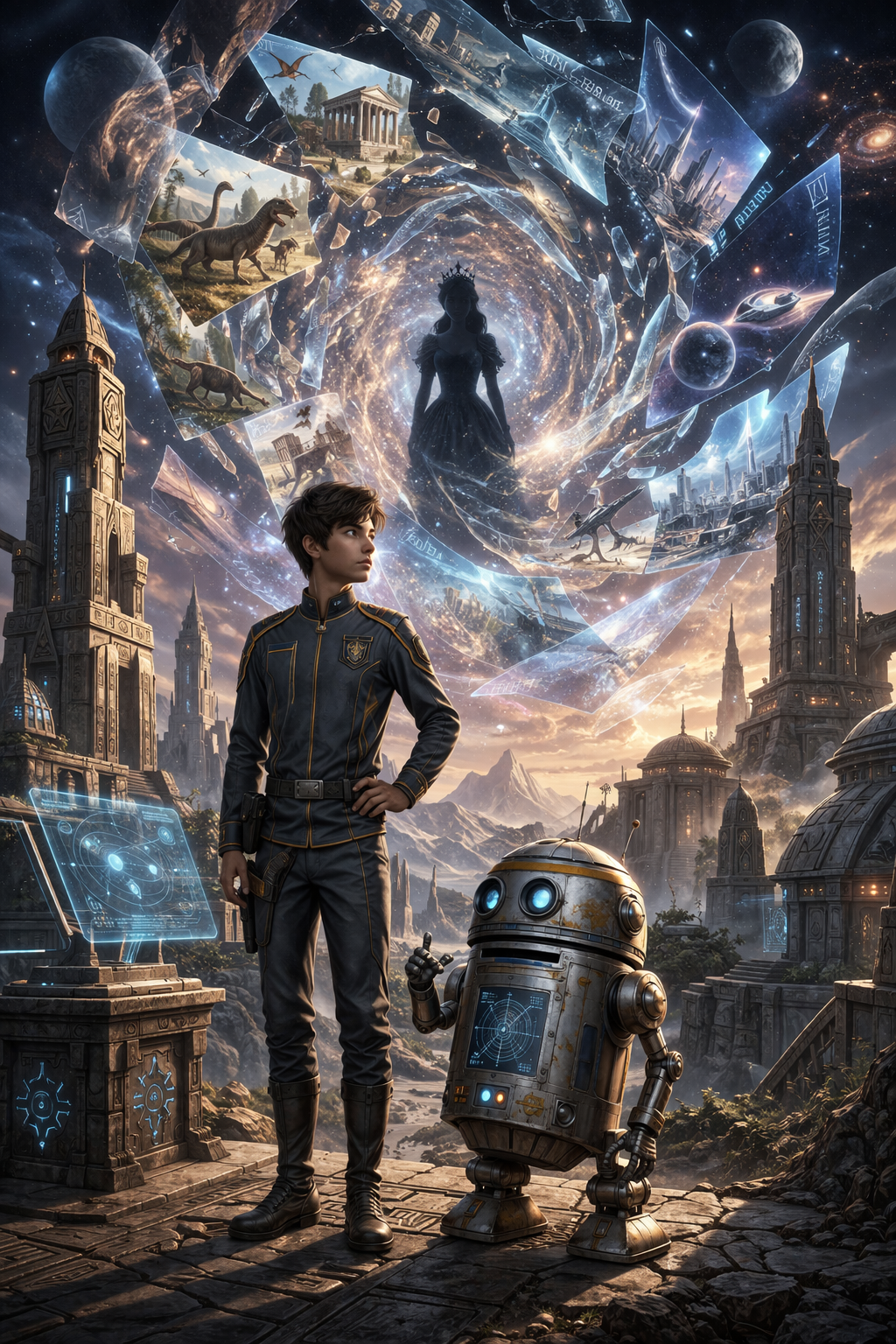
In Norby and the Lost Princess, Isaac Asimov and Janet Asimov present a narrative that appears to be a simple adventure across space and time. Yet, the surface simplicity conceals a carefully structured exploration of logic, identity, and the unpredictable nature of intelligence. This is especially true when that intelligence resides in a small, round, and unconventional robot named Norby. The story serves as a demonstration of problem solving on a galactic scale, showing that clarity of thought remains the most reliable tool in a universe filled with advanced technology.
In the section titled The Unusual Robot, we meet Jeff Wells, a cadet in the Space Academy who lives with his brother Fargo. Jeff’s life changes when he meets Norby, a robot who does not follow the standard patterns. Unlike most machines governed strictly by the Three Laws of Robotics, Norby is emotional and occasionally illogical. Most extraordinary is his ability for unpredictable time travel and space travel. Asimov allows the reader to observe and infer these traits, favoring reason over direct exposition.
The story moves into The Call for Help when news arrives of political instability on the ancient world of Izz. The ruling monarchy is under threat because Princess Rinda, the rightful heir, has vanished under mysterious circumstances. This disappearance threatens to cause chaos by collapsing the balance of power. Fargo is assigned to investigate the situation, and Jeff and Norby accompany him on this mission of recovery. What follows is a complex puzzle involving history and hidden motives.
Upon arriving at The World of Izz, the characters encounter a setting that blends advanced technology with ancient tradition. The planet is a study in contrasts where scientific progress exists alongside rigid social structures. Asimov treats this environment as a system to be analyzed rather than just a backdrop. The disappearance of the princess is viewed as a symptom of deeper instability within the sociology of the planet.
The search continues in The Maze of Time, where Norby’s unique abilities become central to the plot. Instead of moving linearly through space, Norby transports the group across different moments and possibilities. These shifts are not chaotic but appear to be guided by an underlying logic. As the characters encounter fragments of the past and future, they assemble a clearer picture of the events. In this way, time travel becomes a method of gathering data across dimensions.
In The Hidden Identity, the tension increases as it becomes clear the princess has been concealed both physically and conceptually. Her identity has been obscured through deliberate manipulation by those in power. Jeff relies on observation and deduction to find inconsistencies in the stories they are told. Norby provides intuitive insights that, while not strictly logical, consistently lead the group closer to the truth.
The protagonists then face the political core of the conflict in The Court of Illusions. The royal court is a place of deception where truths are selectively hidden to maintain appearances. Asimov constructs this setting as a system of variables where each character has specific motives and degrees of knowledge. The mystery shifts from a question of location to a question of intent and who benefits from the absence of the princess.
The resolution arrives in The Discovery of Rinda through a combination of temporal shifts and reasoning. The princess is found within a constructed reality designed to suppress her true self and prevent her from assuming power. This revelation is presented as the inevitable conclusion of a chain of logic. Asimov emphasizes the process of finding the truth rather than just the moment of discovery.
The story concludes with The Restoration, which deals with the return of the princess and the reestablishment of order. While her presence restores legitimacy, the events have exposed weaknesses where logic was overridden by fear or ambition. The resolution is an adjustment to the system to ensure such disruptions do not happen again. Throughout the book, Norby remains an enigma in The Nature of Norby. He represents a form of cognition that blends logic with intuition, challenging the idea that reason must always be linear.
As a whole, the work exemplifies Asimov’s ability to present sophisticated ideas in a clear and methodical way. The collaboration with Janet Asimov adds a lighter tone and curiosity to the intellectual foundation of the story. The search for the lost princess shows that intelligence is defined by the capacity to seek, to question, and to understand. This story is a quiet affirmation that clarity of thought is the most powerful tool for solving problems in any universe.