Robots, Machines In Man's Image
Asimov traces humanity's evolution from simple tools to logical robots. These machines, governed by safety laws, are functional extensions that reflect and enhance human ingenuity.
The history of human progress is not a collection of sudden leaps but a long and patient evolution of the tools we use to shape our world. In Robots, Machines in Mans Image, the narrative begins with the simple observation that humans have always shaped tools in their own image, first in function and only much later in form. This is not a tale of gleaming metal men but a logical progression of how we seek to extend our own capabilities.
In the beginning, there were Machines and Muscles. This era was defined by tools that served as extensions of human action. A lever served to magnify strength, while the wheel eased the burden of motion. These early tools did not look like humans, yet they performed tasks that were essentially human in nature. This establishes the core idea that a machine does not require a physical likeness to act as a functional imitation of its creator.
The narrative then moves to The First True Machines, which began to operate with a degree of independence. By harnessing natural forces, humans created the water wheel and the windmill to perform continuous work. The development of clockwork furthered this trend, as machines began to take on roles that previously required a constant human presence. This widening gap between human effort and mechanical action represents a significant step in the evolution of the machine.
With the Coming of automation, the focus shifts to how machines began to follow instructions. This era saw the rise of programmable devices, ranging from early looms to complex calculating engines. For the first time, a machine could be told what to do in advance and carry out those instructions without further guidance. While this was not yet true intelligence, it was a critical step toward creating devices that could operate autonomously.
The exploration of intelligence is handled directly in Machines That Think. Here, the computer is introduced as a tool built entirely upon the principles of logic. These machines process information and solve problems at speeds that far exceed human capability. However, there remains a vital distinction between calculation and understanding. A machine might appear to think, but its actions are the result of precise and limited methods designed by humans.
The Shape of Robots addresses the practical question of why a machine would ever be built in a human form. The answer is rooted in engineering rather than art. If a humanoid robot is intended to function in an environment designed for people, such as climbing stairs or opening doors, then a human like shape becomes the most practical solution. This logical approach removes the fantasy often associated with robots and replaces it with clarity.
The complexity of these machines is further examined in The Brain of the Robot. A robot brain is described not as a single organ but as a sophisticated system of sensors, feedback mechanisms, and decision making processes. These interrelated parts work together to create behavior that appears purposeful. This emphasis on structure and control systems reinforces the idea that robot behavior is a product of design and logic.
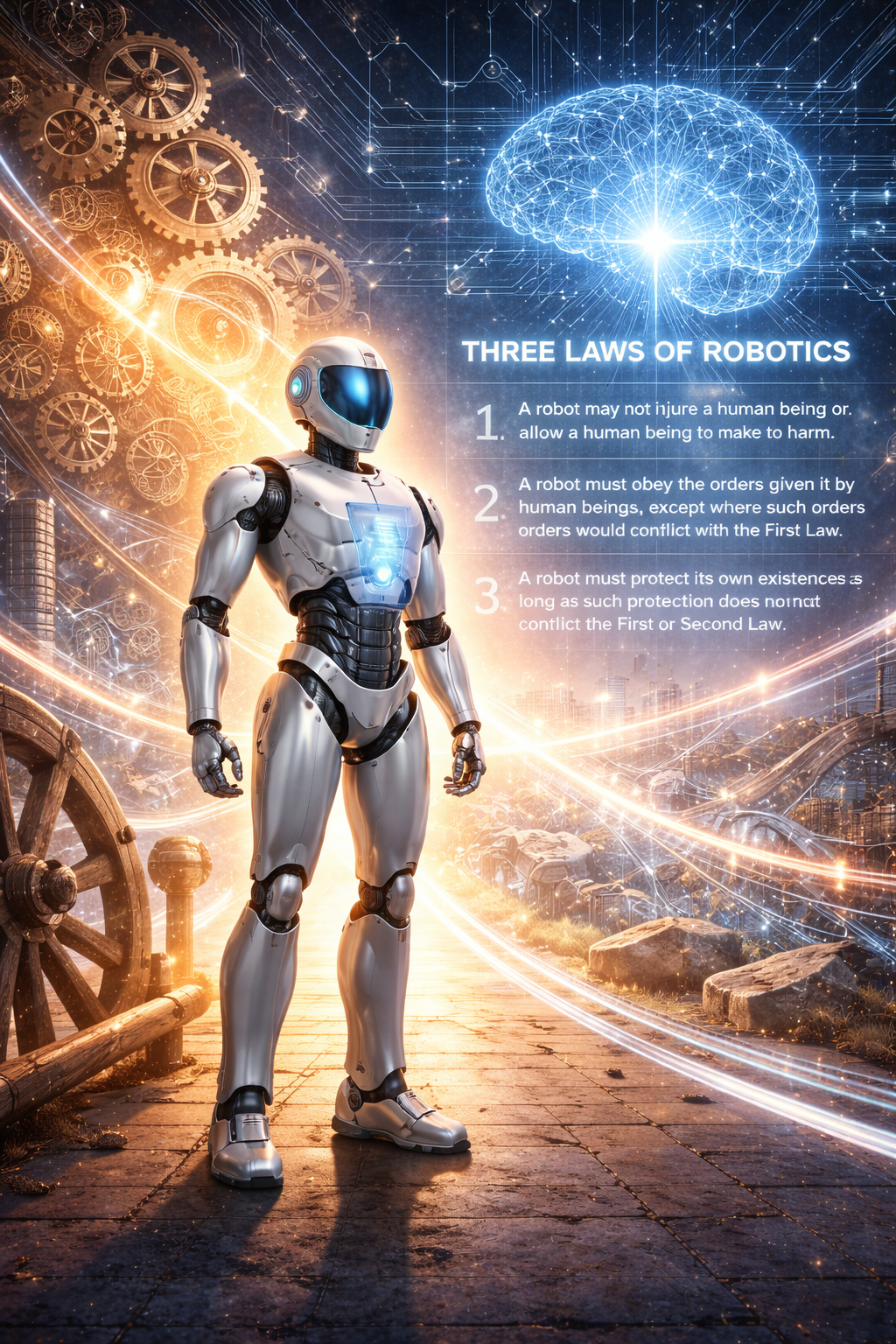
A central part of this framework is the Three Laws of Robotics. These famous principles are presented as practical safeguards to ensure that machines acting in human like ways remain under control. The Three Laws of Robotics require robots to protect humans, obey orders, and preserve themselves in that specific order. These laws provide a necessary structure for the relationship between humans and their mechanical creations.
As robots are integrated into the world, as seen in Robots at Work, they become a quiet support for human activity. They are adopted into industry and laboratories to perform tasks that are dangerous or repetitive. The narrative of Man and Machine acknowledges the psychology of fear that can accompany the rise of the machine. Yet, the argument remains that because machines are built by humans for human purposes, they are extensions of ourselves rather than rivals.
The Limits and Possibilities of these machines are clearly defined. While a machine may excel at a specific task, it lacks the broad and adaptable intelligence found in humans. Artificial intelligence is often narrow and specific to its design, whereas human thought is universal. This means the future is not about replacement but about machines complementing human thought and freeing people for more creative pursuits.
The Future of Robots and Living with Our Creations bring the story to a close by looking at the path ahead. Machines will become more integrated and helpful, allowing humanity to focus on exploration and understanding. The story of the robot is ultimately the story of human ingenuity and curiosity. The strength of this work lies in its restraint and its ability to build a vision of the future that is both reasonable and possible. By the end, we see that our machines are reflections of our own thinking and needs, and understanding them helps us to better understand ourselves.