Spells
Edited by Isaac Asimov, this collection examines magic as primitive science, exploring how humans use logic and learning to transform uncertainty into understanding,
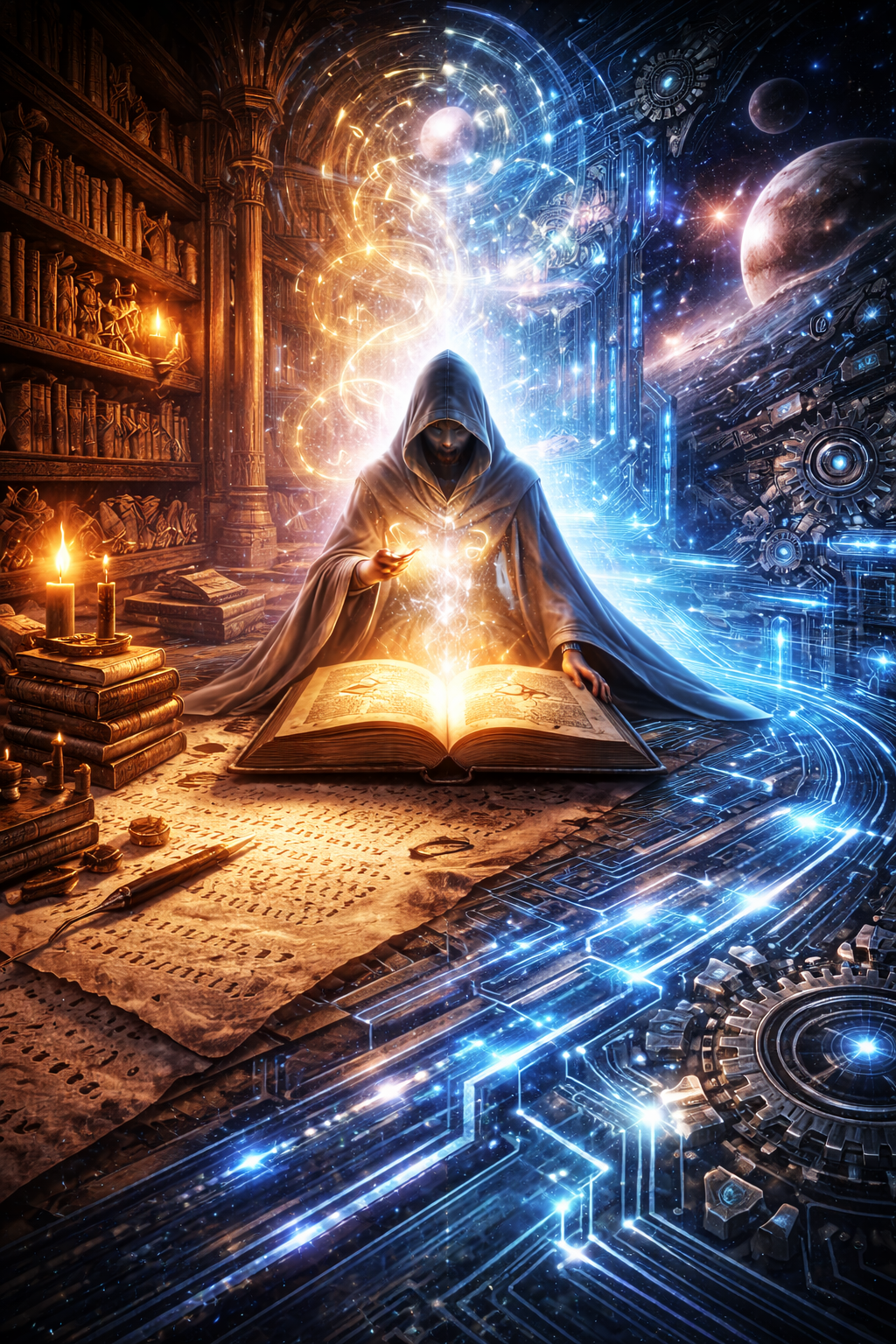
The anthology Spells, edited and introduced by Isaac Asimov, is not a book about magic in the conventional sense. Instead, it is an exploration of the long standing human desire to understand and control the unknown. Asimov frames the collection with logical clarity, suggesting that what we often call spells are actually early attempts at Scientific method and Systematics. He views these primitive sciences as structures shaped by fear, curiosity, and imagination. The stories do not simply present enchantments but examine the Psychology and Logic behind the human belief in magic.
In the opening story, The Words of Power, we are introduced to a world where Linguistics governs Reality. A scholar named Theron discovers that certain phrases can alter Physical law when spoken with exact precision. Theron approaches this discovery analytically, using Experimental physics to catalog effects and test variables. The story moves toward a realization that perfect Control theory over reality removes the unpredictability that gives life meaning. When a spell is perfectly understood, it lose its wonder.
The journey continues in The Green Hills of Enchantment, which offers a look at Anthropology and Ecology. A remote village performs seasonal rituals to ensure fertile crops, which an outsider initially dismisses as superstition. However, the visitor begins to notice subtle correlations between these traditions and environmental patterns. The narrative suggests that ancient spells may have encoded practical wisdom about Nature that eventually blurred into myth over time.
A deeper exploration of Physics occurs in Spell for a New World, where colonists settle on an Exoplanet. On this world, standard Technology fails because the environment is unpredictable. One colonist learns to survive by treating these Anomalies (science) as if they were a new system of rules to be mastered. This reflects the core theme that magic is often science that we do not yet understand.
The collection takes a darker turn in The Price of a Name, which examines Identity (social science) and Information science. In this story, a sorcerer gains power by knowing the true names of individuals, allowing for the influence of their thoughts. The protagonist, Lira, discovers that both external knowledge and self knowledge can be dangerous. The spell acts as a metaphor for Psychology, showing that to be completely known is to lose Autonomy.
In The Clockwork Conjurer, the focus shifts to Mechanical engineering and Automation. An inventor creates machines that can replicate traditional spells through mechanical processes. While this brings predictability and Efficiency to society, the inventor feels a sense of loss. The story explores the tension between technological progress and the human Wonder (emotion) that originally inspired the pursuit of knowledge.
The narrative then turns inward with The Silent Spell, focusing on Intentionality. A young apprentice finds she can perform magic with pure intent, requiring no words or gestures. However, she finds that power without Constraint (mathematics) leads to ambiguity and confusion. The story suggests that rules and rituals are necessary frameworks that prevent purposeful action from dissolving into Entropy.
Knowledge itself is the subject of The Library of Forgotten Charms, which deals with Archival science. An archive contains a vast history of spells, though most are ineffective or wrong. The protagonist realizes that the value of the collection is not in its accuracy but in its Intellectual history. Each failed spell represents a step in the History of science, proving that progress is built on the accumulation of past attempts.
A Spell for Two Minds investigates the Sociology of communication. Two individuals share their thoughts through a magical link, creating a state of perfect Empathy. However, the complete lack of Privacy causes immediate conflict. The story logically examines the limits of understanding, suggesting that some mental distance is required for healthy Interpersonal relationships.
As the world changes, The Last Magician depicts a society moving toward Rationalism. Magic is being replaced by systematic knowledge, and the final practitioner recognizes this as a necessary stage in Human development. His reflective preservation of the old ways ensures that the origins of human Curiosity are not forgotten even as they transform into science.
The final story, Spells, provides a Synthesis of these ideas. A student of both ancient magic and modern science seeks to reconcile the two fields. She discovers that the distinction between them is largely conceptual, based on Precision and accuracy in describing reality. The story concludes that while methods of inquiry evolve, the human impulse to seek knowledge remains constant.
As a whole, Spells functions as a progression of thought rather than a simple sequence of events. Each story examines different aspects of belief and control with the clarity and Logic associated with Isaac Asimov. The anthology transforms the genre from escapism into a serious Inquiry into how humans make sense of the unknown.
The progression of the stories mirrors the Cultural evolution of human thought, moving from external wonders to internal perceptions. By the end of the collection, the boundary between magic and Science dissolves, revealing them as points along a single Spectrum. This collection is an example of Speculative fiction at its most thoughtful. It invites the reader to consider why beliefs exist and how they change as we turn Uncertainty into Knowledge.