The Science Fictional Olympics
Humanity evolves through competition from physical movement to mental abstraction, using games as a scientific metaphor to test human potential while surpassing all universal limits.
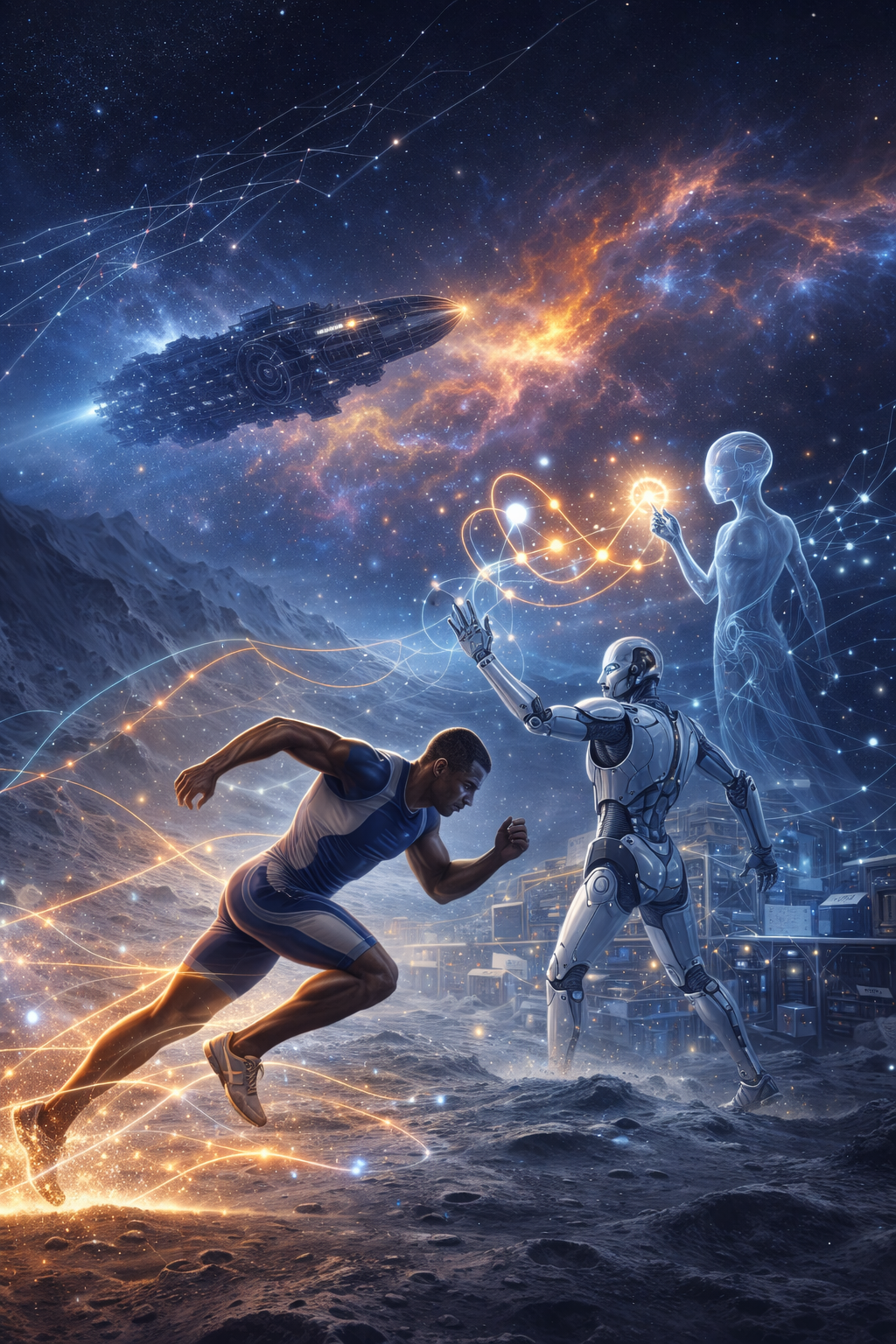
This chronicle is not a random sequence of amusements but a logical progression that begins with the physical body and ends with the pure abstraction of the mind. It is a study of how we negotiate the laws of physics and the limitations of our own biology.
The journey begins in an arena that any human would find familiar, yet the conditions are subtly altered to test the limits of our understanding. In the earliest accounts, we see athletes who are no longer just runners or swimmers but subjects in a grand experiment of fluid dynamics and gravitational shifts. One story describes a sprinter on a low gravity world where a simple stride is transformed into a series of floating equations. Another tells of a swimmer struggling through a medium far more viscous than water, where every stroke is a problem in physics that must be solved in real time. In these moments, the tone is one of quiet curiosity, inviting the observer to see how the human form adapts when the rules of nature are rewritten.
As the narrative expands, the setting moves away from recognizable tracks and pools toward the cold precision of space. On a small asteroid, a competition unfolds that bears little resemblance to traditional sport. There is no running here, instead, the contestants use their bodies to calculate trajectories using orbital mechanics, leaping from one surface to another in arcs that must be perfectly planned in advance. This transition suggests a future where the athlete is indistinguishable from the applied physicist, and victory is awarded not to the strongest muscle but to the most precise mathematical mind. It is a clear, logical step in the evolution of competition, as we leave the cradle of Earth, our intuition must be replaced by calculation.
The focus then shifts from the external movement of the body to the internal processing of the brain. One narrative describes a contest of reaction time held in an environment where signals travel at varying speeds, distorting the very nature of perception. To succeed, the competitors must abandon their immediate senses and rely instead on predictive models of reality. This demonstrates a profound Asimovian principle, that in a technological era, human evolution proceeds through the rigorous training of the mind rather than the slow mutation of the genes. The brain itself becomes an instrument capable of compensating for the strange distortions of deep space.
Midway through the chronicle, a new variable is introduced that challenges our definition of the competitor, the robot. At first, the machines dominate, possessing strength and endurance that no organic being can match. However, the stories pose a fundamental question about the meaning of victory when the outcome is certain. The human participants respond not with greater force, but with unpredictability. They introduce games where the rules change during the play, forcing the robots, who require fixed parameters, to falter. The lesson is presented with characteristic clarity, the true essence of humanity is found not in physical superiority, but in the ability to adapt to the unknown.
The scope of the Olympics eventually reaches beyond our species to include the entire galaxy. In an inter species competition, the very idea of fairness must be reinvented. It is impossible to compare the physical prowess of a creature from a dense atmosphere with one from a vacuum, so the games shift toward abstract qualities. They begin to measure things like pattern recognition, cooperative strategy, and the ability to create beauty under strict constraints. In this stage of the narrative, competition is transformed into a form of collaboration and mutual discovery. The games become a universal language that allows vastly different civilizations to understand one another through the shared pursuit of excellence.
One of the most reflective moments in the collection concerns a solitary individual aboard a generation ship. There are no cheering crowds and no rivals to defeat, only the quiet struggle against the psychological fatigue of a journey that spans decades. The athlete’s task is to maintain a sequence of perfect performances, turning sport into a ritual that preserves a tradition from a home world long forgotten. By the end of the voyage, the record of these performances is no longer a measure of skill but a testament to human continuity. It shows that the drive to excel is something we carry with us, even when we are alone in the void.
As the chronicle nears its conclusion, it examines the blurring line between the natural and the artificial. We see participants whose reflexes are chemically accelerated and whose muscles are reinforced with synthetic fibers. The stories do not offer a simple judgment on these enhancements, instead, they treat them as additional variables in the long term study of what it means to strive. Every modification is simply another data point in the experiment of human potential, asking where the boundary of the individual truly lies.
The final movement of the book turns inward to the virtual realm. Physical differences are discarded as competitors link their minds through direct neural interfaces. In this digital arena, landscapes are constructed and crossed in seconds, and victory is granted for the elegance of a solution rather than the speed of a limb. The Olympics have reached their ultimate destination, the progressive abstraction of effort. What began as the simple act of running and jumping has evolved into the exercise of pure thought and imagination.
When one reviews this entire arc, it becomes clear that the style of the work is deceptively simple. The language is precise and the explanations are as calm as a teacher's demonstration, yet they lead the reader toward a profound optimism. The future is not seen as a violent struggle for dominance, but as an endless series of games where intelligence and creativity are the ultimate prizes. The Olympics serve as a metaphor for the scientific enterprise itself, a disciplined, rule bound, and endlessly inventive attempt to surpass the limits of yesterday. It is a celebration of every participant who feels the need to test their capabilities and then, with quiet determination, asks what the next event will be.