The Sun Shines Bright
This collection of science essays explores the wonders of space and time, ranging from cosmic phenomena like the Sun and moons of Mars to the deepest mysteries of human intelligence
The book, The Sun Shines Bright, is a collection of seventeen science essays written by an extremely prolific author, whom you might already know, and is drawn from the pages of The Magazine of Fantasy and Science Fiction. The larger story being told here is not one of galactic empires or future history, but the unending saga of human discovery how observation corrects old dogma, how a simple discovery connects distant fields of knowledge, and where the human race must logically proceed if it is to survive its own intelligence. The essays are logically divided into sections dealing with cosmic bodies, fundamental particles and elements, the nature of scientists, and the future of humanity.
The first segment, The Sun, begins with "Out, Damned Spot!". This essay starts by celebrating coincidence, linking a personal historical oddity regarding the author’s birth date to the grand history of solar observation. The central story here is the scientific triumph over Aristotelian dogma, which insisted that celestial bodies were flawless. Galileo, using his new telescope, confirmed that the sun possessed spots and rotated. We see science building methodically upon this, moving from the discovery of the regular 11 year sunspot cycle to the astonishing historical anomaly known as the Maunder minimum, a 70 year period (1643–1715) when sunspots essentially vanished. The essay leads toward the grand observation that this period coincided exactly with the reign of Louis XIV, "The Sun King," a coincidence of vast and unlooked for cosmic order.
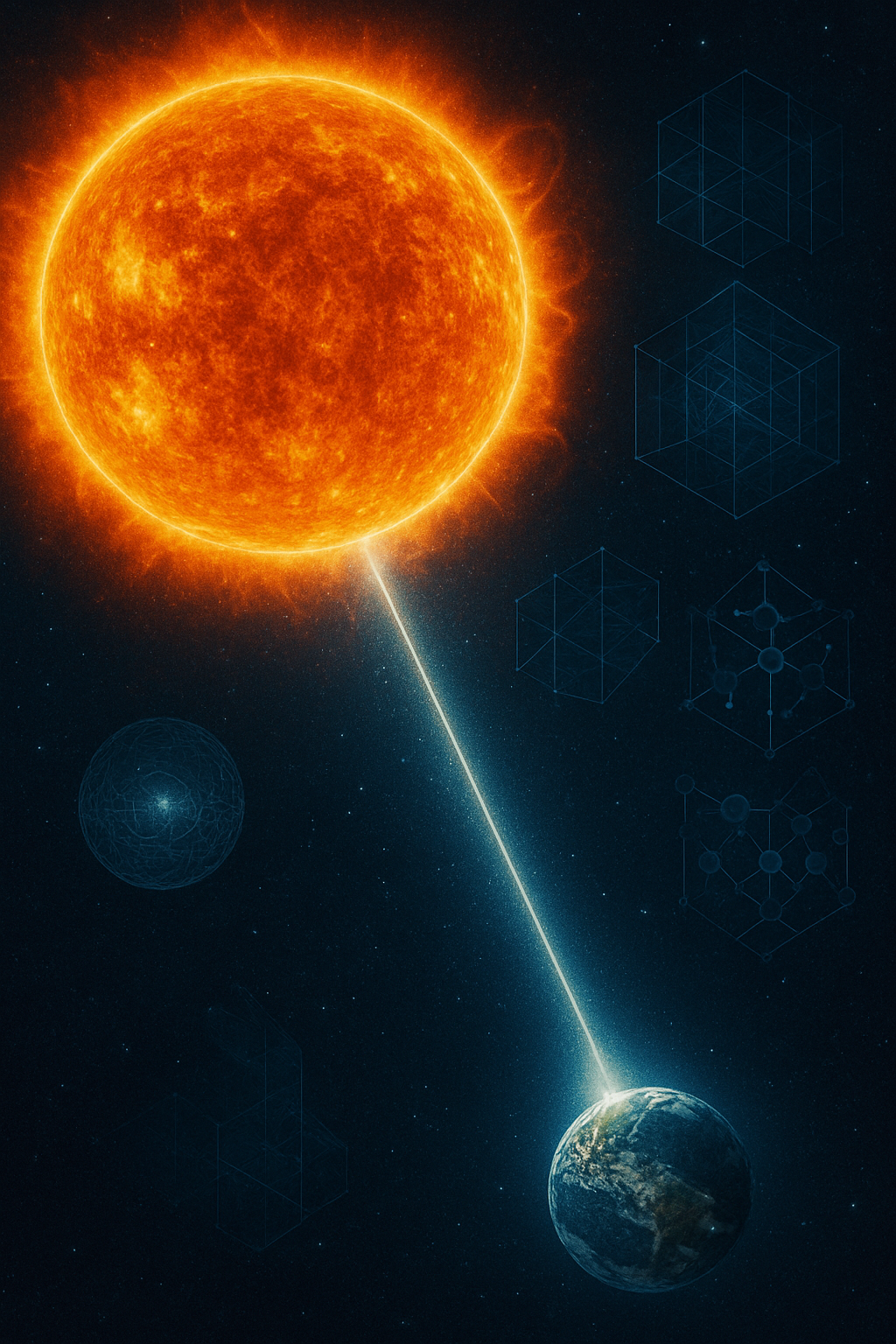
The next chapter, "The Sun Shines Bright," addresses the immense nuclear engine powering our star. The author explains that the sun burns hydrogen into helium, and in this process, sends forth a colossal stream of tiny, virtually untouchable particles called Neutrinos. The narrative builds from this established theoretical foundation to the shocking experimental results of Raymond Davis, Jr., who could only detect one third of the expected solar neutrinos. This massive scientific discrepancy means our understanding of the sun's core, or perhaps the physics of the neutrino itself, must be fundamentally incomplete. The future path involves the difficult creation of "neutrino telescopes" to map the full energy spectrum, hinting at a new era of "neutrino astronomy".
The section concludes with "The Noblest Metal of Them All," detailing the properties of gold and the even rarer and denser platinum group metals, particularly iridium. This discussion of dense, noble metals sets the stage for a great mystery found in the terrestrial rock record: a sudden "blip" of iridium 65 million years ago. The story of this discovery, made by Alvarez and colleagues, immediately converges with the known event of the Great Dying, or the extinction of the dinosaurs. The implication is profound, leading scientific speculation toward a dramatic cosmic catastrophe initially conceived as a mild solar explosion, but quickly progressing toward the theory of a massive asteroid impact that choked the Earth with dust and iridium rich debris.
The next group of essays, The Stars, begins with "How Little?," a piece driven by the scientific necessity of correcting one's own errors. The author corrects a long standing figure in his memory concerning Sirius B, the White Dwarfs companion of the brightest star in the sky, Sirius A,. The essay marches logically through astronomical calculations to show that Sirius B, despite having the mass of our sun, is actually smaller than the Earth and possesses a staggering density. The review points out that this calculation is rooted in the known physics of white dwarfs, yet the extreme data a Surface Gravity nearly half a million times that of Earth is used to imagine how such a powerful, small star would behave if it orbited our own sun.
The next chapter, "Siriusly Speaking," details Sirius's color across history, using logic and historical context to conclude that reports of Sirius being red were likely due to atmospheric scattering near the horizon, or poetic license linking the star to the baleful heat of the "dog days”.
The section closes with "Below the Horizon," a detailed and mathematically organized lesson in celestial coordinates, prompted by a reviewer's nitpick over the visibility of the star Alpha Centauri from the United States.
In the section The Planets, the essay "Just Thirty Years" summarizes the accelerating pace of scientific change by comparing planetary knowledge in 1949 with 1979. In the span of a generation, science fiction concepts of the solar system, such as the canals of Mars, oceans on Venus, and a solid surface on Jupiter, vanished under the relentless light of space probes.
The segment The Moon follows with two interconnected essays on tidal forces. "A Long Day's Journey" demonstrates the undeniable cosmic truth of Tidal Forces: the Moon's gravitational pull creates friction that continually slows Earth's rotation, making the day longer by 0.0016 seconds per century. This fact is verified by historical eclipse records and, impressively, by geological records found in ancient fossil corals.
This leads to "The Inconstant Moon," which explores the consequence of this slowing: the Conservation of Angular Momentum requires that as Earth slows its spin, the Moon must continually recede from us,. The recession is slow, meaning total solar eclipses will cease in about one billion years,. The long term physics then reveals a cosmic reversal: after billions of years, the Sun's tidal influence will cause the Moon to begin spiraling inward, leading ultimately to its breakup and the formation of spectacular, temporary rings around Earth. All these profound changes are, however, rendered academic by the inevitable expansion of the Sun into a red giant in a mere 7 billion years, which will swallow both Earth and Moon.
In The Elements, the story of discovery focuses on one of Asimov’s central themes: the interconnectedness of science, politics, and humanity's future. "The Useless Metal" introduces uranium, which was long known but ignored, overshadowed by the intense glamour of its Radioactivity decay product, radium. This property, discovered by Becquerel and studied by Marie Curie, involves the spontaneous conversion of elements, proving atoms are not ultimate particles.
The next chapter, "Neutrality!," sets the stage for uranium's rise, starting with the discovery of the neutron the neutral subatomic particle perfectly suited for nuclear bombardment. This research progresses rapidly to the theoretical possibility of a self sustaining Nuclear Fission chain reaction.
This dramatic tension culminates in "The Finger of God," where human decision and coincidence clash against history, detailing how Leo Szilard and Albert Einstein convinced President Roosevelt to launch the massive, secret effort to build the atomic bomb, resulting in the use of nuclear weapons to end World War II.
The section The Scientists details the human flaws of integrity and bias in research.
Finally, The People addresses human nature and the ultimate choice for survival, concluding that since intelligence increases the viciousness of conflict, humanity must master its tendency toward destructive competition and embrace "niceness" on a global scale to ensure survival and achieve space exploitation.