Thinking Machines
This story defines intelligence as a process, framing machines as logical extensions of human tools. These programmable collaborators externalize reasoning under our ultimate human responsibility.
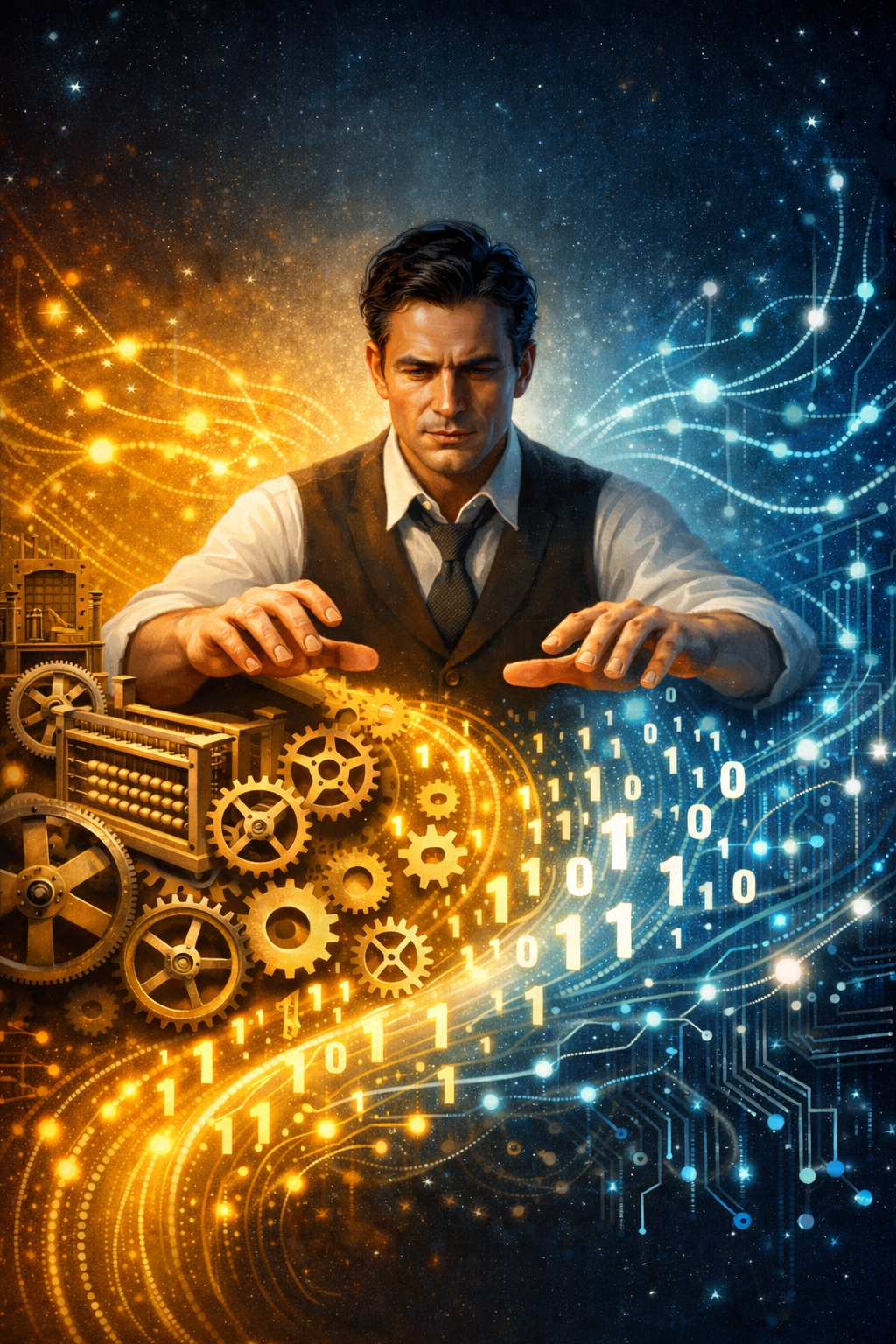
The architecture of the thinking machine relies on the convergence of five foundational concepts that transformed mechanical tools into cognitive partners. The first is the Analytical Engine, a conceptual breakthrough representing the first programmable device capable of conditional logic. This device moved beyond simple arithmetic to perform symbolic manipulation, allowing a machine to process abstract symbols that represent facets of human thought. The operational framework for this process is Boolean logic, which reduces complex reasoning to binary distinctions of "true or false". These logical steps are physically executed through electronic switching systems, where the high-speed behavior of electrons serves as the medium for mechanical thought. Finally, to enable machines to adapt rather than merely follow rigid paths, engineers utilized feedback mechanisms, which allow a system to adjust its internal parameters based on experience, mimicking the learning processes found in neurobiology.
The story of the thinking machine is not a tale of sudden magic or a warning of mechanical monsters, but a long, logical journey of human toolmaking. To understand where this story is building from, we must look at how Isaac Asimov approaches the very idea of intelligence. He does not treat the mind as a mystical or sacred entity that cannot be understood; instead, he views it as a process that can be dismantled and examined. By breaking down thought into smaller pieces like memory, learning, and decision-making, he shows us that the "thinking" we do is a series of steps that can, in principle, be reproduced by a machine. This perspective is the foundation for everything that follows, setting the stage for a world where humans and machines are partners in logic.
In the first mini-story of this progression, we look at the Era of External Logic. Long before there were wires or vacuum tubes, there were the abacus, Pascal’s adding machine, and Leibniz’s "stepped reckoner". These are the earliest chapters of our story, where humans first learned to trust a physical device to perform a logical operation. While these machines did not "think" in the way we usually mean, they proved a vital point: logic could be externalized. By taking the rules of mathematics and building them into gears and beads, humanity began to move the burden of calculation away from the biological brain and into the world of inanimate objects.
The story takes a dramatic turn in the nineteenth century with the second mini-story, centered on the Dream of the Analytical Engine. Here, we meet Charles Babbage and Ada Lovelace, who moved the narrative from simple calculation to true computation. Babbage’s genius was in conceiving a machine that was programmable, capable of performing different tasks based on conditional operations. It was Lovelace, however, who provided the quiet turning point by realizing that such a machine could manipulate symbols rather than just numbers. This realization blurred the boundary between a simple calculator and a cognitive engine, suggesting that if we could represent the world in symbols, a machine could eventually navigate the complexities of human thought.
The third mini-story brings us into the twentieth century with the Binary Marriage of Logic and Electricity. Asimov highlights a beautiful irony here: the abstract, theoretical work of George Boole found a home in the physical behavior of electrons. By reducing thought to simple binary distinctions true or false, on or off engineers were able to build electronic switching systems that could process information at incredible speeds. During World War II, these machines evolved from theoretical possibilities into physical realities that possessed memory and flexibility on a scale never seen before. Asimov is careful to remind us that these machines do not "know" things as we do; they simply follow instructions and store symbols. Yet, he argues that if the result is indistinguishable from human reasoning, the label of "thinking" becomes a matter of function rather than biological essence.
In the fourth mini-story, we explore the Locus of Intelligence found in programming. Asimov explains that the hardware of a computer, no matter how complex, is essentially inert without the instructions that guide it. The true "brain" of the story is the program, which encodes the strategies and rules needed to solve problems. Whether a machine is playing chess or proving a theorem, it is navigating a "problem space" using principles that are strikingly similar to those used by the human mind. This leads into a discussion of learning machines, which represent a leap from fixed instructions to adaptable behavior. By using feedback mechanisms similar to those in our own nervous systems, these machines can modify their actions based on experience, improving their performance over time. This transition from rigid machines to learning systems is where the story truly begins to approach the complexity of life.
As the narrative reaches its peak, it addresses the Conflict of Purpose and Fear. Many people fear that thinking machines will one day surpass or replace their creators, but Asimov dismantles this anxiety with his signature logic. He points out that machines are extensions of human purpose; they are designed to optimize what we value, but they do not possess the biological or emotional drivers to invent their own values. Just as a telescope sees farther than the eye and an engine lifts more than the arm, a thinking machine is simply a tool that computes faster and more accurately than the brain.
Asimov does not make wild predictions about the "end of humanity" or the "rise of the soul." Instead, he asks us to consider if consciousness is even necessary for intelligence. He suggests that because much of human thinking happens without our conscious awareness, a machine that operates through unconscious mechanical processes is not "lesser" than us. This is a profound shift in perspective. It moves the conversation away from a competition between man and machine and toward a future of cultural evolution, where symbolic manipulation by machines is the natural next step after biological evolution produced our brains.
In summary, the "Architecture of the Thinking Machine" is a story of empowerment through understanding. It demystifies the computer and places the responsibility for the future squarely on the shoulders of the designers and the users. The machines will only think the way we teach them, and they will only serve the goals we give them. As the story concludes, we are left not with a feeling of being replaced, but with the realization that we have built a mirror. When we look at the thinking machine, we are really looking at the structured, logical beauty of our own minds, externalized and amplified for the benefit of all.
To understand this better, imagine a master architect who builds a grand crane to help him reach the top of a cathedral. The crane can lift stones far heavier than the architect ever could, and it can place them with a precision his own hands might lack. However, the crane does not know why it is building a cathedral, nor does it care for the beauty of the stained glass. The crane is the "thinking machine" an extension of the architect’s will that allows him to build higher and faster than he ever could alone. The glory of the finished cathedral belongs to the architect, but he could never have touched the sky without the machine.