Travels Through Time
Asimov explores time travel through relativity and entropy, concluding that while future travel is possible, logical paradoxes and moral accountability effectively safeguard our human history.
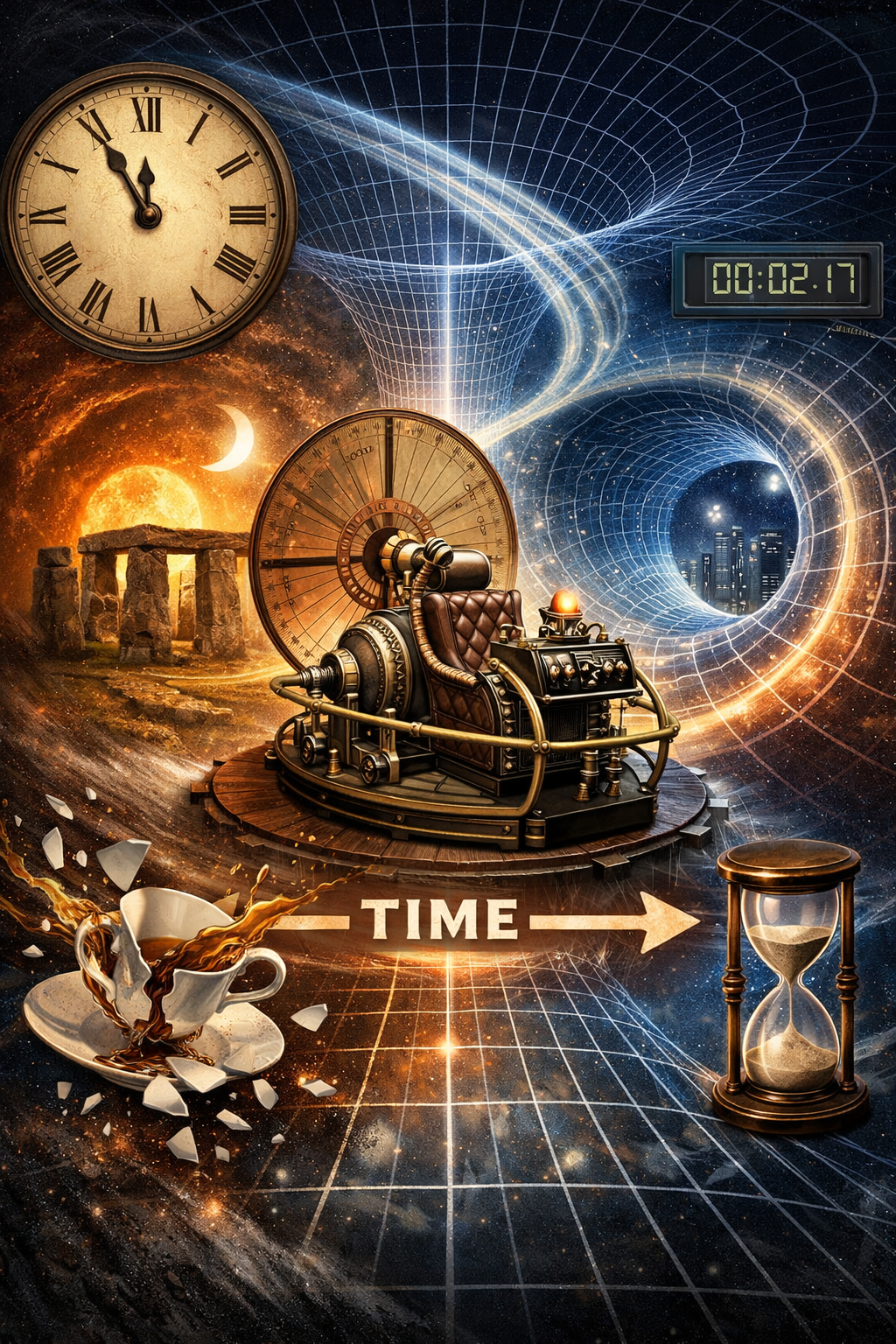
In the history of human thought, few concepts have captured the imagination quite like the ability to step outside the flow of time. In Travels Through Time, Isaac Asimov acts not as a purveyor of fantasy, but as a disciplined historian and scientist, guiding the reader through the evolution of this profound idea. He begins by explaining that before time was a subject of physics, it was a psychological construct born from memory and anticipation. Early civilizations viewed time as a circle, repeating the cycles of the seasons and the stars, and it was only with the rise of modern science that we began to see time as a linear path that could be measured and, perhaps, manipulated.
Asimov notes that the dream of seeing the future or past is as old as humanity, appearing first in the myths of prophets and oracles, which he considers primitive forms of temporal displacement. However, the story of modern time travel truly began in the nineteenth century with H.G. Wells, who proposed that time was a physical dimension like space. This was a crucial leap because it moved the concept from the realm of magic into the realm of mechanical process, providing the foundation for everything that followed in science fiction. While fiction allows for instantaneous travel and perfect navigation, Asimov uses the rest of his inquiry to distinguish these literary luxuries from the strict requirements of physical law.
The first major scientific milestone in this story is the introduction of Special Relativity, which Asimov identifies as the point where time travel moved from speculation to experimentally verified fact,. He explains that motion at high speeds causes Time Dilation, a phenomenon where a traveler ages more slowly than those they leave behind. This effectively allows for a one-way trip into the future, a reality demonstrated by atomic clocks and subatomic particles. Yet, as Asimov moves the story forward, he introduces a significant barrier: the Entropy of the universe. This concept establishes the "arrow of time," which dictates that systems move from order to disorder, ensuring that while we may leap ahead, the path back to the past remains logically and physically restricted.
The narrative then shifts to the seductive but treacherous desire to travel backward in time. Asimov treats the Grandfather Paradox not merely as a brain teaser, but as a vital diagnostic tool to test the validity of any theory of the universe. He argues that any physical model allowing for a logical contradiction must be inherently flawed or incomplete. While he discusses modern attempts to bypass this such as branching universes or self-consistent timelines Asimov remains a skeptic of any solution that relies on metaphysical assumptions rather than testable physics. He acknowledges the mathematical existence of Wormholes and other shortcuts in space-time geometry, but he warns that the energy required to stabilize such paths is far beyond human reach,.
Beyond the mechanics, Asimov explores the profound human and philosophical cost of mastering time. He suggests that if we could endlessly revise our history, the very foundations of our society including legal responsibility and moral accountability would dissolve. A civilization that can edit its past would never truly mature because it would never have to live with the consequences of its choices. Ultimately, Asimov concludes that our obsession with time travel is a reflection of our discomfort with the present. The true lesson of science fiction, he argues, is that every moment we live is already shaping a future that we cannot go back to change. By understanding time, we do not gain the power to escape it, but the wisdom to act effectively within the brief window of existence we are given.
Summaries of the Book’s Thematic Sections
Time as a Human Invention and a Physical Reality Asimov defines time as a transition from a psychological experience of memory into a quantified, linear dimension. He argues that our early cyclical views of time were eventually replaced by a scientific understanding that allows for the theoretical possibility of manipulation.
The Birth of Time Travel in Literature This section traces the evolution of time travel from ancient myths of prophecy to the mechanical transition introduced by H.G. Wells. Asimov credits Wells with the "conceptual leap" of treating time as an axis of space, though he notes that fiction often ignores the harsh realities of physics.
Relativity and the Arrow of Time Asimov details how Einstein's theories proved that traveling to the future is possible through high-speed motion. However, he introduces the "arrow of time" and entropy to explain why this remains a one-way journey, as the universe’s natural progression from order to disorder prevents a simple return to the past.
The Temptation of Traveling Backward The inquiry focuses on the allure of correcting history and the logical dangers of doing so. Asimov uses the grandfather paradox as a primary example of why backward travel is physically suspect, dismissing theories that rely on unproven metaphysical guesses.
Space-Time Geometry and Theoretical Loopholes Asimov examines the "mathematical constructs" like wormholes and rotating universes that appear to allow for backward travel in Einstein’s equations. He concludes that while these are mathematically permissible, the extreme energy and stability requirements make them functionally impossible in physical reality.
The Human Cost of Temporal Power In a shift toward social philosophy, Asimov warns that a society capable of revising history would lose its sense of identity and accountability. He posits that the impossibility of backward travel may be a "safeguard" that keeps the universe stable and forces humanity to learn from its mistakes.
Time Travel as a Mirror of Human Aspiration The final section reframes the topic as a metaphor for our desire to escape irreversible choices. Asimov argues that the real value of the concept is to teach us that we are already "traveling" and must act wisely in the present to shape the future,.
To understand the nature of time as Asimov presents it, think of a manuscript being typed on a manual typewriter. While we can see the pages piling up in the "past" and the blank sheets waiting in the "future," we can only ever strike the keys in the present moment. We might try to imagine a way to reach back and overtype a mistake, but the ink is already set and the paper has moved forward; the only way to ensure a perfect story is to be careful with the keys we strike right now.