Wild Inventions
Asimov argues technology is a logical continuation of nature. Humanity imitates Biological Systems to create tools that successfully extend human reach, senses, and innate capabilities.
The history of human progress is often misunderstood as a series of artificial breaks from the natural world. However, the central theme of Wild Inventions suggests that this conflict is an illusion. Instead of being a violation of nature, invention is a systematic continuation of natural principles. Every device ever fashioned is rooted in patterns that existed long before humans arrived. What distinguishes the human species is the capacity for conscious recognition and refinement of these existing patterns. The typewriter keys of history are silent for only a moment before the logic of this progression becomes clear.
The first story in this journey concerns the dismantling of the belief that technology is unnatural. Human ingenuity arises from observation rather than magic. Early humans did not invent the act of cutting through abstract thought; instead, they noticed that sharp, fractured stones were more effective than blunt ones for breaking through bone and flesh. They did not invent flight but observed the birds in the sky. Even fire was a natural force that was tamed rather than created from nothing. Invention began as simple imitation and eventually matured into a deep understanding of physical laws.
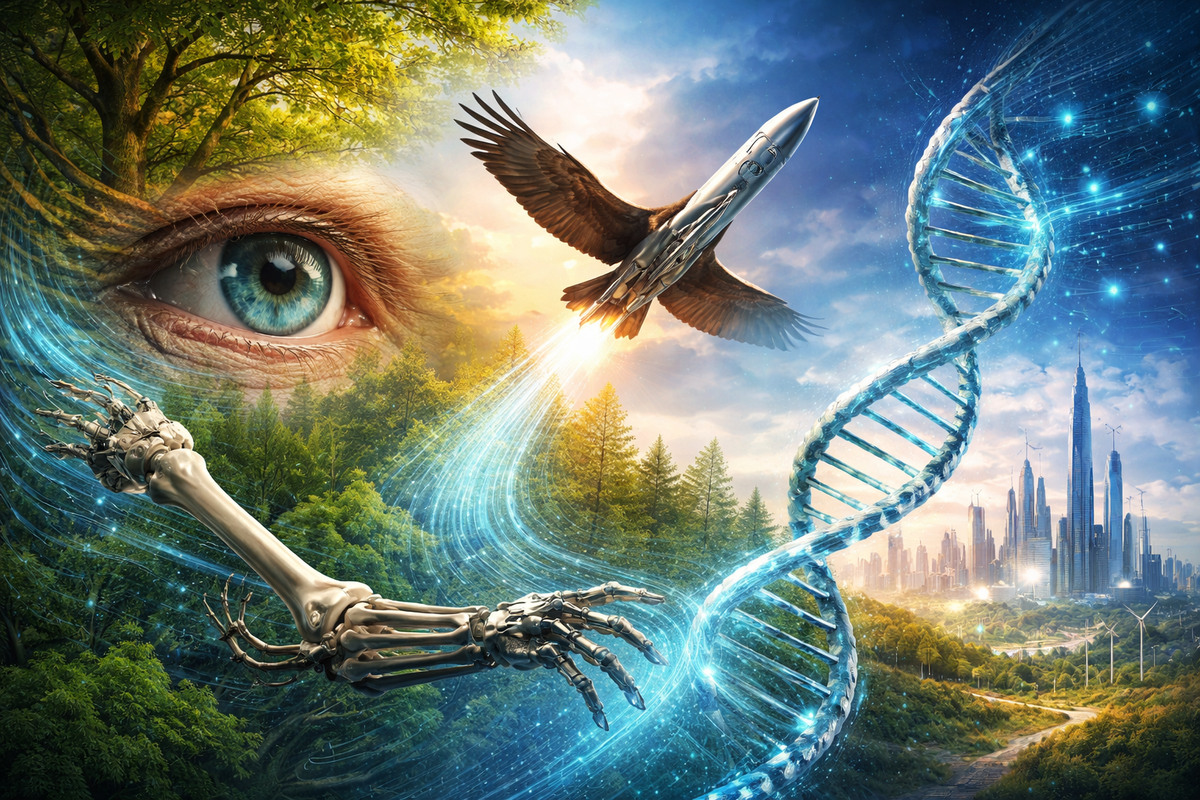
Another chapter in this journey involves biological prototypes. Nature has been conducting research and development for billions of years, and humanity has only recently learned to interpret the results. The human eye provides the initial blueprint for the science of Optics, showing how light can be manipulated. Skeletal structures inspire architectural frameworks, and the nervous system serves as the precursor to electrical communication. Humanity is simply learning to read the results of nature’s long term research.
The narrative then explores the extension of reach. Tools such as spears and levers are not external to human biology but are logical extensions of the human limb. Muscles contract and levers multiply force; once this principle was grasped, mechanical advantage became an inevitable progression. The transition from the arm to the machine is a series of incremental insights rather than a single act of genius. Modern robotic arms are merely the latest footstep in this very broad through line.
The focus then shifts to the amplification of senses. Human vision and hearing are naturally limited, but lenses and microphones allow these senses to extend into new realms. Instruments like telescopes and microscopes are viewed as prosthetics that continue the work of natural sense organs. By treating technology this way, the perceived boundary between biology and machinery dissolves. Sense organs are continued by artificial means to help humanity perceive the universe more clearly.
The study of flight provides an elegant example of mastering natural principles. Birds fly by obeying laws of lift and airflow. Once humans uncovered the science of Aerodynamics, the need to copy feathers vanished. Flight evolved through abstraction from balloons to rockets. Even a rocket is governed by the same laws of motion that propel a squid through the ocean, proving that what seems wild is often just unfamiliar. Successive stages of abstraction allow for the mastery of nature's principles without mimicking its appearance.
Energy use represents a major story in this progression. All living organisms are energy processors, and human inventions follow this same biological pattern. A waterwheel mimics a flowing river, and an internal combustion engine is a replicate of controlled Oxidation, which is a process fundamental to cellular respiration. Civilization’s energy systems are essentially biological metabolism operating on a massive scale. Humanity has simply taken the chemical processes of the cell and expanded them to power cities.
Communication and information storage also have deep natural roots. Long before writing existed, nature solved the problem of data transmission through DNA. This genetic code is a chemical language of incredible fidelity. Printing, radio, and computers all share the same goal of preserving information against the decay of time. The difference between genetic material and a modern computer is a matter of efficiency and scale, not purpose. Information is the thread that connects all forms of life and invention.
Computers are framed as the logical descendants of simple tools. They are the children of counting stones and abacuses rather than mysterious or magical entities. While the human brain is more complex, it is still an information processing organ that obeys physical laws. Computers do not think through magic, and neither do neurons; both systems are bound by the reality of the physical world. The sense of surprise at computer capabilities reflects a former ignorance of how these laws function.
The narrative also looks at feedback and control. Natural systems regulate themselves to maintain stability, such as in the maintenance of body temperature or ecosystem balance. Human inventions like thermostats and autopilots reflect these same principles of Cybernetics. Mastery of feedback allows machines to respond to the world rather than acting blindly, which makes technology resemble life more closely than ever before. This turning point allows machines to behave with a sense of purpose.
A cautionary story is told regarding the speed of progress. Nature evolves slowly, but human invention accelerates. This creates a risk where technological growth happens faster than social understanding. Invention divorced from comprehension is dangerous not because it is unnatural, but because it is premature. When growth outpaces wisdom, an imbalance occurs that can lead to destruction. This is the only part of invention that is truly wild and unpredictable.
The final philosophy is one of responsibility. Invention is not an external force but an expression of humanity itself. Tools reshape society, but society chooses which tools to build. By recognizing technology as an extension of natural processes, humans gain humility. Every machine is a footnote to biology. If humanity continues to study nature rather than trying to defy it, invention will remain an articulate expression of life. The wildness of invention is not lawlessness, but creativity constrained by the reality of the universe.
To understand this entire progression, imagine a person building a house in the middle of a forest. They might think their house is separate from the trees, but the walls are made of wood and the shape is designed to keep out the rain just as a thick canopy does. Human invention is not building something that does not belong; it is simply using the materials and rules of the forest to build a home that can eventually reach the stars.