X Stands for Unknown
This collection features seventeen essays on physics, chemistry, astronomy, and mathematics, celebrating the logical process of uncovering the many pleasurable mysteries of the vast unknown.
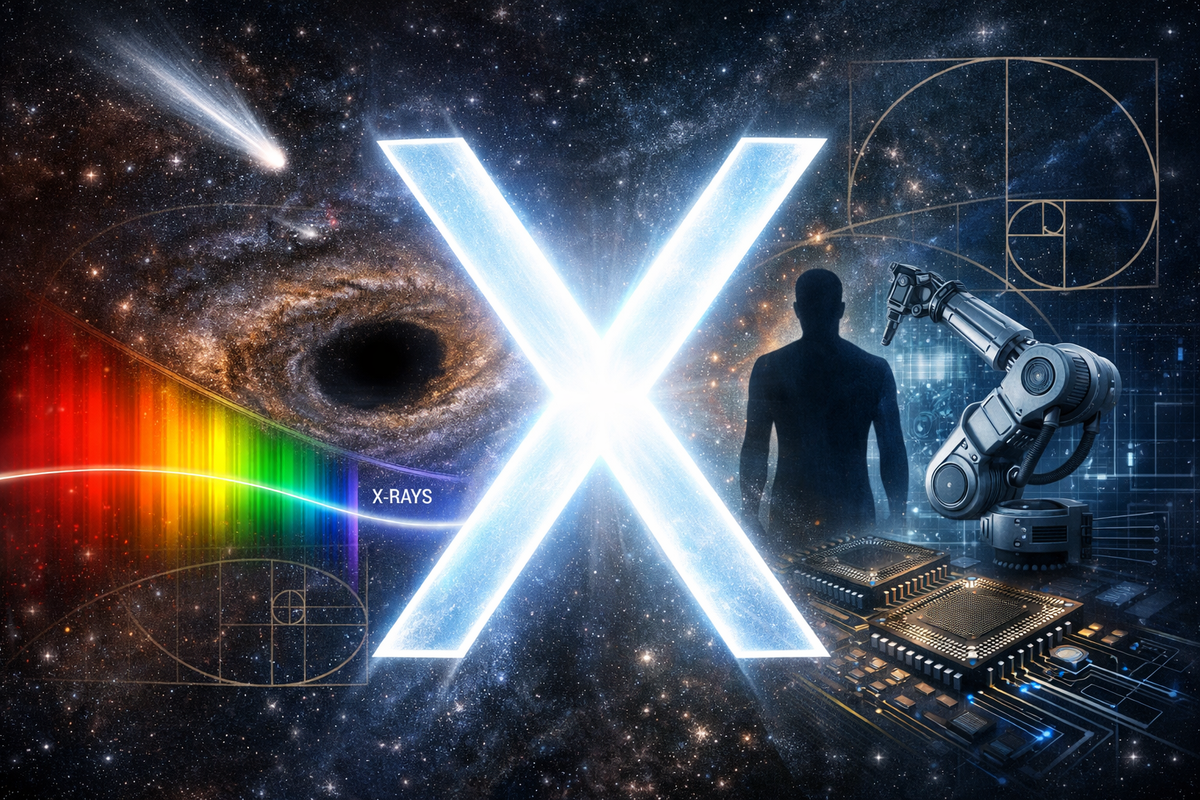
Isaac Asimov maintained that the true delight of science lies in the process of finding out, rather than in the simple possession of knowledge. In his collection of essays, X Stands for Unknown, he presents the history of scientific discovery as a grand narrative where humanity slowly resolves the mysteries of the universe, only to find new and more exciting unknowns at every turn. The story of this book is the story of human reason as it builds from simple observations of light and matter toward an understanding of the vast and complex cosmos. This journey is organized into logical sections covering physics, chemistry, astronomy, mathematics, and the intersection of science and society.
The first part of our story focuses on the physics of the electromagnetic spectrum. The narrative begins with the simple mnemonic Read Out Your Good Book in Verse and Isaac Newton discovering the optical spectrum in 1666. The story builds as scientists like Thomas Young prove light consists of waves through interference fringes, leading William Herschel to discover infrared radiation. Johann Ritter continued this progression into the ultraviolet, discovered through its photochemical effects on silver nitrate. The story reaches a theoretical climax with James Clerk Maxwell, whose equations unified electricity and magnetism into the electromagnetic field, predicting a spectrum spanning roughly 400 octaves. The practical confirmation of these theories follows with Heinrich Hertz, who detected radio waves, and Guglielmo Marconi, who turned them into a communication tool, eventually leading to the birth of radio astronomy by Karl Jansky. Finally, the narrative details the accidental discovery of X rays by Wilhelm Roentgen and the subsequent identification of gamma rays and cosmic rays.
The narrative then shifts to chemistry and the fundamental components of life. Asimov introduces the carbon family on the periodic table, noting the striking chemical similarities between carbon and its larger sibling, silicon. While silicon is far more abundant in the Earth crust, the story explains why life is carbon based. Carbon forms stable, soluble molecules like carbon dioxide, whereas silicon tends to form giant, insoluble lattices known as silicates or stones. Asimov explores the silicone compounds, which are hybrid molecules that serve as vital industrial lubricants. He concludes this chemical saga by showing that while silicon may not form biological life on Earth, it has achieved a different kind of life through semiconductors, transistors, and microchips, leading to the development of artificial intelligence and industrial robots.
The astronomy section expands the scale of the story to the celestial level. He uses Comet Kohoutek and Comet Halley to explain the mechanics of highly eccentric orbits. The story reviews the recorded appearances of the comet, debunking the notion that its arrival predicts historical disasters while demonstrating how human culture has traditionally feared the unknown. A clear lesson on orbital heights follows, specifically the geosynchronous orbit, or Clarke orbit, and how it functions. The narrative tells the dramatic history of novas and supernovas, from Hipparchus and Tycho Brahe to the remnant Crab Nebula. It traces the humbling history of our place in the universe, moving from geocentrism to the discovery that we live in the boondocks of a vast spiral galaxy that likely contains a massive black hole at its center.
In the final chapters, the story addresses mathematics and the defense of reason. Asimov uses the Fibonacci series to find the limit known as the golden section, illustrating the unexpected beauty found within number theory. The book concludes with a defense of the scientific method against biblical literalism and pseudoscience such as astrology. Asimov argues that a scientific theory is not a mere guess but a highly tested, logical framework for understanding reality.
Reviewing the work as a whole, it is a masterpiece of clarity and logical progression. By framing the history of science as a sequence of how we found out, Asimov avoids the dry delivery of facts. His writing style is accessible, using simple words to explain complex concepts like the Planck constant or n type semiconductors. The collection highlights that the unknown is not a source of fear, but a perpetual source of pleasure for the human mind. The story builds from the limited horizons of ancient observers toward a future where silicon based life and carbon based life coexist. It leads to a worldview where reason is the only reliable guide through the darkness of ignorance. Asimov brings erudition and wit to subjects as diverse as the etymology of the word amethyst and the failure of comet pills. This collection serves as a vital reminder that while science is always incomplete, its process is the most powerful tool humanity possesses.
Short summaries of each story of the book follow.
Read Out Your Good Book in Verse explores the colors of the visible spectrum and the history of light as a wave, detailing the discovery of infrared radiation by William Herschel.
Four Hundred Octaves describes the discovery of ultraviolet light and James Clerk Maxwell unifying the electromagnetic spectrum, calculating its total range as approximately 400 octaves.
The Three Who Died Too Soon covers the history of radio waves and radio astronomy, focusing on the contributions of Maxwell, Heinrich Hertz, and Karl Jansky.
X Stands for Unknown details the discovery of X rays by Wilhelm Roentgen, the identification of electrons, and the categorization of alpha particles, beta particles, and gamma rays.
Big Brother compares carbon and silicon, explaining their chemical similarities as members of the same atomic family.
Bread and Stone explores why carbon is the basis for life while silicon is not, focusing on the strength of atomic bonds and the nature of silicates.
A Difference of an E discusses silicones and their industrial uses while speculating on the theoretical possibility of silicone based life.
Silicon Life After All traces the development of the transistor and the microchip, arguing that silicon based artificial intelligence represents a second form of life.
The Long Ellipse is a study of cometary orbits using Comet Halley and Comet Kohoutek to explain how eccentricity defines the paths of celestial bodies.
Change of Time and State Asimov reviews the history of appearances of the comet and debunks the belief that they are omens of disaster.
Whatzisnames Orbit explains the physics of geosynchronous orbits, identifying the Clarke orbit as a unique equatorial path.
Ready and Waiting is a history of novas and supernovas, explaining the collapse of massive stars and the remnants they leave behind, such as the Crab Nebula.
Dead Center chronicles the shift from geocentrism to heliocentrism and eventually to the understanding that the Sun is moving relative to the center of the Galaxy.
Out in the Boondocks Asimov describes how astronomers used globular clusters to locate the true center of the Milky Way, placing our solar system in the galactic suburbs.
To Ungild Refined Gold A mathematical exploration of the Fibonacci series and its relationship to the golden section.
The Circle of the Earth Asimov analyzes biblical passages to show that the ancient authors assumed a flat earth, arguing against biblical inerrancy.
The Armies of the Night In the final essay, Asimov denounces astrology and scientific illiteracy, defining a scientific theory as a rigorously tested logical framework.