Catastrophes
Catastrophes are inevitable processes, not aberrations, driven by complexity, plate tectonics, and cosmic risks. Understanding these forces through reason offers humanity the necessary knowledge and power to mitigate and survive.
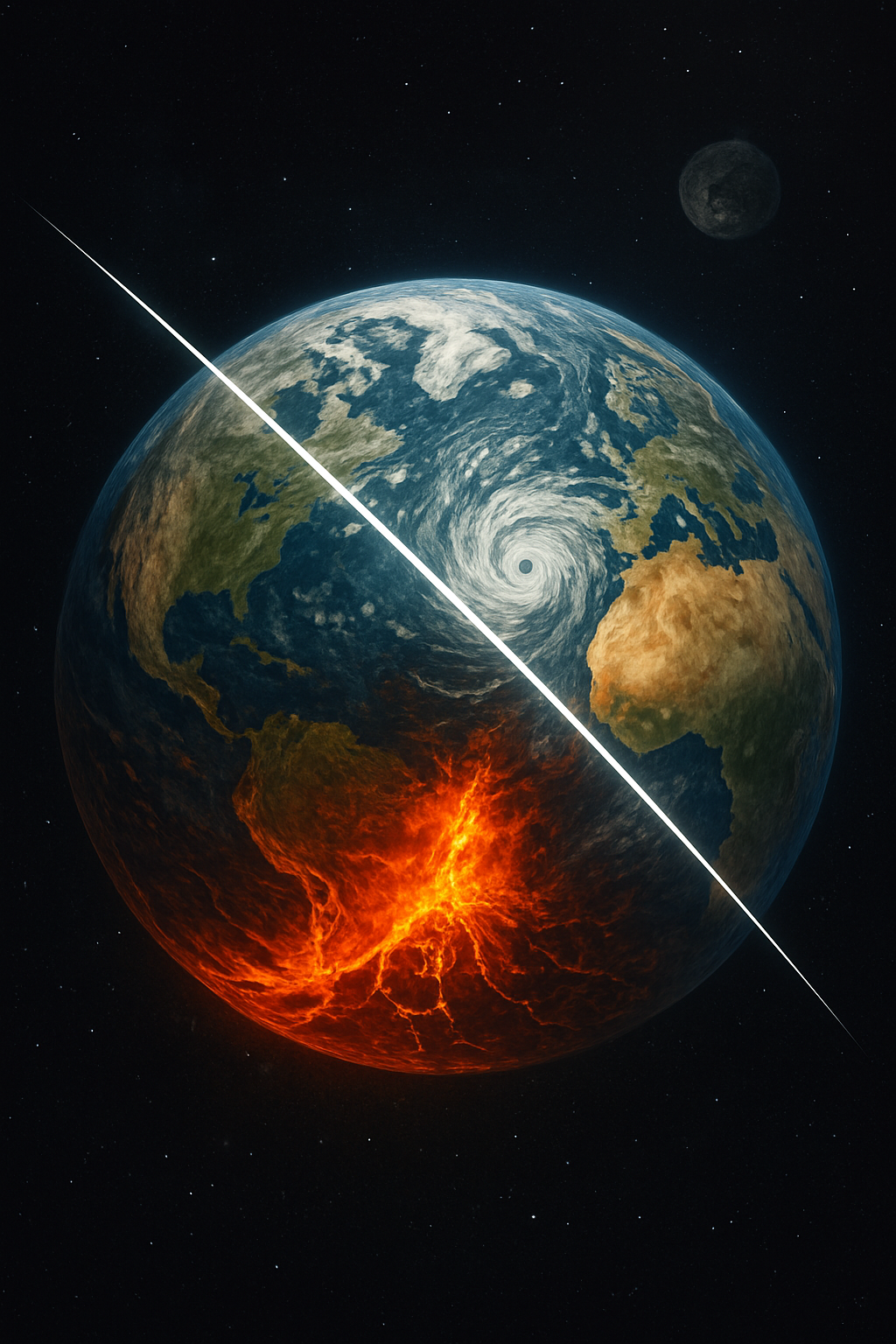
Humanity, forever seeking comfort in predictability, often finds itself face to face with the startling volatility of the cosmos. The great chronicler of our rational age undertakes a survey in Catastrophes!, a book that does not seek to invoke dread, but rather to establish a necessary clarity regarding the disruptive forces that shape our existence. His goal, characteristically, is to replace the mythic fear of divine retribution or random fate with the calm, ordered explanation of natural law. He demonstrates that when we understand the mechanism of destruction, we gain the perspective required for resilience.
The examination begins with a fundamental principle that guides all complex systems, whether a cell or a planet: the potential for catastrophic failure increases with complexity. Yet, in a necessary paradox, highly complex systems—like the Earth itself—also possess superior methods for resisting total breakdown. Catastrophes are thus not merely accidents or glitches; they are essential, built-in features of a dynamic world, without which the specific environment we inhabit could never have taken form. The author sets up the book's intellectual progress by highlighting the great contrast between our learned human expectation of steady stability and the planet's long, volatile history.
The initial gaze is directed inward, deep into the mechanics of the planetary structure. We are first presented with the spectacle of fire, the terrible beauty of volcanism. Stripping away the ancient terror, the author defines a volcano not as an act of godly wrath, but as a mechanism through which the Earth simply relieves internal pressure. The continuous convection of the planet's molten interior, driven over billions of years, must inevitably find points of weakness in the solid crust, leading to necessary venting. Though the destruction wreaked by these events can be enormous, the long-term view reveals a profound duality. These violent events—the same heat that spews lava—are responsible for enriching the soil, shaping atmospheres, and driving the tectonic engine that defines our continents. Volcanic events, in this light, are seen as destructive forces that, across geological time, ultimately fashion the very conditions necessary for life to thrive.
Following the Earth's fiery exhaling comes the jarring reality of the ground grinding its teeth: earthquakes. Here, the ancient human reliance on the ground as the ultimate symbol of stability is betrayed. The author explains these seismic events using the concept of elastic rebound, where sections of crust, locked by friction, accumulate insurmountable strain until they suddenly release energy in devastating waves. Even these sudden, terrifying motions are necessary for planetary dynamism. A planet without plate tectonics is, geologically speaking, a dead planet—a smooth, featureless sphere without the defining structures of mountains and trenches. The catastrophe in this case, the author notes shrewdly, is often not inherent in the earthquake itself, but in the human tendency to build great civilizations in fertile river valleys and coastal regions—places often situated directly along active tectonic boundaries. The event is natural; the resulting disaster is civilizational.
Moving up from the lithosphere, the book's focus shifts to the relentless atmosphere. Weather, in its extreme forms—storms, hurricanes, and droughts—is revealed to be the chaotic, restless interplay of solar energy and planetary rotation. Storms, the author explains, are simply nature's massive, necessary attempt to balance the heat budget, redistributing energy from the warm equator toward the colder poles. They are not aberrations, but essential modes of operation, driven by the same fundamental physics that produces the gentlest breeze; only the scale alters the impact. Modern study reveals that chaos, not divine intention, governs these atmospheric workings, confirming that storms are merely the essential by-products of the planet functioning as a heat engine.
The narrative expands once more, widening the lens beyond the Earth itself to consider the truly overwhelming cosmic stage. While terrestrial hazards strike us as immediate, the universe commands far greater means of upheaval. The probability of an impact event that could destroy a civilization is low across a human lifespan, yet it becomes statistically high across the deep history of the planet. The author views the tracking of near-Earth objects by astronomers as a profound act of rational vigilance, replacing paralyzing fear with action. If a catastrophe is possible, the antidote, always, is knowledge. Though rarer threats, like gamma-ray bursts, are mentioned to underscore the universal truth that the cosmos is not specifically tailored for human comfort, the emphasis remains on applying reason to mitigate the known risks.
Catastrophe, we learn, is not solely geological or atmospheric, but also woven into the history of life itself. The book addresses the grand waves of mass extinction that have repeatedly reshaped life on Earth. These periods—the Permian, Triassic, Cretaceous—are presented not as ecological failures, but as essential mechanisms of environmental renewal. The author points to the key, opportunity-driven principle of evolution: catastrophic events eliminate the dominant, making ecological room for novel forms. The very rise of the mammals, for instance, depended entirely on the disaster that ended the dinosaurs' long dominance. Destruction, viewed across deep time, proves to be the indispensable engine of renewal.
Finally, having chronicled the indifferent, relentless processes of nature, the book pivots sharply to a consideration of those catastrophes entirely within the realm of human agency. Dangers such as nuclear conflict, environmental degradation, and resource depletion are distinguished from the planetary movements that cause earthquakes. The author is rational yet clearly concerned, emphasizing that these specific catastrophes are unique because they are fundamentally avoidable. Unlike the inevitable laws governing a storm, the folly that leads to environmental destruction is purely optional. Because the tools of such widespread, modern destruction are human-made, the responsibility and the means of control must also rest solely with human planning and prudence.
In this final, encompassing perspective, the author argues that instability is not an anomaly but an inherent part of the planet's functional fabric. The ultimate task facing intelligent life is not the impossible hope for a universe of perfect equilibrium, but the capacity to understand, anticipate, and, critically, mitigate the effects of inevitable disruptions. Knowledge serves as the fundamental shield. Science grants us both the necessary perspective to accept the universe's harsh truths and the power to diminish the specific vulnerabilities that once made natural disasters seem apocalyptic. The book concludes not with despair, but with a deeply Asimovian optimism: while the universe may be objectively harsh, the consistent, rational application of intelligence can render it navigable. Catastrophes are part of the story, but human ignorance need not be. The book leads inevitably toward the same conclusion found in all the author's great narratives: that only applied reason offers a pathway to long-term survival and true command over our destiny.