Comets
Asimov chronicles humanity's logical journey from viewing comets as terrifying omens to understanding them as orderly, icy travelers governed by universal natural laws.
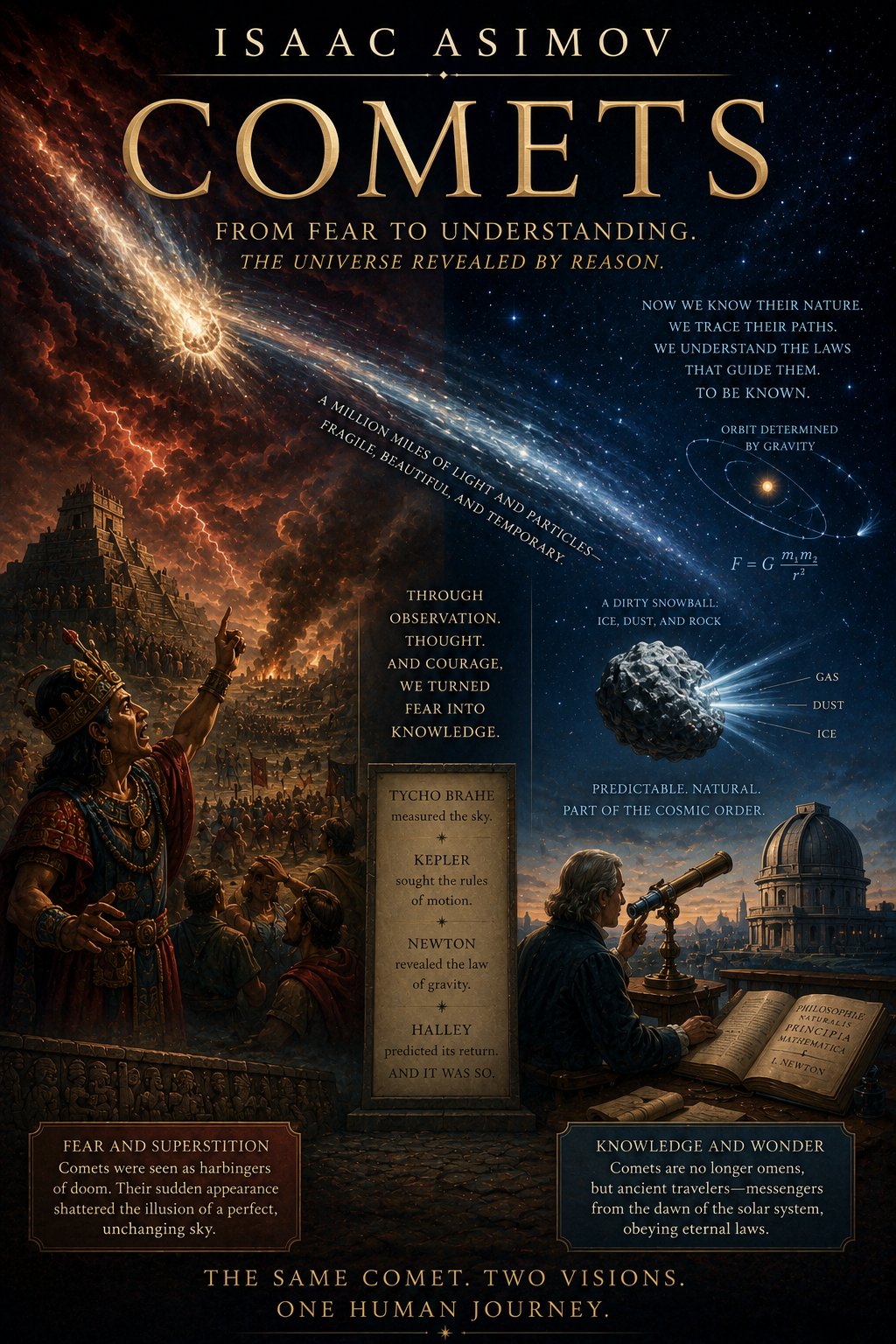
To understand Isaac Asimov’s work on comets is to understand the grand arc of human thought itself. In this book, Asimov does not merely present a collection of astronomical data; he crafts a narrative where the protagonist is the human mind and the antagonist is the fear of the unknown. For those familiar with Asimov’s broader body of work, from the Foundation series to his countless essays on science, this approach is a hallmark of his genius. He views history as a slow, often difficult, but ultimately triumphant march toward reason. The story he tells here is building from a place of primal terror and leading toward a future where humanity stands as an informed observer of a vast and ancient universe.
Asimov begins by establishing the setting: a world where the heavens were a source of both awe and deep anxiety. Throughout most of history, comets were not seen as part of the natural order. To the ancient observer, the stars were fixed and the planets followed predictable paths, but comets were erratic intruders that appeared without warning and vanished just as strangely. This unpredictability made them symbols of doom. Asimov explains with his characteristic logic that this fear was not a sign of ancient stupidity, but a natural human reaction to a phenomenon that seemed to violate the rules of a supposedly perfect and unchanging sky.
As we progress through the narrative, we see the first stirrings of a different perspective. This leads us into the specific episodes that Asimov treats like mini stories, each one a stepping stone in the development of scientific law.
The Fear of the Sky In the earliest chapters, humanity is portrayed as a collective character living in a state of celestial superstition. For kings and commoners alike, a comet was an omen, a divine interruption in the sky that signaled war, death, or disaster. Asimov illustrates that because civilizations lacked the tools of scientific astronomy, they had no choice but to interpret these sudden lights through the lens of their own anxieties. This story is one of vulnerability, where the lack of understanding creates a world where even the stars can be terrifying.
The Ordered Universe The narrative then shifts to the era of Greek philosophers and the long centuries that followed. This is a story of intellectual debate. Scholars struggled to decide if comets were atmospheric events, essentially weather occurring near Earth, or if they were truly celestial objects belonging to the heavens. This was a conflict between different ways of seeing the world. Without enough evidence to settle the matter, the mystery of the comet remained a point of philosophical contention for nearly two thousand years.
Tycho Brahe Measures the Sky The story reaches a major turning point with the arrival of Tycho Brahe. This episode functions as a scientific detective story. Brahe did something simple but revolutionary: he carefully measured the position of a comet against the stars behind it. By doing so, he proved that the comet was much farther away than the Moon. This measurement did more than just locate an object in space; it shattered the old idea that the heavens were unchanging and perfect. It was the first time the dynamic nature of the universe was proven through observation.
Kepler and the Problem of Motion Johannes Kepler struggled to understand how comets moved. Unlike planets, which followed orderly paths, comets seemed erratic. Asimov carefully explains how the search for their trajectories became part of a larger effort to uncover the laws governing the solar system. Science advances here not through sudden revelation, but through persistence.
Newton and the Return of Halley’s Comet Perhaps the most elegant story in the book involves the collaboration between Isaac Newton and Edmond Halley. Newton provided the laws of gravity, showing that the same forces that pull an apple to the ground also govern the stars. Halley then took these laws and applied them to comets. By looking at records of past comet sightings, he realized that what people thought were different objects were actually the same comet returning over and over again. He made a bold prediction that the comet would return in the future. When it did, the fear of the comet was replaced by the power of prediction. The intruder had become a neighbor.
What a Comet Is Made Of As the history of discovery moves into the modern era, the focus changes from where a comet goes to what a comet is. Asimov describes the transition from seeing comets as fiery objects to understanding them as bodies made of ice, dust, and frozen gases. He explains the physical process by which the Suns heat causes the comet to release the material that forms its spectacular tail. This is a story of composition, revealing that the most dramatic sights in the sky are often made of the simplest materials.
The Tails of Comets In this section, Asimov focuses on the visual spectacle of comets. He describes tails that stretch for millions of miles, yet they are astonishingly thin. A comet appears magnificent not because it is dense, but because it reflects sunlight across enormous distances. Asimov delights in this contrast. The great celestial spectacle is, in physical terms, extraordinarily fragile. This story emphasizes that beauty in the universe does not require density or mass, but simply the right interaction with solar radiation.
Comets and Catastrophe The tone of the book darkens as Asimov explores the story of collisions. He acknowledges that throughout Earths history, comets and other objects have struck the planet with devastating results. However, true to his rationalist nature, he refuses to be sensationalist. He presents this not as a reason for new terror, but as a part of the natural history of the solar system. Space is vast, and while impacts are part of the story of life and death on a planetary scale, they are rare events that can be understood and studied.
The Origin of Comets The final mini story expands the scale of the book to the very edge of the solar system. Scientists began to wonder where comets come from, leading to the theory of distant reservoirs of ice far beyond the known planets. Asimov presents comets as messengers. Because they have been frozen in the cold depths of space for billions of years, they contain the original materials from which the solar system was formed. To study a comet is to look back at the beginning of our own history.
Visitors from the Edge of the Solar System The later chapters give comets a new identity. They are no longer intruders or anomalies. They become messengers from the earliest history of the solar system, preserving material from its formation billions of years ago. To study a comet is, in a sense, to examine a remnant of the beginning.
In reviewing this work, it is clear that Asimov has achieved something beyond a simple science text. He has written a biography of a human idea. The book is a review of our own progress. He organizes the material so that we, as readers, feel the same shift from dread to delight that astronomers felt over the centuries. He shows us that when we understand the laws of the universe, the universe does not become less beautiful; it becomes more so.
Asimovs style remains perfectly clear throughout. He uses simple words to describe complex orbits and logical steps to explain why a tail always points away from the Sun. He avoids the jargon that often alienates readers, choosing instead to focus on the human narrative of discovery.
The book concludes with a powerful reflection on the human mind. The story of comets is building toward a time when we no longer see the universe as a series of frightening accidents. Instead, we see it as an orderly structure that we are capable of understanding. Asimovs work is a celebration of that capability. He leaves us with the realization that we have transformed a sign of disaster into a symbol of our own ability to reason. In the end, the comet is a bridge between the ancient past and a future of infinite discovery.