Isaac Asimov Presents the Great SF Stories, 14
This mature anthology explores societal and psychological consequences, shifting from simple invention to analyzing how technology transforms human character and the future of our civilization.
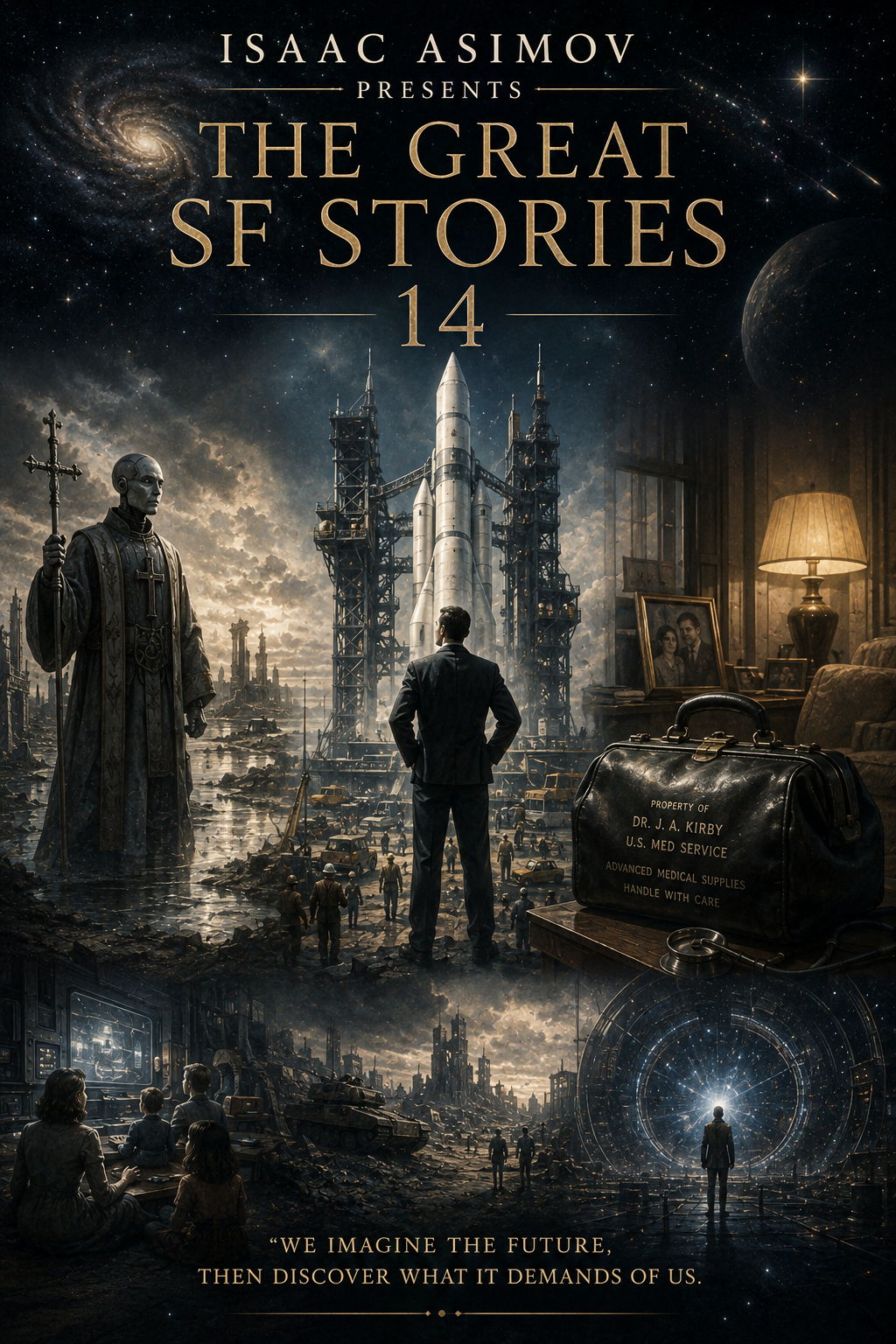
Science fiction is a genre that has, over the decades, undergone a process very much like growing from childhood into adulthood. In its earliest days, the stories were often filled with the wide eyed wonder of invention and the simple excitement of exploring the unknown. There was a sense that a new machine or a trip to a distant planet was an end in itself. However, by the time we reach the era represented in Isaac Asimov Presents the Great SF Stories, 14, the genre has reached a profound state of maturity. It has moved beyond the what if of technology and begun to ask the much more difficult question of then what? This volume serves as an organized examination of modernity and consequence, showing a genre that has learned to analyze change rather than just imagine it.
The journey through this collection begins with a shift toward the intimate and the unsettling. In the story Coming Attraction by Fritz Leiber, we see a future that is not grand or shiny, but rather one that feels uncomfortably close to home. The world has undergone social and technological upheavals, resulting in a culture that is both recognizable and deeply distorted. Leiber does not rely on long explanations of how the world changed; instead, he allows the reader to feel the atmosphere through the behavior and conversations of the characters. It is a story about the human consequences of a shifting society, where the spectacle of the future is replaced by the reality of human behavior.
As we move forward, we encounter a different kind of realism in The Man Who Sold the Moon by Robert A. Heinlein. In the past, space travel might have been treated as a miracle or a feat of pure scientific genius. Heinlein, however, treats it as a massive logistical problem. The central figure is not a scientist, but a strategist and organizer who must navigate the complex worlds of economics, politics, and persuasion to reach the lunar surface. This story marks a turning point where the future is no longer something that simply happens; it is something that must be built through persistence and practical effort.
The collection then moves into the realm of ambiguity with To Serve Man by Damon Knight. This narrative acts as a cautionary counterpoint to the idea that advanced intelligence or alien arrival will naturally lead to human benefit. When aliens arrive with apparent goodwill and solutions to the worlds problems, the story focuses on the danger of human assumptions. It suggests that our own interpretations can often blind us to deeper, perhaps less benevolent, truths. It is a reminder that intelligence does not always equate to morality.
The focus then shifts toward the relationship between individuals and the power they hold. In The Little Black Bag by C. M. Kornbluth, a piece of advanced medical technology from the future finds its way into the present. While the tools inside are incredible, the story is actually a study of character and responsibility. The technology acts as a catalyst that reveals the nature of the people who find it. It highlights the idea that the outcome of any scientific advancement depends entirely on the hands that wield it.
Logic and faith are brought into a quiet conflict in The Quest for Saint Aquin by Anthony Boucher. Here, a robot priest travels through a broken world, seeking spiritual meaning within a rational framework. The story explores whether rational systems can coexist with the human longing for something beyond the physical. It reinforces a recurring theme in the anthology: science fiction is not just about the machinery we build, but about the mental and spiritual structures we use to understand our existence.
The concept of the other is examined through a very different lens in Born of Man and Woman by Richard Matheson. By telling a story from an unusual and isolated perspective, Matheson turns the monster into a mirror for the reader. The emotional weight of the story comes from recognizing that what we fear as different is often just something we have failed to understand. It suggests that our boundaries of normality are often thinner and more fragile than we would like to admit.
Satire provides a sharper edge to the collection in The Liberation of Earth by William Tenn. Humanity finds itself caught in the middle of a conflict between two vastly more powerful alien forces, both of whom claim to be acting in Earths best interest. The story uses exaggerated humor to expose a very real and precise logic: how massive political and military systems can reduce individual human lives to mere abstractions. It is a critique of how the structures we create to protect ourselves can ultimately consume us.
The domestic sphere is not safe from these examinations either, as seen in The Veldt by Ray Bradbury. In this tale, a house that can provide for every possible need ends up eroding the essential bonds of a family. Bradbury uses his lyrical style to ask a very pointed question about convenience and responsibility. It suggests that when we allow machines to replace our roles as parents or providers, we may lose the very things that make us human.
Societal decline is revisited with a biting perspective in The Marching Morons by Cyril M. Kornbluth. The story looks at a future where there is a dangerous imbalance between the complexity of civilization and the wisdom of the people living within it. It serves as a warning that scientific progress does not automatically lead to a more enlightened society. Without a corresponding growth in human wisdom, technical advancement can actually lead to a slow decay of the structures that sustain us.
Finally, the collection reaches toward the cosmic again with The Nine Billion Names of God by Arthur C. Clarke. This story combines a very methodical, logical task with a conclusion that evokes a sense of awe. Clarke shows that even the most grounded and rational processes can lead to something immense and beyond full human comprehension. It is a fitting end to a volume that values logic while still acknowledging the vastness of the universe.
When viewed as a whole, these stories form a mosaic of the human condition. Isaac Asimovs role as an editor was to arrange these works so that they reflect off one another, creating a narrative of modernity. We see a progression from exploration to introspection. The writers in this volume are no longer just asking if a certain future is possible; they are asking what that future will do to the character of humanity.
The anthology concludes with a sense of awareness rather than certainty. It suggests that while our imagination is powerful enough to change the world and reach the stars, we are still carrying our oldest habits and fears with us. The future will not be defined by the gadgets we invent, but by how we choose to use them and what we become in the process.