How Did We Find Out About Volcanoes
Earth's volcanoes"outbursts of a pent-up planet" are driven by internal heat and radioactivity, evolving from ancient myths (Thera, Vulcan) to modern tectonic plate understanding.
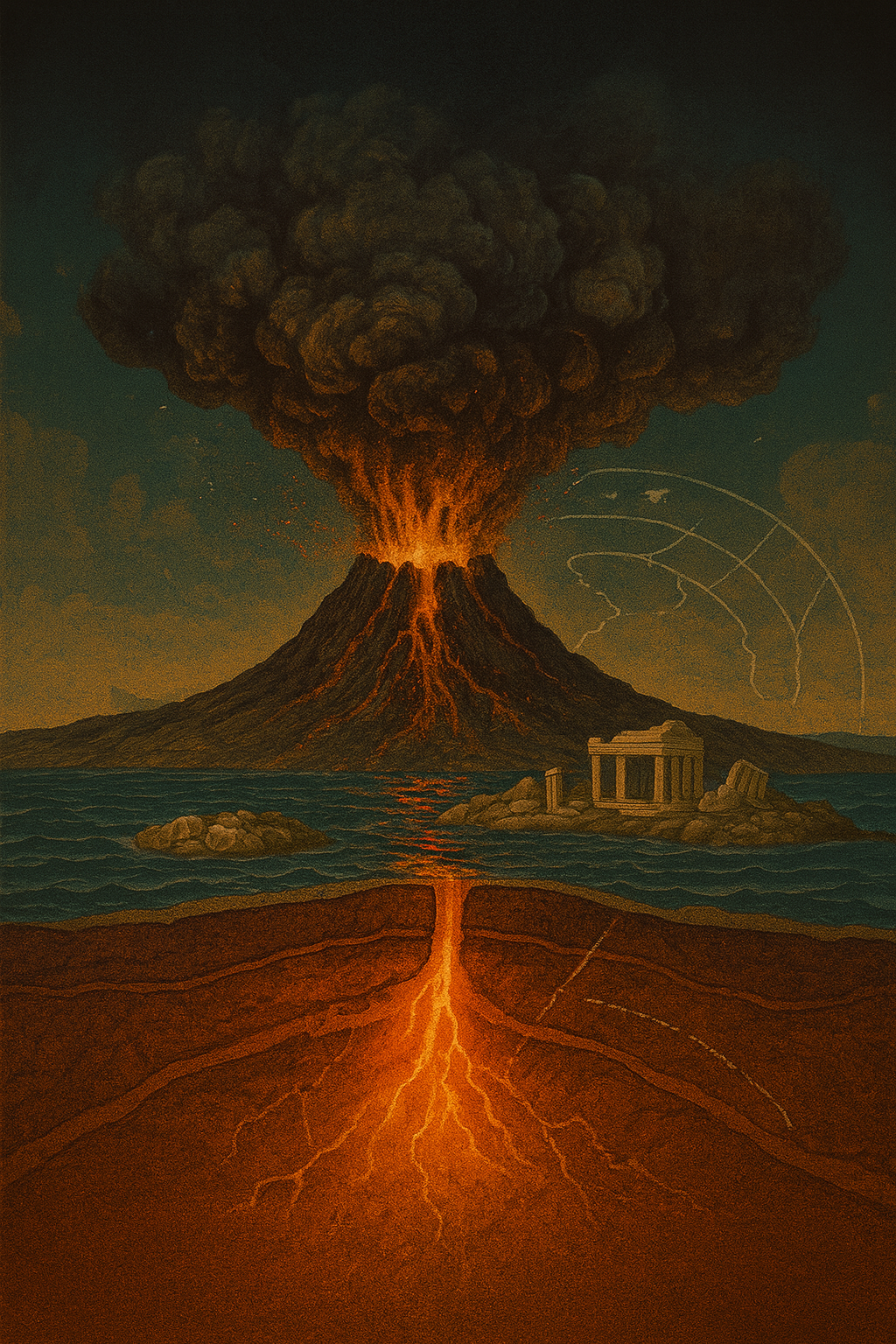
The great story of how humanity came to understand the fiery outbursts of our own planet is a narrative tracing the path from fearful legend to careful calculation. This book presents that journey with the characteristic clarity and logical progression of Isaac Asimov, building a clear foundation of historical ignorance before systematically tearing away the mystery with simple, direct science. The true story, in this case, is the story of discovery itself, demonstrating how a powerful natural phenomenon, operating on a cosmic scale, slowly yielded its secrets to human curiosity.
The narrative logically divides itself into several distinct chapters, each detailing a phase in our understanding of these "outbursts of a pent-up planet".
Explosion at Thera
The story begins in the cradle of European civilization, the islands of the Aegean Sea, focusing particularly on the large island of Crete, a land that developed an important, peaceful culture as early as 3000 B.C.. Cretan civilization spread across the islands, including the Cyclades, eventually reaching the southernmost island known as Thera. Thera itself was a rich and civilized place for five hundred years, beginning about 2000 B.C., shaped like a solid circle—a large mountain rising from the Aegean floor. The book then describes how, about 1500 B.C., this mountain, which was not an ordinary peak, suddenly and violently exploded, scattering itself into the upper air in a vast cloud of dust and ash. This cataclysm left a massive hole in the sea, changing the island’s shape forever. The resulting shaking of the seabed created enormous waves, known as tsunamis, which crashed upon the shores of nearby lands, including Crete, causing terrible damage to cities and contributing significantly to the destruction of the Minoan civilization. This opening chapter shows how a single geological event can alter the course of human history, leaving only a faint echo in later Greek legends of great floods or lost cities like Atlantis.
Ancient Thoughts about Volcanoes
Having set the stage with historical destruction, the book pivots to how the ancient mind attempted to make sense of the steam, glow, and overflowing rock, or lava. The Romans were particularly impressed by the island of Vulcano, located near Sicily, which gave its name to all such mountains, calling them volcanoes after the god of fire, Vulcan. This early understanding was steeped in mythology; people assumed supernatural beings were at work inside the fiery peaks. The Greeks told tales of giants, like Enceladus, imprisoned under Mount Etna, whose groans and wrath caused the mountain to rumble and erupt. Even the sight of hot, liquid rock forced philosophers to conclude there must be heat under the earth’s surface. Early scientific thinkers, such as Aristotle and Strabo, looked for natural causes, hypothesizing that hot, imprisoned air under the crust created vibrations (earthquakes) and sought release through mountains, acting as safety valves. The book further traces how the visual image of volcanoes—with fire, heat, and the choking smell of sulfur, or "brimstone"—became permanently linked to the concept of subterranean punishment, leading to the idea of a fiery Hell. This section details the vital shift from godly explanation to physical inquiry, even if the early hypotheses were flawed.
Great Volcanic Eruptions
The narrative next explores the recurring and often disastrous pattern of volcanic activity, emphasizing that ancient peoples did not fully grasp the danger of mountains that had long been quiet. The most famous example from the Roman era is the explosion of Mount Vesuvius in A.D. 79, which had long been mistaken for an ordinary mountain. The eruption engulfed the surrounding towns, including Pompeii and Herculaneum, killing perhaps twenty thousand people. The book then expands its scope to vast eruptions outside of Europe, demonstrating the world-altering scale of these events. The 1783 eruption of Laki in Iceland, for instance, spewed ash and sulfur dioxide, killing domestic animals and crops, resulting in the death by starvation or disease of one-fifth of the island's population. More catastrophic still was Mount Tambora in Indonesia in 1815, which blew off four thousand feet of its height and hurled thirty-six cubic miles of rock into the air. This dust cooled the earth's temperature for a year, leading to the "year without a summer" far across the globe. Krakatoa, exploding sixty-eight years later, produced a noise heard thousands of miles away and generated enormous tsunamis. The story concludes this chapter of destruction by mentioning deadly modern events in the Western Hemisphere, such as the 1902 eruption of Mount Pelée in Martinique, where red-hot gases quickly killed thirty-eight thousand people in the capital city of Saint Pierre. The recent reawakening of Mount Saint Helens in 1980 further confirms that the danger of a long-dormant volcano is perpetual. This section serves as a meticulous catalog of the planet's explosive power, reinforcing the need for scientific understanding.
The Heat Below Our Feet
With the historical evidence of volcanoes firmly established, the book turns to the modern science that answers the ultimate question: what causes them? The text confirms the ancient suspicion that the earth is intensely hot inside, citing evidence from deep mines where the temperature increases with depth. The temperature of the inner core is described as being almost as hot as the surface of the sun. The book explains the origin of this internal fire using the accepted theory that the Earth formed billions of years ago from colliding cold particles of gas and dust; the energy of this violent accumulation created a white-hot planet. The crucial mystery—why the Earth hasn't cooled down after billions of years—is explained by two factors: rock acts as an insulator, keeping the heat trapped, and, most importantly, radioactivity. Radioactive substances like uranium decay slowly and constantly generate heat within the planet's mantle, ensuring that the Earth's interior remains hot and able to produce volcanoes for billions of years into the future. Finally, the book addresses why volcanoes are located only in specific areas, introducing the concept of the Earth's crust being divided into massive, slowly shifting tectonic plates, dragged by currents of warm, flowing rock in the mantle. Volcanoes form at the weak points where these plates meet, such as the "Ring of Fire" around the Pacific Ocean. This comprehensive chapter demystifies the cause, transforming the volcano from a supernatural scourge into a predictable consequence of internal planetary forces.
Volcanoes on Other Worlds
The final chapter steps away from Earth to contextualize our planet’s geology within the solar system. It is logical to expect that other large bodies, which were once hot, also experienced volcanic activity. The book notes that the Moon and Mars show clear signs of past volcanism, though these are now extinct, such as the massive Olympus Mons on Mars. However, modern space exploration revealed that Earth is not the only world currently erupting. The narrative climaxes with the astonishing discovery made by the Voyager 1 probe: the satellite Io, orbiting Jupiter, is volcanically active. This activity is generated not by internal radioactive heat, but by the gravitational squeeze and pull (tidal heating) exerted by Jupiter, which heats Io's interior sufficiently to produce eruptions of ash and sulfur vapors. This concluding perspective broadens the reader’s view, confirming that volcanism is a fundamental geological process common throughout the cosmos, even if Earth remains the primary focus of our concern.
The book is a classic example of Asimov’s scientific popularization, simple yet rigorous, providing a complete historical and technical understanding of a complex topic. It builds a powerful argument that knowledge, though not a cure, is the only means of preparing for the inherent danger that remains: despite knowing why volcanoes erupt, predicting when remains a challenge. The ultimate lesson is that humanity is locked in a long-term geological relationship with a living, fiery planet, a relationship demanding perpetual study and respect. It is an intellectual journey, tracking human curiosity from superstitious terror to the sophisticated understanding of planetary mechanics.