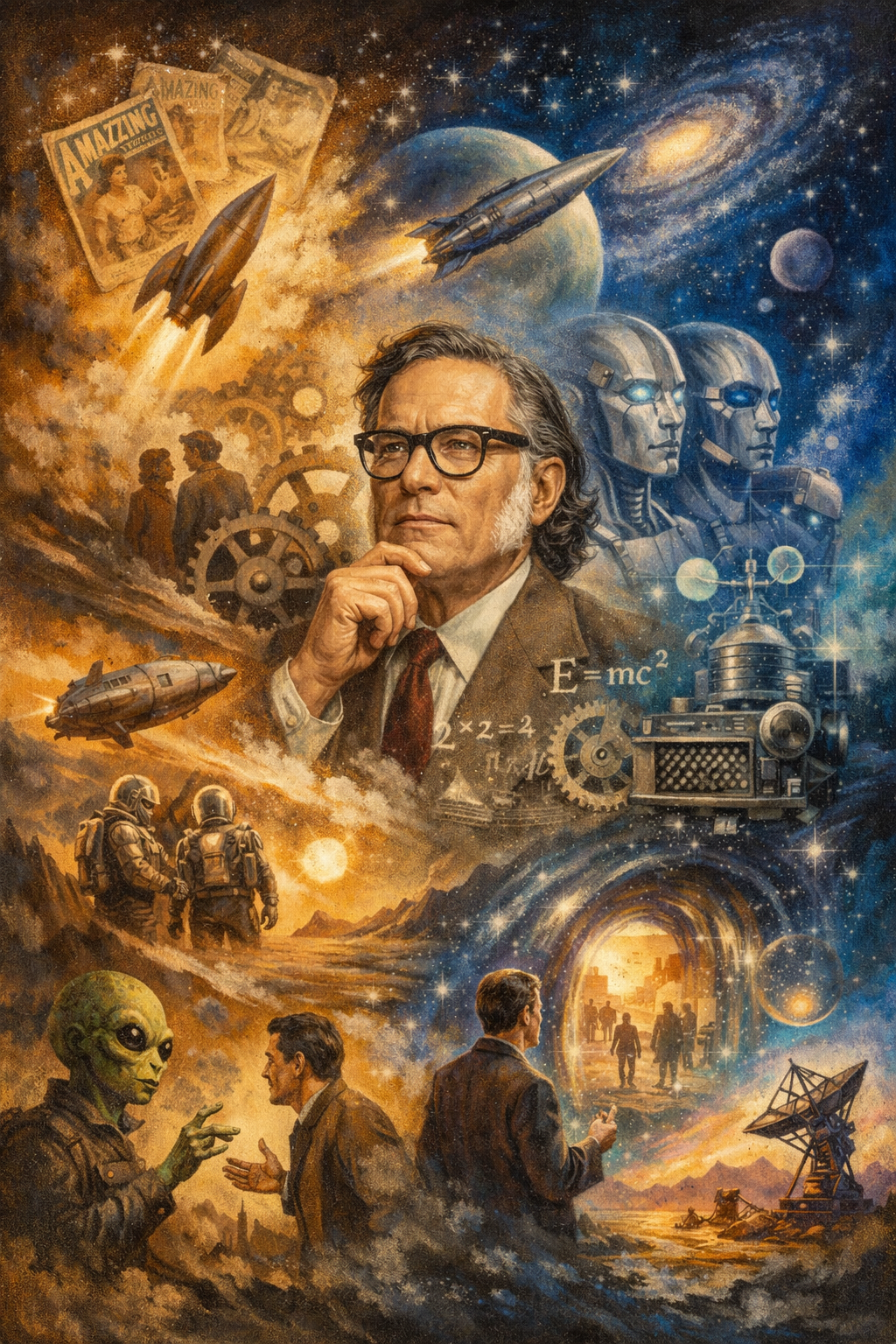
Isaac Asimov Presents the Great SF Stories, 6
This anthology features thirteen stories from 1944 exploring interstellar travel, nuclear fission, cyborgs, and evolution, marking the genre maturing into a logical analysis of humanity.

The year 1944 was a period of immense growth for the genre that produced what has been called gold from the pulps. This sixth volume of a storied anthology represents science fiction maturing into a literature of logical and bold ideas. It was a time when the genre shifted focus toward the human condition and the perception of the place of humanity in the universe.
A.E. van Vogt contributed a foundational tale of interstellar travel called Far Centaurus. The story builds from the isolation of deep space as a crew uses a drug called Eternity to survive a voyage lasting centuries. It leads toward a clear and logical look at the high price of being a pioneer, specifically the irony that progress in the era left behind will always move faster than those traveling the stars.
Cleve Cartmill wrote a controversial story titled Deadline which build from a mission to destroy a weapon of history in an alien capital. The narrative used specific knowledge of nuclear fission to speculate on a devastating device containing U 235. It leads to a profound question of whether a race can survive its own technical ingenuity after the fictional science mirrored the then top secret Manhattan Project.
Leigh Brackett introduced a haunting atmosphere in The Veil of Astellar which feels like a blend of space opera and hard boiled detective traditions. The story builds from the perspective of a man serving a world outlawed from space and time while facing soul shattering guilt. It leads toward a final attempt at redemption through self sacrifice while exploring the cost of choosing biological immortality over a human life.
Fritz Leiber presented a world where defined insanity has become the norm in his story titled Sanity. The narrative builds around a sane man who tries to bring rationality back to government in a society where defined mental health has shifted. It leads to the realization that an adherence to an ancient norm makes one the ultimate outlier requiring treatment.
John R. Pierce wrote a profound tale called Invariant concerning a man named Homer Green. The story builds from a form of biological immortality achieved through perfect regeneration experiments. It leads to the tragedy of a life that can never again experience change or growth because the patterns of the brain reform in an exact and invariant pattern.
Clifford D. Simak contributed three foundational stories that trace a logical progression of human withdrawal. The first story, City, builds from the development of nuclear power and hydroponics. It leads toward the slow death of urban centers as the city as a human institution outlives its usefulness.
The second Simak story, Huddling Place, explores the psychological consequence of this withdrawal. It builds from a deep seated agoraphobia that prevents a man from leaving his home. It leads to a poignant exploration of how tradition and possessions can become a psychological campfire that chains a mind.
The final Simak entry, Desertion, takes withdrawal to its ultimate conclusion on the planet Jupiter. The story builds from a refusal to return to the squalor of human existence. It leads to the realization that an alien body offers a life much richer than the poor equipment of human senses.
Fredric Brown wrote Arena which is a famous account of single combat. To prevent total war, a higher entity places a human and an alien outsider in a closed environment to settle a conflict. It builds on the necessity of courage and brainpower over physical strength and leads to a resolution that preserves a civilization.
Lester Del Rey examined the last normal man in a world of superior beings in the story Kindness. The narrative builds from a protagonist who desires to escape the kindness of a race that has mastered intuition. It leads to an exploration of what it means to be an evolutionary relic in a world that only has pity for your kind of thinking.
Lewis Padgett wrote When the Bough Breaks which examines the domestic side of the super child. Future descendants return to the past to educate an infant whose brain is capable of grasping concepts through mutation. It builds from the mounting tension of parents who find themselves irrelevant and leads to the chilling realization that parental tolerance has its limits.
Theodore Sturgeon created a masterpiece of man versus machine in Killdozer. An ancient alien electron field possesses heavy equipment on a remote island. The story builds through the growing terror of a crew being hunted by a machine with a will of its own and leads to a struggle for survival against an implacable foe defeated only through electronics.
C.L. Moore wrote No Woman Born which tells the story of a famous dancer whose body is destroyed but whose brain is saved. The story builds from the creation of a sleek metal shell and moves toward her return to the stage. It is a study of the cyborg concept and leads toward a future where a human ego must eventually transcend its origins.
These works together show that 1944 was a year where science fiction focused on logical ideas centered on the human condition. These authors took the gold from the pulps and forged a legacy that remains unbreakable.