Mythical Beasties
This anthology uses mythical creatures as mirrors for humanity, progressing from playful humor to science fiction to examine our deepest fears, ambitions, loneliness, and dreams.
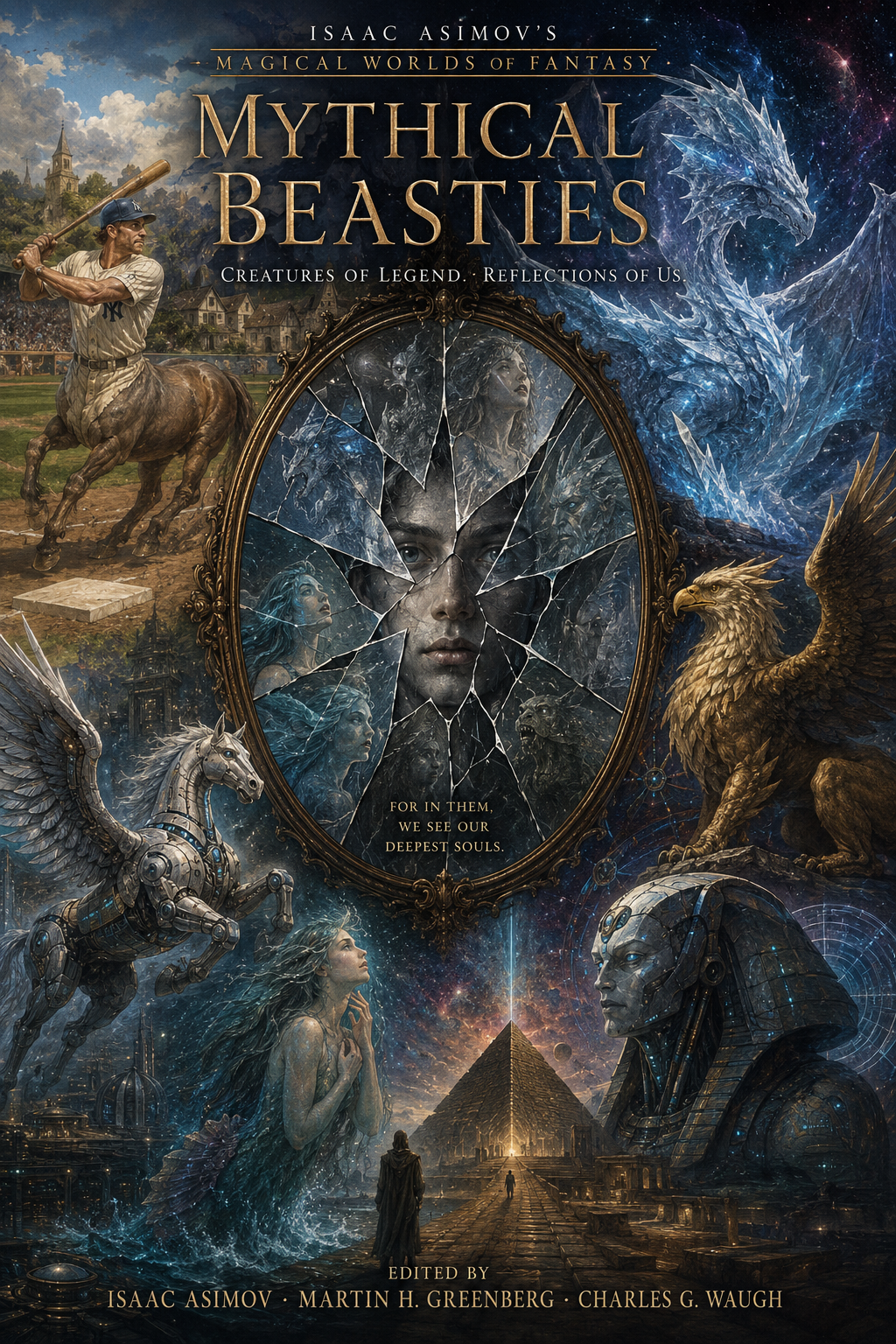
Imagine a great library where the boundaries between what is real and what is imagined begin to fade away. Isaac Asimov, a man who spent his life celebrating the power of the human mind and the steady progress of science, sits at a desk with a book called Mythical Beasties. This book is not a single story but a collection of many voices, all brought together to show us that the monsters we imagine are actually reflections of ourselves. Asimov believed that fantasy is not a way to hide from the truth but a different way to look at it. In this anthology, he and his fellow editors have gathered tales that move from light humor into deep sadness, and finally into the world of the future.
The journey begins with Centaur Fielder for the Yankees, a story that builds from the funny and impossible idea of a creature from myth playing a modern game of baseball. It leads us to think about how our society treats those who are different. The centaur is a talented athlete, but he is also a figure who stands alone, caught between two worlds. This story shows us that even when we admire someone for their skills, we often fail to truly accept them if they do not look or act like everyone else. It is a clear look at the quiet loneliness that comes with being unique in a world that values the ordinary.
As we move further into the collection, the tone changes with The Ice Dragon. This story builds from the cold and silent beauty of winter, where the dragon is not a monster of fire but a force of nature itself. It leads to a very moving exploration of the connection between a young girl and the world of snow and ice. Through her eyes, we see that the most magnificent things in life are often the most dangerous. The story teaches us that growing up means learning to live in a world where beauty and sadness are often tied together.
In Prince Prigio, the narrative builds from the familiar rules of old fairy tales where magical gifts are given to royal children. It leads to a very clever look at how Logic can be a more powerful tool than a sword. The prince is a man who thinks too much for his own good in a world that only wants heroes to be brave and strong. It is a satirical tale that shows us how difficult it can be to use your brain in a society that prefers simple action over careful thought.
The mirror turns dark when we reach The Gorgon. This story builds from the ancient Greek legend of a woman who can turn men into stone with a single look. It leads to a tragic view of how isolation and misunderstanding can create a monster. The creature is not evil by choice, but she becomes monstrous because that is how the world insists on seeing her. It is a powerful reminder that we often fear the things we do not understand and that our own cruelty can be more frightening than any beast.
A gentler perspective is found in The Griffin and the Minor Canon. This story builds from the arrival of a great mythical beast in a small and quiet town. Instead of leading to a battle, it leads to a conversation about fear and understanding. A humble churchman learns that you can tame even the most fearsome creature by being patient and kind. The story suggests that civilization moves forward when people choose to talk to the unknown instead of trying to destroy it through force.
The scale of the stories grows much larger in The Kragen. This tale builds from the life of humans on a distant planet covered by water where civilizations are slowly falling apart. It leads to a meditation on how people survive in a world ruled by a giant and mysterious sea beast. We see that the customs and hidden corruption of human society can be just as scary as the monster in the waves. It is a story about the long history of human decadence and the struggle to stay alive against great odds.
The Little Mermaid builds from the deep and painful wish of a creature from the sea to belong to the human world and gain a soul. It leads to a very serious and existential tragedy about the cost of wanting to be something you are not. This is not a happy romance, but a story that understands the pain of longing for a connection that is always just out of reach. It shows us how much we are willing to sacrifice for the hope of love and permanence.
Humor returns in Letters from Laura, which builds its fantasy through the everyday letters that people write to one another. It leads to a funny situation where a mythical creature causes a great deal of trouble in a normal town. Instead of epic fights, the creature brings gossip and small social problems. This story shows us that if magic were real, we would probably just treat it like another piece of daily news or a social inconvenience.
The anthology then moves toward the future in The Triumph of Pegasus. This story builds from the image of the winged horse and places it in a world where people use Genetics to try and create wonder through science. It leads us to ask if we can ever truly replace the magic of the old stories with our new technology. It is a logical look at how our myths might change form as we learn more about how life works.
Caution Inflammable builds from the world of modern business and government offices. It leads to a sharp and funny critique of a society that tries to manage everything with rules and paperwork. Even when faced with something wonderful and dangerous, the people in this story only care about how to make it practical or how to follow the correct procedures. It shows that our own bureaucracy can be the most confusing thing of all.
In The Pyramid Project, the mystery of the sphinx builds into a story about the stars. It leads to the idea that Extraterrestrial life might be the reason why we have so many ancient legends. The story suggests that the universe is much older and stranger than we think and that our myths are just our way of trying to describe things we did not yet understand.
The Silken Swift builds from the meeting between a girl and a very fast and beautiful creature that is hard to catch. It leads to a deep study of Empathy and how important it is to be kind to other living beings. The story shows that the best part of being human is our ability to feel what another creature feels, even if they are very different from us. It is a gentle reminder that understanding is the highest virtue we can have.
Finally, the collection ends with Mood Wendigo, a story that builds from the scary legends of the woods and the hunger that can drive a person mad. It leads to a place where the boundaries between the mind and the monster disappear. The story shows how Psychology can be tied to our oldest fears. It brings us back to the start of the book by showing that the real mythical beasties live inside our own hearts and minds.
This book is a very clear and logical collection that shows us why these stories endure across the centuries. Isaac Asimov understood that we use dragons and mermaids and griffins to talk about our own anxieties and hopes. By reading about these beasts, we are really reading about what it means to be human in a world that is full of mystery. It is a work that values both the imagination of the past and the reason of the future.