The Dangers of Intelligence and Other Science Essays
Asimov argues intelligence drives progress but poses risks, necessitating wisdom, the scientific method, and moral responsibility to navigate the universe and ensure human future survival.
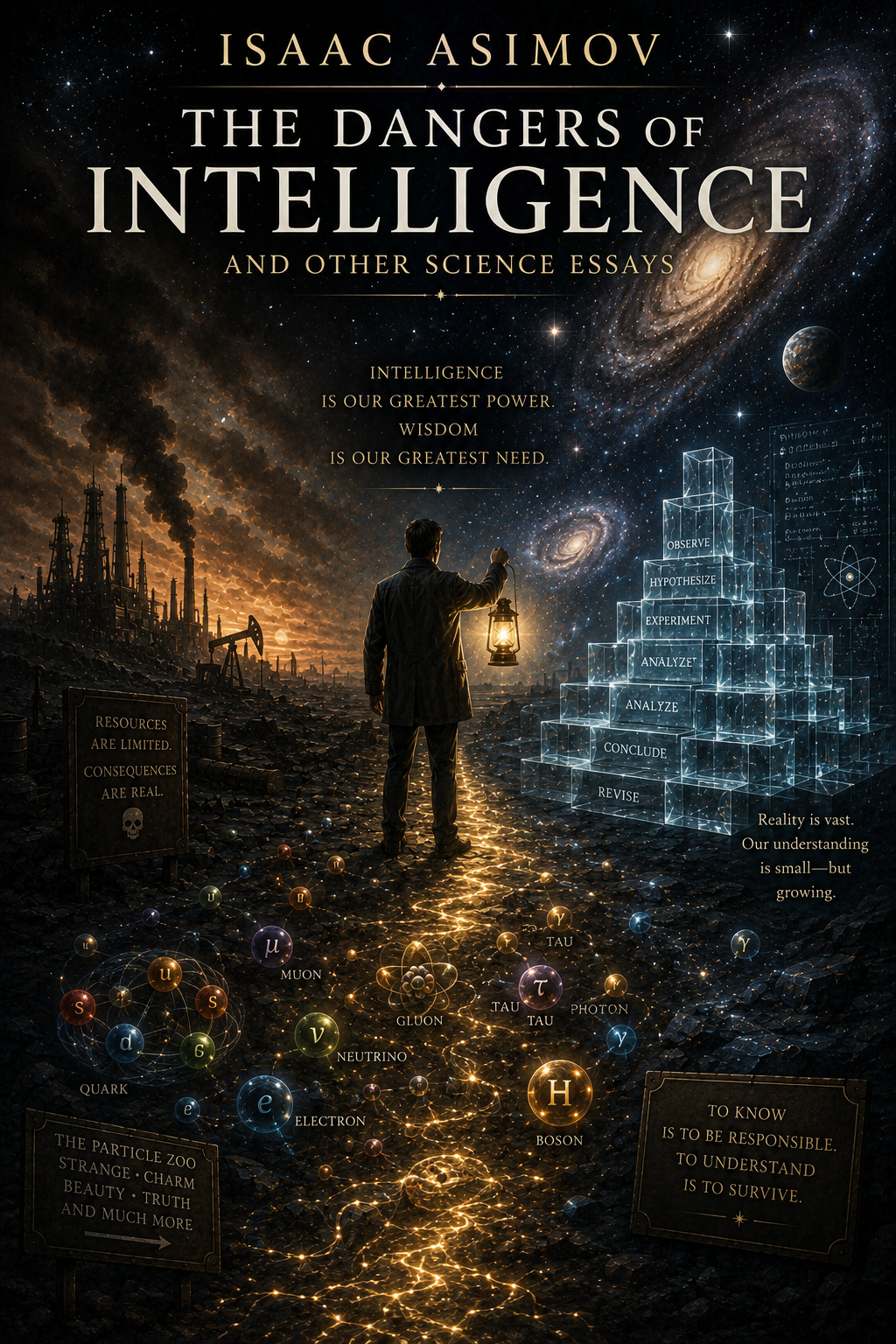
Imagine a person standing on a vast, dark plain, holding a single candle. That candle is not the truth itself, but the curiosity that leads toward it. In the collection of essays known as The Dangers of Intelligence and Other Science Essays, Isaac Asimov takes the reader by the hand and walks across this plain, showing that while the light of the candle is small, the act of carrying it is the most significant thing a human being can do. This book is not a dense manual of facts, but a narrative of the human mind struggling to understand its own potential and its own limitations.
The story begins with a fundamental paradox about the very tool we use to survive. In the opening movement, Asimov observes that intelligence is the defining characteristic of our species, the engine of all our progress. Yet, this same intelligence is a source of profound risk. A simple creature, driven by instinct, has a limited capacity for destruction. A creature that can think, however, can amplify its power until it touches the scales of the planet itself. The danger is not found in the intelligence itself, but in the gap between our ability to create and our wisdom to restrain that creation. It is a story of a species that has grown powerful enough to be dangerous, but perhaps not yet wise enough to be safe.
To understand this danger, we must look inward at the machinery of thought. Asimov describes the human mind as a system designed for pattern recognition and memory, yet one that is often led astray by the gravity of habit and the clouds of emotion. We often believe we are being rational when we are merely being comfortable. The scientific method, in this light, becomes more than just a way to study laboratory samples; it is a way to discipline the mind against its own weaknesses. It is the story of how we learn to think about thinking, turning the lens of inquiry back upon the observer.
As we move deeper into the narrative, we encounter the way our understanding of the world changes. There is a common mistake in believing that knowledge is a simple move from a state of being wrong to a state of being right. Asimov argues instead for a more nuanced progression. The people of the past were not absolutely wrong; they were approximately wrong. Each new discovery does not necessarily destroy what came before, but refines it, making the picture a little sharper and the errors a little smaller. It is a slow, steady climb up a mountain where the peak is never quite reached, but the view becomes clearer with every step.
This clarity is hampered by the fact that we are, in a sense, living in a Planet of the Blind. Our biological senses are narrow and limited, tuned only to a small slice of reality. We cannot see the waves that carry our voices through the air or the tiny structures that build our bodies. Science, then, is the story of how we build extensions for our senses. Telescopes and microscopes are the new eyes that allow us to perceive a reality that is far richer and more orderly than our ancestors could have imagined.
However, the story takes a somber turn when it addresses the physical costs of our brilliance. Our industrial civilization is a great machine that runs on energy, and for a long time, we acted as though that resource were infinite. Asimov traces the logic of growth, how population and industry expand until they press against the hard limits of finite resources. It is a narrative of a house that is running out of fuel while the winter approaches. Yet even here, the story is not one of despair. The same intelligence that led us into this predicament offers the tools to lead us out, provided we have the responsibility to apply them before the pressure becomes a catastrophe.
Every tool we invent to solve a problem seems to carry a hidden face. Technology is not a simple gift; it is a trade. We gain mobility through the automobile, but we lose the old structure of our cities. We gain instant communication, but we find ourselves overwhelmed by the sheer volume of information, a challenge of modern living. This is the story of unintended consequences, a reminder that scientific progress does not happen in a vacuum. It ripples outward, changing the world in ways that even the most intelligent mind cannot fully predict.
Perhaps the most important chapter in this story of human thought is the realization of our own ignorance. For centuries, various systems of belief claimed to have all the answers. The great turning point for modern science was the courage to admit the opposite. By identifying what we do not know, we turn a wall into a door. An unanswered question is not a failure; it is an invitation to explore. This flexibility is what allows a civilization to survive. When we become too certain of ourselves, we become rigid and fragile. When we value the question as much as the answer, we remain capable of growth.
The narrative then scales from the infinitesimal to the infinite. We follow the journey of discovery into the heart of matter, where atoms were once thought to be the final word, only to reveal a complex zoo of even smaller particles. Then, the perspective shifts outward, showing a humanity that once thought it was the center of the universe, only to find itself on a small speck in a vast sea of galaxies. The beauty of this part of the story is that it does not make us feel small. Instead, it highlights the majesty of the human mind, which, from its tiny perch, can comprehend the vastness of the cosmos through nothing more than the power of reason.
As the book reaches its conclusion, it confronts the moral weight of this journey. Discovery and responsibility cannot be separated. Those who uncover the secrets of nature cannot ignore how those secrets are used to reshape society. The tension is a permanent part of the human condition. We must keep learning, for to stop is to stagnate, but we must also grow in wisdom at the same rate we grow in knowledge.
The final impression of this collection is one of quiet, logical hope. Science is neither a savior nor a monster; it is a tool, the greatest one we have. Its value is determined entirely by the quality of the thought behind its use. The future will not be decided by machines or inventions alone, but by our ability to recognize the dangers our intelligence creates before they become irreversible. We are imperfect creatures, but we are creatures who can ask better questions. As long as the inquiry continues honestly, the story of humanity remains one of progress.
In the story titled The Dangers of Intelligence, Asimov explores the paradox that our greatest survival trait, intelligence, is also our greatest threat. He argues that while intelligence grants us power over our environment, it lacks an inherent moral compass, making wisdom and foresight essential to prevent us from destroying ourselves with our own tools.
In Thinking About Thinking, the focus is on the mechanics of the human mind. Asimov describes how our brains are wired for pattern recognition but are easily swayed by emotion and habit. He presents the scientific method as a necessary discipline to help us overcome these mental shortcuts and think more rationally.
The Relativity of Wrong addresses the misconception that scientific theories are either right or wrong. Asimov explains that knowledge is a process of refinement. Each new theory is usually less wrong than the one before, moving us closer to the truth without completely invalidating previous, less accurate observations.
The Planet of the Blind emphasizes the limits of human perception. Because our biological senses only detect a tiny fraction of reality, science acts as a set of artificial senses. By using technology to see what was once invisible, we discover a universe that is far more complex than our raw senses suggest.
The Nightmare Life Without Fuel provides a sobering look at the energy crisis. Asimov uses logic to show how a civilization dependent on finite resources will inevitably face a reckoning as population and consumption grow. He stresses that while the situation is dire, human intelligence can find alternative solutions if applied responsibly.
In The Two Faces of Technology, Asimov examines how every technological advancement brings both a solution and a new set of problems. Using examples like the car and digital communication, he shows that the social and environmental changes caused by inventions are often as significant as the inventions themselves.
The Discovery of Ignorance highlights how the acknowledgment of uncertainty is the true catalyst for scientific progress. By admitting we do not know everything, we create the opportunity for investigation and discovery, contrasting the open ended nature of science with the closed systems of the past.
The Hazards of Certainty warns against the comfort of absolute certainty. Asimov argues that rigid ideologies are dangerous because they resist evidence, whereas the scientific willingness to revise one's views is the hallmark of a healthy, advancing civilization.
The Smallest Particles follows the journey into subatomic physics. Asimov traces the history of how we moved from the idea of the indivisible atom to the discovery of a complex world of quarks and other particles, showing that reality becomes more intricate the deeper we look.
The Immense Universe scales up to the cosmic level. It recounts how humanity realized the Earth is not the center of existence and that our galaxy is just one of billions. It celebrates the fact that the human mind can understand such enormous scales through logic.
Science and Responsibility concludes with a meditation on the ethics of discovery. Asimov argues that scientists have a moral obligation to consider the impact of their work on society, asserting that the survival of civilization depends on our ability to manage our knowledge with wisdom.