The Alternate Asimovs
This collection reveals Asimov’s diverse imaginative voices logical, emotional, and philosophical exploring humanity, technology, and mortality through multifaceted stories that showcase his mind’s vast possibilities.
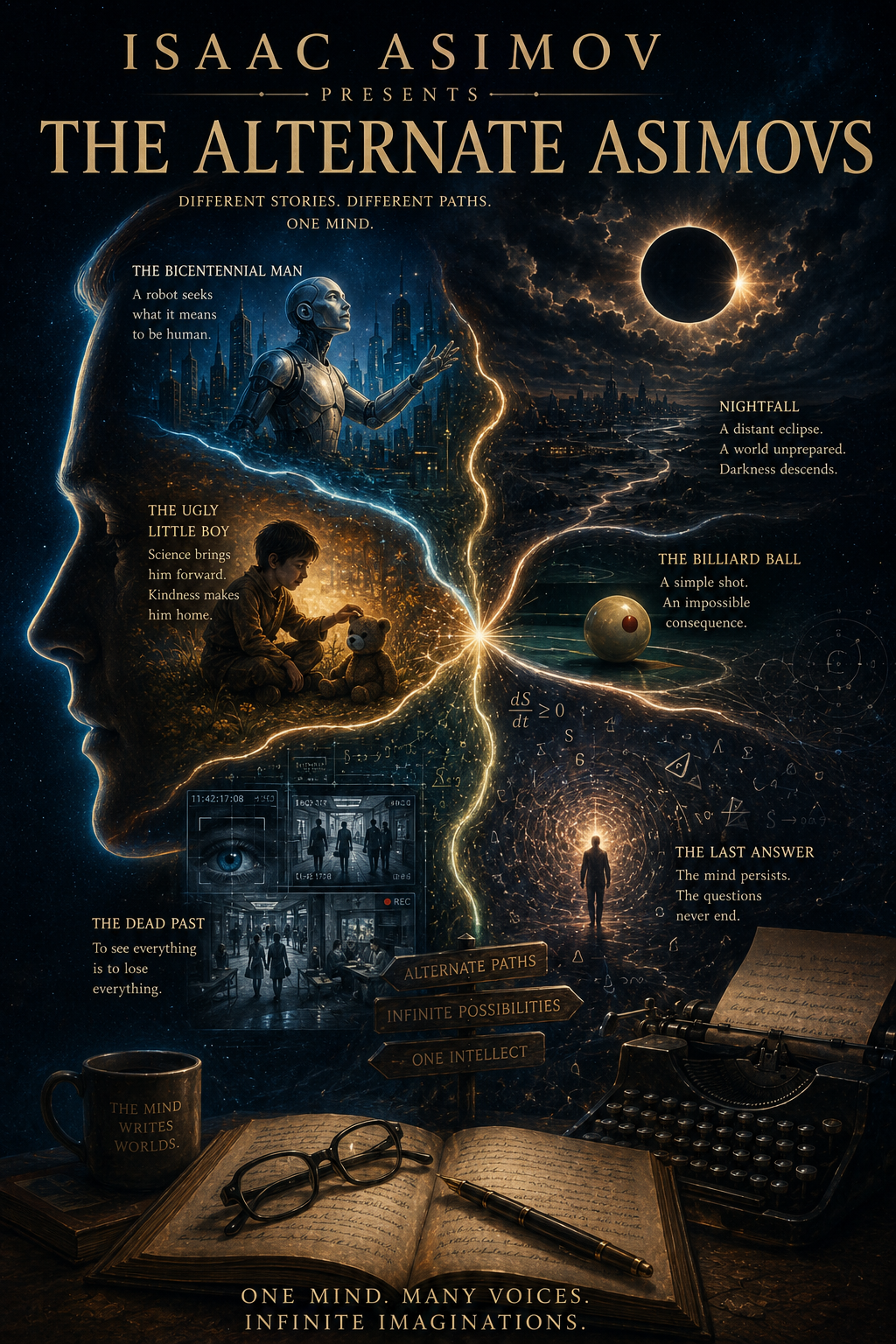
Imagine a library where every book is written by the same man, yet each volume seems to emerge from a different version of his soul. This is the intellectual landscape of The Alternate Asimovs. It is an unusual work that defies the standard categories of a novel or a simple anthology. Instead, it serves as a collection of possibilities, showing the different directions that a single, vast imagination might have taken. While many readers associate this author with the rigid logic of the Three Laws of Robotics or the mathematical certainties of a galactic empire, this collection suggests that such a view is incomplete. It reveals a mind capable of humor, deep darkness, and introspective questioning that often sits outside his most famous patterns.
The journey through these alternate voices begins with a fundamental inquiry into the nature of the writer himself. In The Idea of the Alternate Writer, the collection establishes that the stories ahead will explore moods and methods that deviate from the expected clarity and restraint. It is a map of a mind in motion, proving that even a writer known for reason can find himself wandering into the shadows of the unknown.
One of the earliest explorations in this map is The Billiard Ball. This story builds from the tension between abstract scientific achievement and the messy reality of human emotion. It presents a world where a scientific theory carries dangerous weight, but the true conflict is found in the personalities of the men involved. It suggests that intelligence is never a vacuum; it is always entangled with the people who possess it. The story leads to the realization that even the most brilliant mind cannot fully separate its discoveries from its human flaws.
The scale then expands into the cosmic and the eternal with The Last Answer. While many are familiar with the search for the reversal of entropy, this story moves in a more intimate and uneasy direction. It builds from the premise that death is not the end of inquiry, leading a solitary mind to confront a vast, reality shaping intelligence. Rather than offering a mystical conclusion, it applies strict logic to the afterlife. It asks whether the continuation of thought without end would eventually become a burden, serving as a darker companion to the authors more optimistic cosmic tales.
The tone shifts toward the profoundly personal in The Ugly Little Boy. Here, the story builds from a scientific experiment that pulls a child from the distant past into the present. What begins as an academic exercise in observation leads to a deep exploration of human connection. The story dismantles the idea that civilization is defined by technology or culture. Instead, it moves toward the logical conclusion that the most fundamental human trait is the need for care and connection, regardless of which era one belongs to.
In the celebrated The Bicentennial Man, the familiar subject of robotics is approached from an altered angle. Andrew Martin, a robot, seeks something beyond his original programming to achieve legal status and physical change. It is a journey toward the eventual acceptance of mortality. The logic of each step is clear, yet the story leads the reader to a powerful emotional truth: humanity is not defined by the absence of error or the possession of immortality, but by the limitations we choose to accept.
The collection also turns its gaze inward to the act of creation itself in Gold. This story examines the difficulty of communicating ideas across different mediums and the inevitable misunderstandings that occur between a creator and their audience. It is a self aware reflection on the nature of art, suggesting that technology is merely a tool for the much harder task of human expression.
A more unsettling logical progression appears in The Dead Past. It builds from a single invention, a device that can view the past, and follows its implications with relentless clarity. It does not lead to a spectacle of destruction, but to something much more haunting: the quiet collapse of privacy. The story demonstrates that when secrets become impossible, society itself must fundamentally change, illustrating how a single rational advancement can lead to an unforeseen psychological horror.
The existential weight of scientific discovery is felt in Breeds There a Man, which explores the possibility of human insignificance. It builds from a scientists overwhelming sense of despair and leads to a questioning of whether humanity matters at all in the grand scale of the universe. Yet, even in this darkness, the story shows that the human mind cannot stop its inquiry. Even when the answers are uncomfortable, the drive to ask questions remains a defining characteristic.
To balance these heavy themes, the collection includes lighter, more gentle works like Shah Guido G. and The Fun They Had. These mini stories focus on ordinary life and everyday situations that have been slightly altered by the conditions of the future. They serve as a reminder that science fiction can be found in the small moments of human experience, not just in cosmic revolutions.
Finally, Nightfall serves as the bridge that connects these many facets. It builds from a precise scientific problem, a world that never knows darkness facing an eclipse that arrives only once in millennia, and leads to a total psychological collapse of civilization. It perfectly balances rational thought with social observation and the drama of human limitation. It shows the author as both the builder of logical systems and the observer of the fragile human spirit.
In summary, The Alternate Asimovs is a testament to the diversity of a single intellect. It reveals that the familiar, logical reasoner is only one part of a larger whole that includes a moral philosopher, a satirist, and an explorer of doubt. The collection does not represent a departure from the authors legendary body of work, but rather a significant widening of it. It proves that a writer, like the universe itself, contains far more possibilities than any single story can ever fully reveal.