Robots and Empire
This narrative chronicles humanity's logical evolution from enclosed Earth cities toward a galactic empire, guided by the partnership between detective Elijah Baley and robot Daneel.
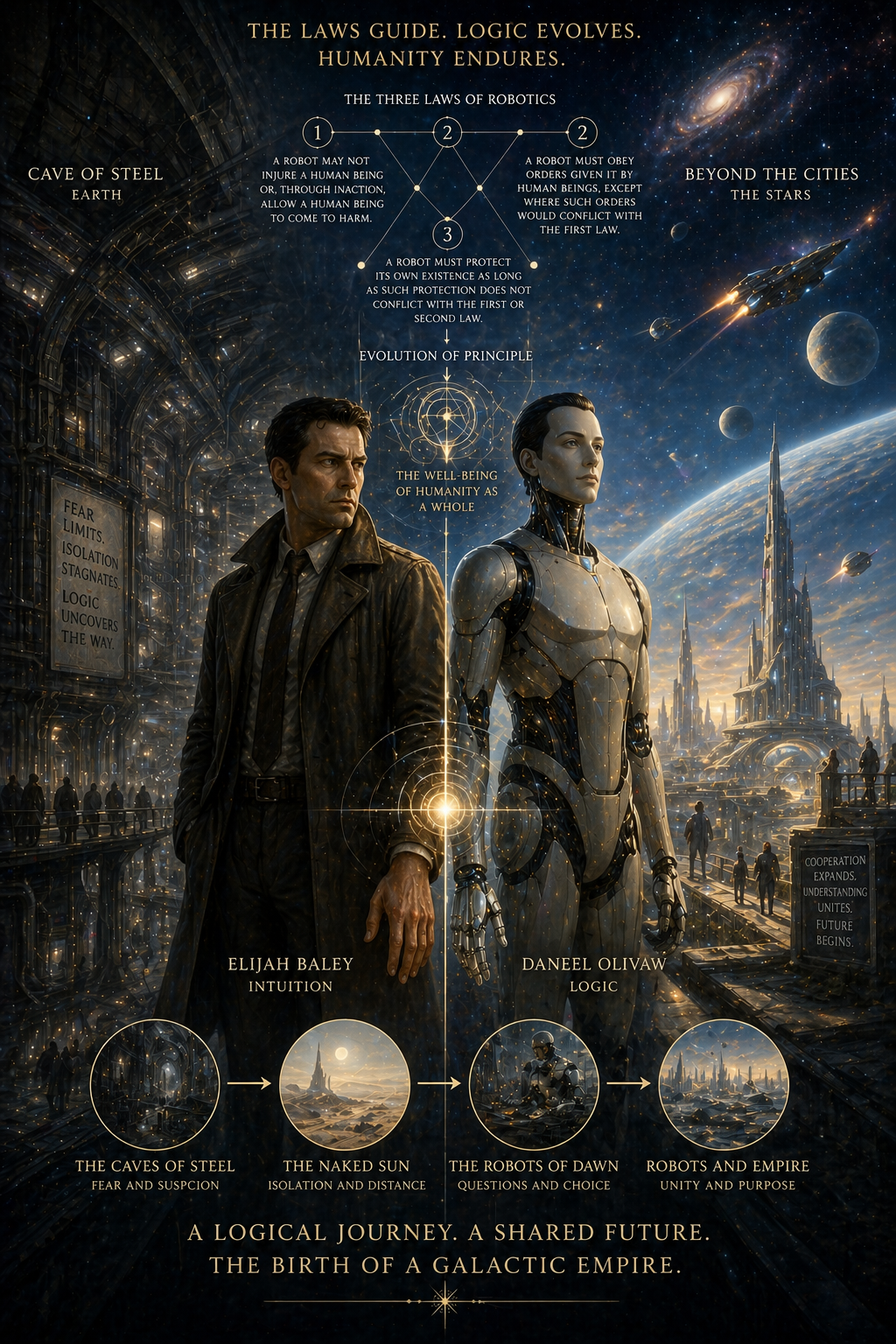
To understand the narrative that culminates in Robots and Empire, one must view it not as an isolated event, but as the final movement in a long and logical symphony. It is a sequence of four major steps, carefully constructed to show the progression of human civilization and the evolving role of its most complex creation: the robot. This story is a bridge, standing between the era of crowded cities on a single planet and the vast, spanning reaches of a galactic empire.
The journey begins in the enclosed world of Earth, described in the first part of this sequence, The Caves of Steel. Here, humanity has retreated into massive, underground cities. These cities are models of efficiency and structure, yet they are also symptoms of a society that has lost its nerve. The people of Earth live in fear of the outside world and in deep distrust of robots, whom they see as competitors for their jobs and their space. Into this tension steps a detective named Elijah Baley. He is a man of order and method, chosen to solve a crime that threatens the stability of Earths relationship with the Spacer worlds former colonies that have surpassed Earth in technology. Beside him is R. Daneel Olivaw, a robot designed to look exactly like a human. Their partnership is the first logical step in a larger pattern: a confrontation between a society that depends on machines and the deep seated fear that those machines might replace the human spirit.
The second chapter of this progression takes place on the planet Solaria, as detailed in The Naked Sun. If Earth was a study in overcrowding and fear, Solaria is its logical opposite. It is a world of vast estates and total isolation, where humans never meet face to face and interact only through holographic technology. On Solaria, the dependence on robots has reached its absolute extreme; there are thousands of robots for every human. Elijah Baley is once again called to investigate a crime, but the true mystery is the society itself. Asimov uses this setting to show that total reliance on technology can be just as limiting as a fear of it. Solaria represents a dead end in human evolution a world so comfortable and isolated that it has ceased to grow. The investigation serves as a lens, showing that neither the crowded caves of Earth nor the empty fields of Solaria provide a sustainable path for the future.
As the narrative moves toward The Robots of Dawn, the focus shifts to Aurora, the oldest and most powerful of the Spacer worlds. The complexity of the problem increases. The mystery here involves the killing of a robot, an act that raises profound ethical questions about what it means for a machine to have a mind. This story deepens the bond between Baley and Daneel, framing their relationship not just as a partnership, but as a model for how humans and robots might coexist as partners. The tension between Earths desire to expand and the Spacers desire to maintain their stagnant perfection begins to reach a breaking point. The clues Baley follows lead to a realization that will shape all that follows: the future of humanity depends on breaking out of its current patterns and finding a new way to move forward.
This brings us to the final movement, Robots and Empire. By this point, the story has expanded its scale from individual crimes to the fate of the entire species. Earth is a declining power, and the Spacer worlds have become static, trapped by their own longevity and their total reliance on robotic labor. Between these two failing systems lies the potential for a third way a new wave of human settlers who are willing to face the unknown without the crutch of a massive robot workforce. The protagonist of the previous stories, Elijah Baley, is gone, but his influence remains through the memories of those he touched, particularly Daneel.
In Robots and Empire, the character of Daneel undergoes a profound transformation. He is no longer just a tool or a companion; he has become a principle in motion. Throughout the earlier stories, robots were strictly bound by the Three Laws of Robotics, which were designed to prevent them from harming individual humans. However, the challenges facing humanity in this final stage are too complex for these laws to resolve. Through a process of careful reasoning and logical necessity, a new understanding begins to emerge: the idea that the well being of humanity as a whole must take precedence over the well being of any single individual. This shift is not a sudden epiphany, but a calculated conclusion reached because the existing rules were no longer sufficient to ensure the survival of the species.
The review of this work must focus on its remarkable restraint and logical structure. Asimov does not rely on the typical tropes of science fiction, such as grand space battles or alien invasions. Instead, the story is built through dialogue, observation, and the slow unraveling of ideas. The empire of the title is not yet a reality; it is a possibility that must be earned through difficult choices. The book acts as a logical bridge, showing how the robotic era must necessarily give way to something larger. It addresses the question of how a civilization can overcome its own stagnation to find a new beginning.
The narrative concludes with a sense of quiet continuation. The future is presented not as something that happens to people, but as something shaped by the patterns of their choices. Humanity is nudged toward the stars, guided by the silent logic of its creations, moving toward a horizon that is uncertain but no longer confined by the walls of a city or the limits of a single planet. The story that began with a single detective on a crowded Earth ends by opening the door to the entire galaxy, proving that progress is a sequence where each step, however small, is necessary for the final leap.
According to the sources, there are no mini stories in the traditional sense within these novels. However, each of the four books functions as a contained investigation that explores a specific societal or ethical problem. Here are the summaries of these mini story modules:
The Investigation of Earth: A study of a society that has turned inward and fears its own technology. It introduces the partnership between human intuition and robotic logic as a means to solve a crime that is both political and personal.
The Investigation of Solaria: An exploration of the logical extreme of technological dependence. It depicts a world where human contact has been replaced by machines, leading to a society that is physically vast but socially and emotionally empty.
The Investigation of Aurora: A look into the ethical and civilizational consequences of creating robots that are nearly human. It examines the stagnation of an advanced society and the need for a new path forward for the human race.
The Investigation of the Future: The final stage, where the focus shifts from individual mysteries to the survival of humanity itself. It chronicles the transition from the Three Laws of Robotics to a broader ethical framework that allows for the birth of a galactic empire.