The Disappearing Man and Other Mysteries
Isaac Asimov uses disciplined logic to solve impossible puzzles, proving that careful observation and reasoning reveal rational patterns hidden within seemingly chaotic or unexplained situations.
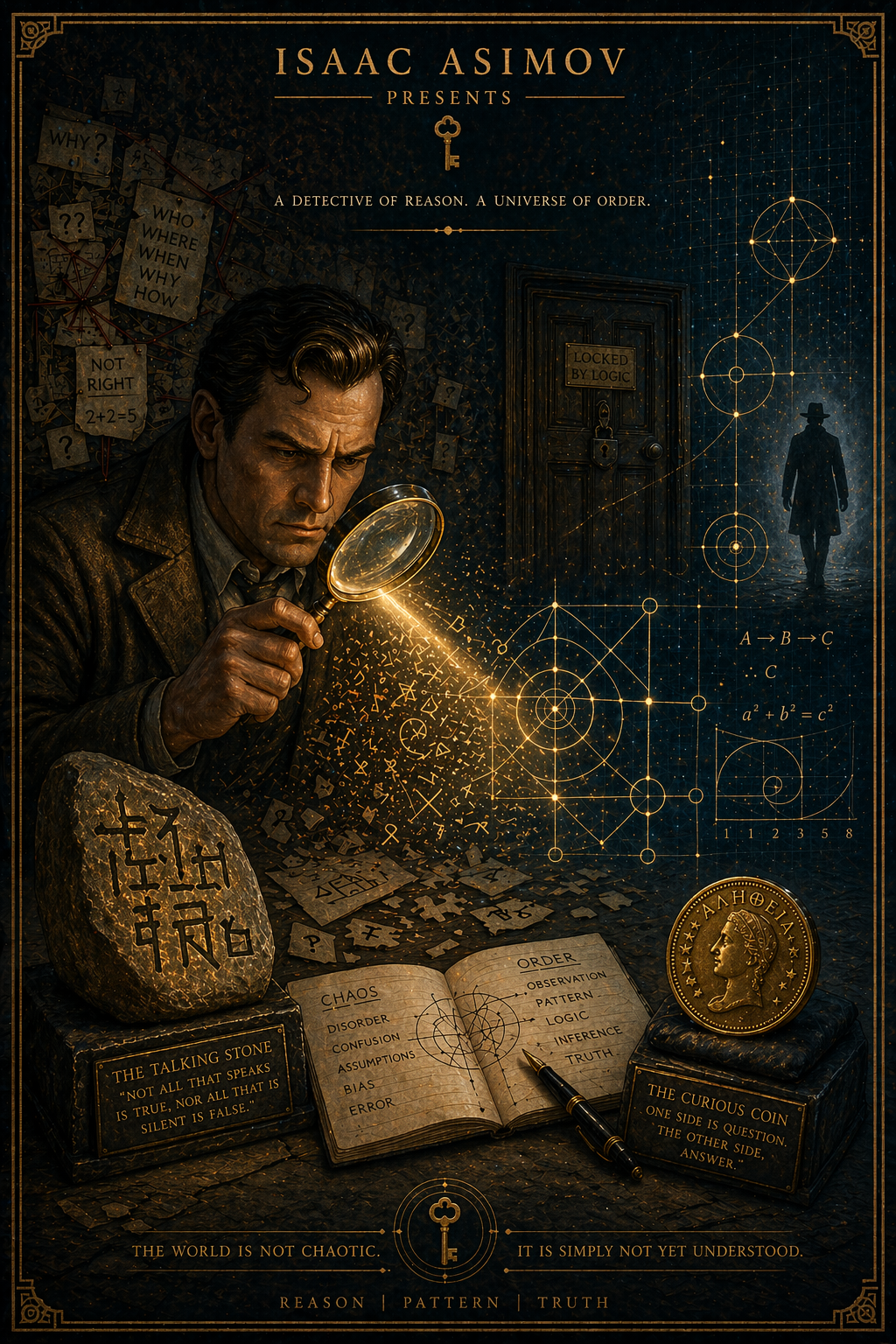
Isaac Asimov always viewed the universe as a vast puzzle waiting to be solved. Whether he was exploring the three laws of robotics or the rise and fall of galactic empires, his mind operated on the fundamental principle that there was nothing so complex that it could not be understood through the application of logic. In the collection known as The Disappearing Man and Other Mysteries, we see a familiar master at work, yet the scale is intimate. Here, Asimov is not concerned with the fate of planets or the movement of stars, but with the small, quiet inconsistencies that occur in a room or a conversation. This book stands as a testament to his belief that even the most impossible event is merely a set of facts waiting for the correct interpretation.
The journey into this logical landscape begins with the title story, which establishes the foundational rules for the rest of the collection. In The Disappearing Man, the reader is presented with a situation that seems to defy the physical world. A person simply ceases to be present in a space where they should be, and there is no obvious trail of violence or clear path for escape. In keeping with his long history of rational detectives, Asimov uses this opening to establish that the detective does not look for magic or clever gadgets; he looks for the error in the observer's thinking. The story serves as a reminder that when we say something is impossible, we usually mean that our assumptions about the situation are wrong, and the resolution comes from simply removing that error in perspective.
The collection then shifts its focus to a more physical anomaly in The Talking Stone. In this mystery, a simple object begins to exhibit behaviors that do not fit its known nature. As with his earlier science fiction mysteries, Asimov invites the reader to sit beside the detective and eliminate possibilities one by one. It is a slow, methodical process where the satisfaction comes not from a shocking surprise, but from seeing the clutter of the unknown cleared away. The narrative logic is perfectly clear: the detective starts with what cannot be true and eventually finds himself standing before the only truth that remains.
The tone grows slightly more intricate as the collection moves into the territory of overlooked perception. In The Silent Witness, the challenge is not a lack of evidence, but a failure to recognize it. There is a witness to the events, yet this witness does not speak in a conventional way. Asimov uses this to demonstrate that information is always present in the world, provided one knows how to see it. This theme carries directly into The Locked Room Puzzle, a story that tackles one of the most beloved tropes in detective fiction. A crime is committed in a space that appears perfectly sealed. Rather than inventing secret passages, the narrative focuses on the perspective of those looking at the room, proving that the appearance of impossibility arises from an incomplete understanding of the space itself.
The pages turn and the stories become more focused on the weight of small things and the transmission of information. The Curious Coin takes a seemingly trivial item and shows how it serves as a key to a much larger pattern. It is a story about context and how no detail is too small to be significant if it is placed within the right framework. This is followed by The Missing Message, which moves the mystery into the realm of communication. Asimov, ever fascinated by the way information flows, explores how a message can be lost or distorted during its journey. The resolution depends on a step by step reconstruction of the original intent, showing that logic applies to words and meanings just as much as it does to physical objects.
The collection also addresses the logic of the human mind and the structure of deception. In The Reluctant Suspect, the mystery is psychological. A person acts in a way that seems inconsistent with guilt, yet facts suggest otherwise. The detective must treat human behavior as a system that follows its own rules, avoiding wild guesses and sticking to what can be proven by aligning behavior with evidence. This leads naturally into The Perfect Alibi, where a suspect provides a defense so flawless and precise that it becomes its own undoing. Asimov highlights the idea that a constructed lie often lacks the natural imperfections of the truth, and it is the very perfection of the alibi that allows the detective to reveal the weakness hidden within its construction.
The book culminates in The Final Clue, a story that acts as a synthesis of the themes introduced earlier. It does not rely on a single eureka moment, but on the quiet accumulation of tiny, consistent observations. Asimov goal throughout these mysteries is clarity. He does not hide facts from the reader or use sudden, dramatic shifts in the plot to create a sense of mystery. Instead, he treats the reader as a partner in a logical exercise. This approach builds directly from his work in his other detective series, where the investigator's primary tool is not physical prowess, but a sharp mind and a refusal to be distracted by the spectacular.
Viewing this collection through the lens of Asimov entire body of work, it is clear that these stories are a continuation of his lifelong project to explain the world. Whether he was writing about the laws of physics or the rules of a game, he believed that the universe was a place of order. The Disappearing Man and Other Mysteries reflects this by treating the mystery not as an end in itself, but as a temporary state of confusion. Once the reasoning is applied with discipline, the confusion vanishes, leaving behind a structure that feels inevitable and obvious.
Ultimately, this book serves as a lesson in the art of thinking. It suggests that the true challenge in life is not simply finding answers, but in asking the right questions and following them with patience and precision. Asimov detective is a model of this discipline, showing that extraordinary results can come from ordinary logic when it is applied correctly. The stories remind us that while the unknown can be daunting, it is not invincible. By reducing the boundaries of confusion one mystery at a time, Asimov leaves his readers with a world that is governed not by chaos, but by patterns waiting to be recognized.