How Did We Find Out About DNA
Asimov chronicles the logical journey from ignorance to understanding heredity. From Mendel’s experiments to the DNA double helix, scientists decoded life’s fundamental, hidden molecular blueprints.
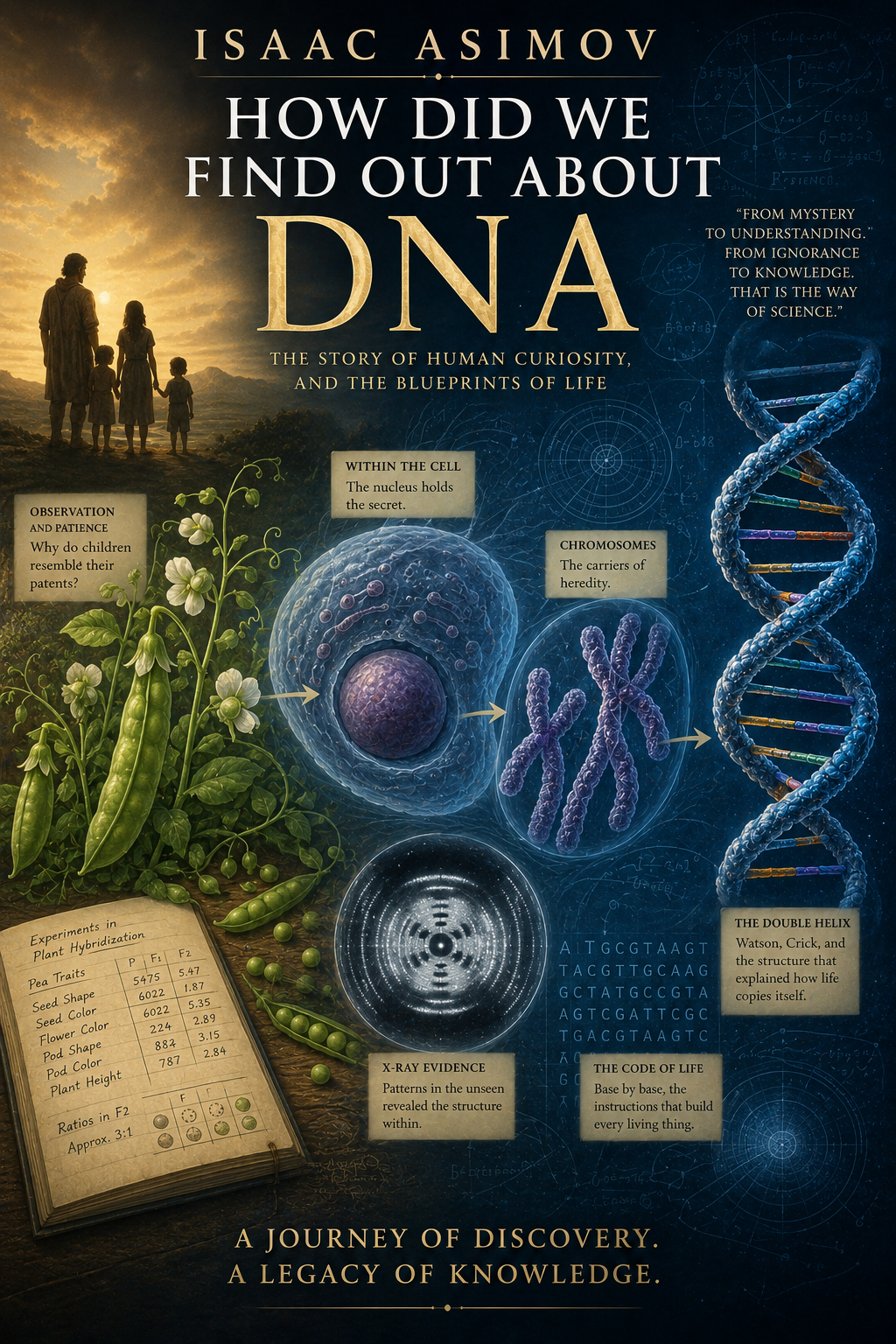
The human quest to understand life did not begin with a grand revelation but with a simple observation of a pattern that repeated in every generation. For thousands of years, people looked at their children and saw their own features reflected back at them, yet the reason for this stayed hidden. In the beginning of the book, we are introduced to the ancient idea that characteristics were like liquids that mixed together. This is the starting point for The Problem of Inheritance, which explains that if life were truly just a mixture, all the unique traits we see would have blended into a single grey average long ago. This logical flaw suggested that there had to be a more precise and orderly way that heredity worked, even if it could not be seen with the naked eye.
As the story of discovery moves forward, the focus shifts from the whole organism to the tiny building blocks that make up all living things. This transition is captured in The Search for the Cell, where the invention of the microscope opened a window into a world that was previously invisible. Suddenly, scientists realized that life was not a single mystery but a complex system of smaller parts. Within these parts, they found a central command center, which is the focus of The Discovery of the Nucleus. At first, no one understood what this central structure did, but its presence hinted that the instructions for life were stored in a very specific place. The narrative builds tension by showing how researchers were looking at the right structures without yet knowing how to read them.
The mystery begins to clear when the book introduces a monk who worked in a quiet garden. In the story of Mendel and the Hidden Laws, we see how careful counting of pea plants revealed that traits act like independent units rather than blending fluids. He discovered that some traits are strong and others stay hidden, only to reappear later. However, in Forgotten Discoveries, the narrative takes a turn to show that even the most important truths can be lost if the world is not ready to hear them. It took decades for others to realize that the monk had already solved the mathematical puzzle of inheritance. This part of the book serves as a reminder that science is a human endeavor that depends as much on communication as it does on discovery.
The investigation then moves into the physical realm of the chromosome in the section titled Chromosomes and Heredity. Scientists observed that these threadlike structures behaved exactly like the mathematical factors the monk had described. This realization led to a period of intense searching described in The Search for the Genetic Material. There was a major conflict in the scientific community about which chemical carried the blueprints of life. Most people bet on complex proteins, while a simpler molecule was viewed as an unlikely candidate. This sets the stage for a dramatic shift in understanding as the evidence began to point toward a substance that many had initially dismissed.
The climax of the discovery comes through a series of elegant experiments. In Experiments with Bacteria, we learn about a principle that could transform one type of cell into another, proving that heredity is controlled by a specific chemical. This leads directly to the moment when DNA Takes the Stage, where rigorous testing finally proved which molecule was the master of instructions. The story then moves to its most famous peak in The Double Helix and The Clues from X rays. It describes how researchers worked with physical models and light patterns to find a shape that could explain everything. They found a twisting structure that showed exactly how a molecule could copy itself and pass information down through time.
The final chapters, including The Genetic code and Changing the Instructions of Life, explain that we have finally learned to read the language of life. The sequence of chemicals in the molecule acts like a set of instructions for building an organism. The book is a masterpiece of logical presentation because it does not just give facts; it shows the steps of how we reached them. It reviews the history of biology not as a list of dates but as a living story of human curiosity. By building from ignorance to understanding, it makes the complex world of molecular science feel accessible and deeply logical.
The Problem of Inheritance summary: This story describes the ancient mystery of why offspring resemble parents and explains why the old idea of blending traits like liquids was logically impossible.
The Search for the Cell summary: This story covers the invention of the microscope and the discovery that all living things are composed of tiny individual units that act as the foundation of life.
The Discovery of the Nucleus summary: This story follows the identification of a dense core inside cells and the early uncertainty scientists felt about what its actual role in the cell might be.
Mendel and the Hidden Laws summary: This story focuses on Gregor Mendel who used pea plants to prove that traits are passed down as distinct units that follow specific mathematical rules.
Forgotten Discoveries summary: This story explains how the ground breaking work of Mendel was ignored for many years until the scientific community was finally advanced enough to rediscover it.
Chromosomes and Heredity summary: This story tracks the observation of threadlike structures in the nucleus and how they were eventually linked to the laws of inheritance discovered by Mendel.
The Search for the Genetic Material summary: This story details the scientific debate over whether proteins or a simpler chemical molecule carried the hereditary instructions for all living organisms.
Experiments with Bacteria summary: This story describes how researchers found a substance that could permanently change the traits of bacteria, providing a major clue about the nature of genetic material.
DNA Takes the Stage summary: This story explains the experiments that finally proved which molecule was responsible for heredity, moving the focus of biology into the realm of chemistry.
The Double Helix summary: This story recounts the building of a physical model that revealed the twisting structure of the molecule and explained how it could replicate itself accurately.
The Clues from X rays summary: This story acknowledges the vital role of specialized photography and light patterns in providing the data needed to understand the physical shape of the molecule.
The Genetic Code summary: This story explores how the sequence of chemicals in the molecule acts as a set of instructions that the cell uses to manufacture the proteins it needs.
Changing the Instructions of Life summary: This story looks at the modern implications of these discoveries and how we have gained the ability to analyze and potentially edit the blueprints of life.