The Subatomic Monster
This book logically traces the scientific journey from indivisible atoms to complex quarks and unified forces, revealing the vast, structured complexity hidden deep within matter.
The story of our understanding of the universe begins with a sense of complete uncertainty about the nature of matter. In his work, Isaac Asimov approaches this subject not as a collection of settled truths, but as a unfolding narrative of human inquiry within the field of physics. He begins at a point where the atom was considered to be continuous and simple. This early vision of reality was elegant and reasonable based on the evidence available at the time. Asimov reminds us that the path to knowledge often starts with an approximation rather than a final truth. Each step taken in this journey is careful and logical, building a foundation for the revelations that follow.
For a long period, people believed that matter could not be divided past a certain point. This concept of the smallest possible units provided a stable way to look at the world for centuries. Asimov explains that this idea was not a sign of poor thinking but a necessary starting point for scientific growth. Science starts with these simple models and moves forward only when new evidence appears. This part of the story sets the stage for a dramatic shift in how we perceive the very ground beneath our feet. It shows that even a clear and logical idea can be challenged as our tools for observation become more precise.
The calm of the indivisible world was eventually disturbed by experiments that showed the presence of internal parts. Atoms were found to be more than just solid and featureless spheres. The discovery of the electron was the specific moment that changed the direction of the story. Suddenly, what was thought to be a single unit was revealed to have its own structure. This new information demanded a logical adjustment in how the universe was described. Asimov presents this change as a natural step in the evolution of science rather than a chaotic disruption.
As the narrative moves deeper, it focuses on the center of this newly discovered structure. Researchers found that the mass of the atom was concentrated in a very small and dense area called the nucleus. This discovery brought the proton into focus as a fundamental part of the system. The atom began to take on a form that was both orderly and complex. Each discovery was explained with clarity, allowing the implications to be traced without any exaggeration. This progress showed that the deeper one looks, the more structure there is to find.
The picture of the atom became even clearer when the neutron was added to the story. Its existence resolved many inconsistencies that had puzzled scientists previously. The nucleus was finally understood to be a combination of protons and neutrons working together. Asimov pauses here to show how this new piece of the puzzle fits into the existing framework. He reinforces the idea that knowledge grows by adding to what we already know instead of replacing it entirely. This integration of new facts allows for a more stable and comprehensive view of reality.
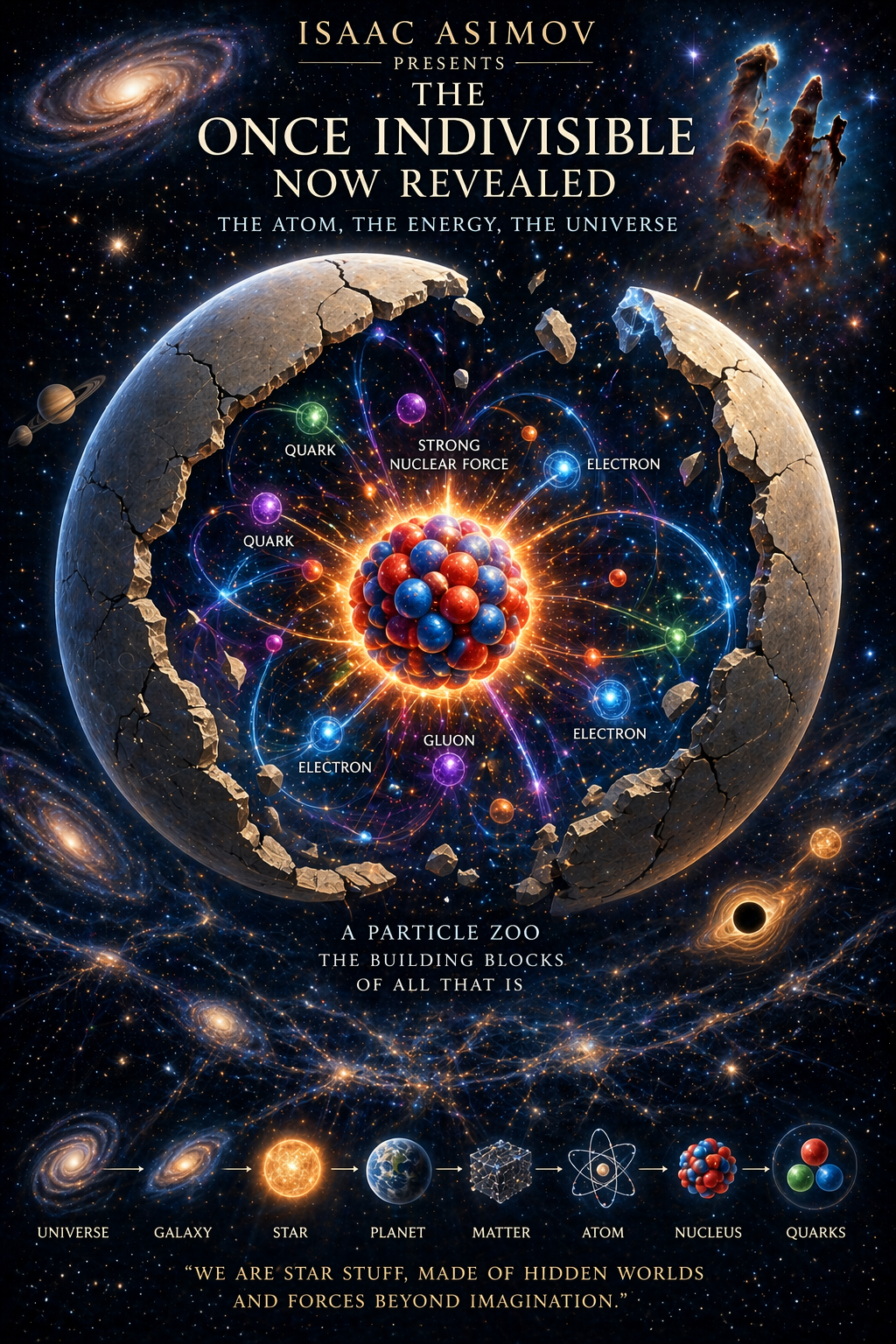
Once the contents of the atom were identified, the story turned to the question of how it all stays together. The forces required to hold these particles in place are far stronger than anything we see in our daily lives. The concept of the strong nuclear force is introduced to explain this remarkable binding energy. The atom was no longer seen as a simple object but as a system of extreme complexity. This shift in focus from what is there to how it functions marks a significant deepening of the narrative. It shows that the rules of the subatomic world are very different from the ones we know.
A major turning point occurs when the story explores the potential to release the energy locked inside the nucleus. Reactions such as fission and fusion are described as processes governed by strict physical laws. Small changes at the subatomic level are shown to produce effects that are truly massive. The atom, which started the story as a symbol of stability, is now seen as a source of immense power. Asimov keeps these explanations grounded in reality, avoiding abstract concepts in favor of clear logic. This development links the tiny world of the atom to the large scale of human technology.
As scientists continued to probe the nucleus, they found a bewildering number of new entities. This era of discovery led to what is often called a particle zoo. Entities like mesons and baryons began to appear in experimental data, each with unique properties. The simplicity that defined the earlier chapters of the story was replaced by a new level of confusion. Asimov treats this confusion as a natural part of the scientific process. He explains that when knowledge grows quickly, the next task must always be classification.
To handle this growing collection of particles, scientists began to look for deeper patterns. They proposed that the particles in the zoo might not be fundamental but made of even smaller units. This led to the introduction of quarks as the building blocks of matter. Quarks have properties that challenge our basic intuition, yet they provide a logical basis for atomic structure. Asimov describes these ideas with care, making sure the reader understands their necessity. The complexity of the subatomic world is finally revealed in its full and strange glory.
The story eventually widens its view to connect these small particles with the rest of the universe. The four fundamental forces are examined together as parts of a single system. These include the strong and weak forces along with electromagnetism and gravity. Asimov demonstrates that understanding the smallest things can help us explain the largest structures in reality. The atom is transformed from an isolated concept into a key for unlocking the universe. This broad perspective provides a sense of unity to the entire scientific endeavor.
The final stages of the narrative discuss the search for a unified theory. Scientists hope to find a single framework that can explain all forces and particles. Although this goal has not been reached, the direction of the work is clear and purposeful. Asimov does not see this as a failure but as a sign of an ongoing journey. The search for understanding is driven by the same logic that guided the very first scientists. This ongoing effort ensures that our map of the universe will continue to expand.
Throughout this work, Asimov uses a style that is calm and confident. He refuses to add unnecessary drama to a subject that is already fascinating on its own. He achieves clarity not by leaving things out but by explaining every step carefully. The reader is guided through complex ideas without ever feeling overwhelmed. This approach allows the connections between different discoveries to become clear. It shows how a series of individual moments can form a single and coherent story.
By the conclusion, the title of the book takes on a new and deeper significance. The monster mentioned in the title is not a creature but the vast complexity of matter itself. This complexity is something to be understood rather than feared. It is a structured world governed by laws that the human mind can discover. The journey leaves the reader with a sense of quiet wonder at the nature of reality. It reveals that science is a process of taking careful steps grounded in observation and reason.
The story ends with the realization that every answer leads to more questions. The edge of what we know has moved, but it still exists. What was once invisible and mysterious has been mapped and explored. Asimov reminds us that the subatomic world is a landscape that can be understood through logic. Even though the work is never truly finished, the progress made is a testament to human curiosity. The narrative closes on a note of looking forward to the next discovery waiting just beyond the horizon.
The Discovery of the Electron
This story details the moment when the atom was first found to have internal structure. It describes how experiments revealed a small and negative particle that could be removed from the atom. This event shattered the idea of the indivisible atom and forced a new way of thinking about matter. It was the first step toward understanding the electronic nature of the universe.
The Identification of the Nucleus
In this narrative, the focus is on finding the heart of the atom. Scientists used precise methods to discover a small and dense core where most of the mass resides. This discovery introduced the proton and provided a clear center around which the rest of the atom is organized. It changed the model of the atom from a solid ball to a complex system with a defined center.
The Unveiling of Quarks
This story explores the search for the most fundamental level of reality. When the number of subatomic particles became too large to manage, scientists proposed that they were made of quarks. These tiny building blocks explained the patterns seen in larger particles. Even though quarks have strange properties, they provided the logic needed to bring order to the subatomic realm.