Isaac Asimov Presents the Great SF Stories, 13
Asimov curates stories from a single year to show how science fiction grows as a logical body of thought, exploring recurring themes of human progress.
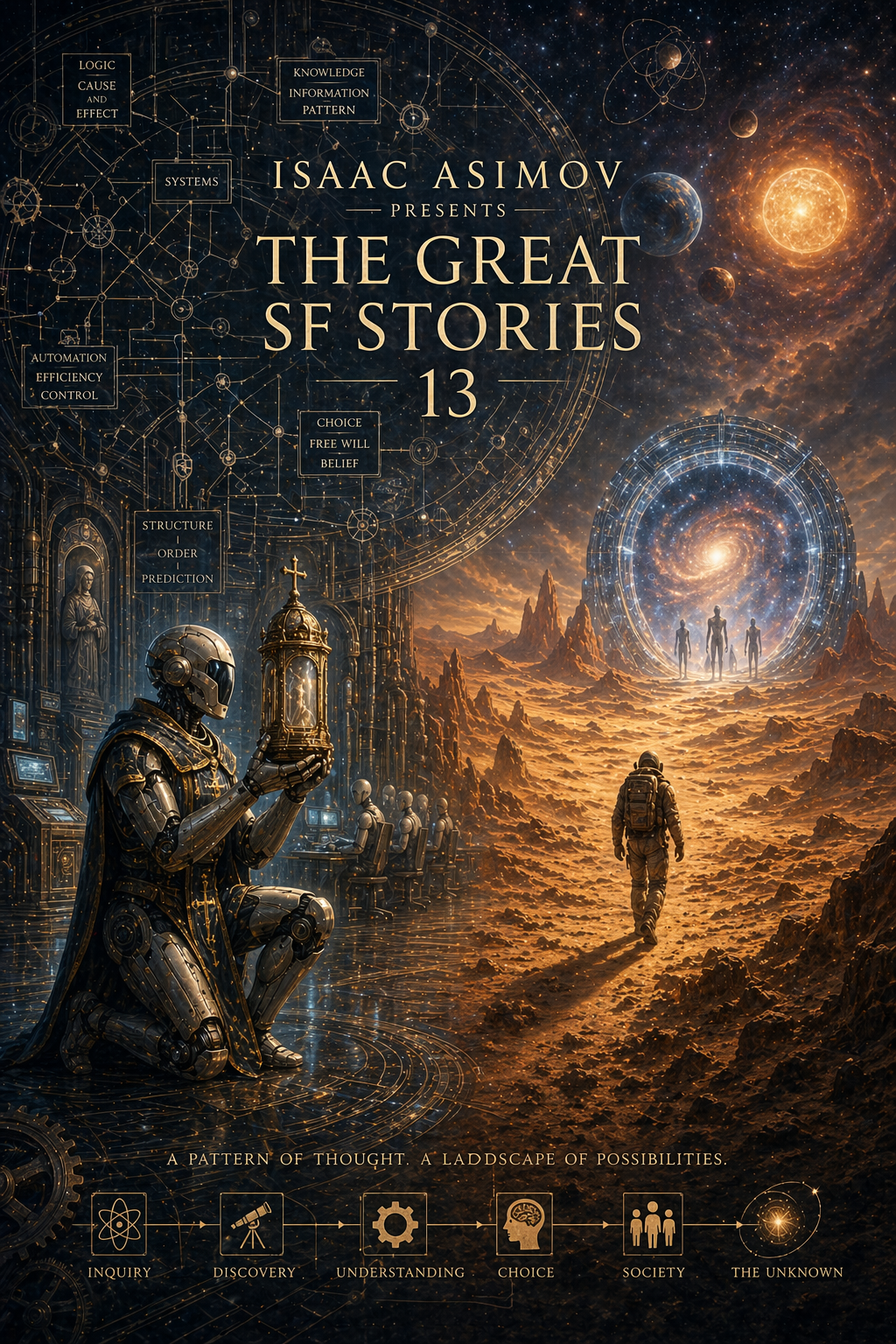
A traveler through the history of ideas often finds themselves at a specific crossroads, and in this case, that crossroads is the year captured in Isaac Asimov Presents the Great SF Stories, 13. To understand this volume is to understand more than just a set of tales; it is to recognize a quiet, methodical project undertaken by Isaac Asimov to demonstrate that science fiction is a steadily developing body of thought. This collection serves as a blueprint for the architecture of the future, where writers working independently move in similar directions, revealing a larger pattern of human progress and anxiety.
As the traveler opens the book, they encounter the first pillar of this architecture: The Quest for Saint Aquin by Anthony Boucher. This narrative does not begin with the roar of rockets but with the quiet hum of logic and belief. It follows a robot priest tasked with a search for a holy relic, navigating the tension between programmed certainty and the nature of faith. It is a deliberate starting point, for it establishes that the exploration of the future must first begin with an examination of the structure of thought itself. Here, we see the foundation of Asimov’s own interests, the intersection of the mechanical and the philosophical.
Moving further into the collection, the scope expands toward the stars in The Helping Hand by Poul Anderson. The story examines the complexities of interstellar contact, where humans and aliens must attempt to cooperate. However, the traveler learns that intelligence is no guarantee of clarity. Each species interprets the world through its own assumptions, leading to inevitable misunderstandings. This story suggests that the future is not merely a continuation of what we know, but an expansion into encounters that will fundamentally challenge our basic ways of thinking.
The path then turns inward with The Fun They Had by Isaac Asimov. In this brief, understated narrative, the focus is on the intimate scale of human life, specifically, education. It contrasts a future of perfectly efficient, automated schooling with the memory of traditional, social learning. The story reflects a recurring theme in the architecture of the future: that technological progress, while logical, carries an emotional cost that is not always obvious. It reminds the reader that as we build our world, we also alter the human experience.
The traveler then finds themselves on a harsh, alien landscape in A Walk in the Sun by Geoffrey A. Landis. This is a story of survival, built on precise scientific detail and the necessity of human ingenuity. Every step taken across the world is a calculation, and every decision is grounded in the laws of physics. It illustrates how knowledge is a vital tool for endurance, turning survival itself into a form of complex problem solving.
A different kind of challenge arises in The Nine Billion Names of God by Arthur C. Clarke. Here, a seemingly simple task, the completion of a list, leads toward a conceptual horizon that is vast and unexpected. The narrative is restrained, yet it suggests that following a single premise to its logical conclusion can result in a realization that is both inevitable and staggering. It shows that the architecture of the future is not just made of steel and silicon, but of ideas that can reshape the universe.
The tone shifts toward the satirical and the cautionary in The Marching Morons by Cyril M. Kornbluth. The traveler is presented with a future where a thin layer of intelligence struggles to manage a rising tide of ignorance. It asks a serious question beneath its humor: what happens to a civilization when its complexity outpaces the understanding of its citizens?. Asimov places this here to show that the future is not always an orderly progression; it can be shaped by human limitations and chaos.
Reflecting on the unknown, And Then There Were None by Eric Frank Russell explores the concept of hidden influence. In this narrative, the presence of the alien is felt not through direct conflict, but through its absence, suggesting that humanity may have been guided by forces it does not perceive. This reinforces the idea that the edge of human knowledge is often uncertain, and that our progress may be part of a larger, invisible design.
The sense of mystery continues in The Sentinels by Arthur C. Clarke, where the discovery of an ancient structure suggests a pattern far beyond human comprehension. The story does not provide easy answers; instead, it frames a question that invites the reader to look further into the dark. It serves as a reminder that science fiction is often about the questions we are not yet ready to answer.
Finally, the traveler encounters The Machine Stops by E. M. Forster, a story that feels remarkably immediate despite its age. It depicts a society that has become entirely dependent on a vast, automated system, losing its connection to the physical world in the process. The narrative logically follows this dependency to its ultimate vulnerability, echoing the earlier themes of machines as extensions of our capability that eventually become structures that trap us.
As the volume concludes, the traveler realizes that these stories are not scattered ideas, but a conversation among parts. Each narrative contributes to a shared exploration of knowledge, limitation, and consequence. The collection is a progression that guides the reader from simple premises to complex considerations. It does not offer a single vision of what is to come, but a framework of possibilities grounded in logic.
In reviewing this work, one sees the hand of the architect. Through his selection and arrangement, Asimov creates a coherent vision from variety. The book leaves the reader at a threshold, aware that while the future is uncertain, each step follows logically from the last. It is a testament to the idea that science fiction is not an escape, but a way to engage more deeply with the reality of our developing thought. The architecture of the infinite future, as presented here, is not a boundary but a beginning.