The Tyrannosaurus Prescription One Hundred Other Science Essays
Asimov explores technology, space, history, fantasy, and humanity through curiosity, humor, reason, optimism, and interconnected knowledge.
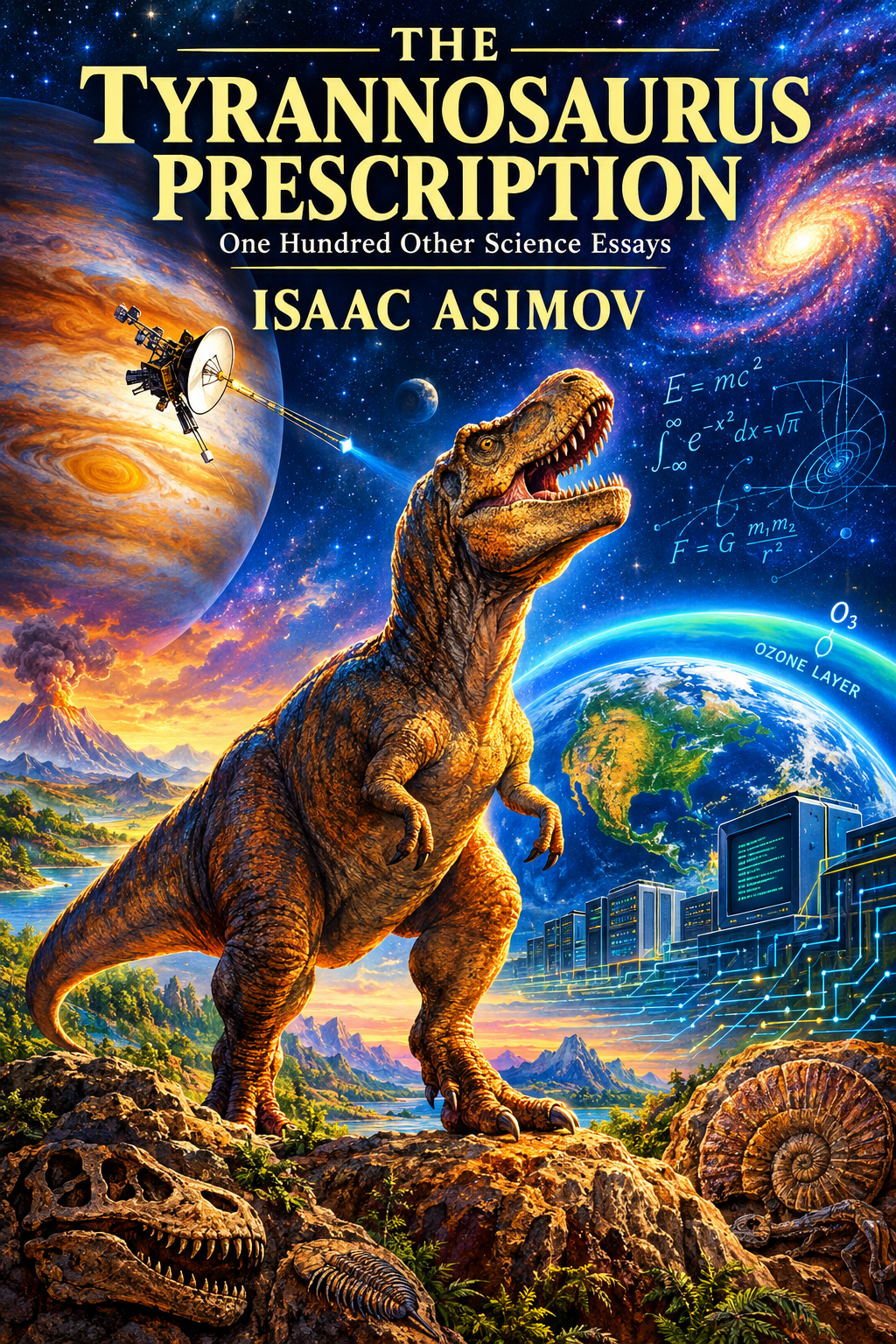
Isaac Asimov’s The Tyrannosaurus Prescription: and One Hundred Other Science Essays, published in 1989, presents an intellectual journey across science, history, space, literature, and human nature. Rather than following a single fiction narrative, this collection of 101 previously uncollected pieces functions as a grand cabinet of curiosities divided into seven broad realms. Written with Asimov’s signature clarity, humor, skepticism, and rational optimism, the book builds from immediate human challenges on Earth and leads toward deep space, scientific history, fantasy, and personal reflection.
The journey begins in "The Future," where Asimov explores how civilization might navigate its upcoming trials. In "Our Future in Education," he emphasizes that education must serve as a vital survival mechanism against population growth, resource depletion, and environmental decay. He examines how technology can augment human intellect in "Filling the Brain Gap" and anticipates distance information access in "The Global Computerized Library". Balancing technical progress with realistic human constraints in "What Computers Won’t Do," "The Future of Handicraft," "The Future of Chemical Engineering," and "Men and Marriage," Asimov's logical presentation demonstrates that predicting human behavior is far more complex than forecasting machines.
From Earth, the narrative expands into "Space," driven by the fundamental urge for discovery outlined in "The Lure of Exploration". The book builds toward practical planetary destinations in "Our Second World" and "All Aboard for Phobos," while stressing in "What Do We Do Next in Space?" that cosmic voyages are meaningful only when they expand genuine human knowledge. In "Adventure in Space," "The Distant Flights," and "The Telephone in Space," Asimov addresses the vast distances, required patience, and communication demands of interstellar travel, leading to "The Average Person as Astronaut," which envisions extraordinary spaceflight ultimately becoming a routine activity for humanity.
The narrative then turns to fundamental "Science," exploring planetary discovery in "Giant Jupiter" and "Pluto, the Constant Surprise" to show how new data continually reshapes scientific understanding. Atmospheric and environmental dilemmas are confronted in "A Hole in the Sky," while "Our Changing Perception of the Universe" and "What Is the Universe?" present scientific knowledge as an ongoing process of refinement. The book highlights the impact of individual genius in "The One Man Revolution" concerning Albert Einstein, explores potential natural forces in "The Fifth Force," and traces evolutionary and prehistoric discoveries in "The Double Discovery of Evolution," "Master Lizard, the King," and "The Hot Blooded Giants".
In the "SciQuest" section, Asimov focuses on the human story behind discovery through pieces such as "The Absent Minded Professor," "The First Scientist," "The Race for Honor," "Thoughts in Prison," "Getting Started," and "Scientists Are Human". Essays like "The Joys of the Unexpected" and "Scientific Heretics" reveal that nature often advances science by defying expectations, while "Self Correcting" stresses that the true strength of the scientific method lies in its ability to identify and fix errors. This progresses logically to "The Knowledge of Good and Evil" and "Science and Technology," placing ethical accountability directly on human choices.
The grand "Forewords" section leads the reader through human civilization, history, and myth. Asimov explores space missions in "Shuttle," "The Good Deed of Voyager 2," "The Longest Voyage," and "First Contact," before investigating historical shifts in "The Lost City," "The Ifs of History," "Empires," and "In Days of Old". He analyzes human psychology and culture in "Psychology," "Show Business," "Super," "Larger than Life," "Neanderthal Man," "The Nonhuman Brains," "Computer Envy," and "Dogs". In fantasy pieces like "Dragons!," "Hobgoblin," "Is Fantasy Forever?," "Wizards," "Witches," "Curses!," "Monsters," "The Power of Evil," and "The Devil," Asimov demonstrates that human beings create supernatural monsters and myths to cope with fear and explain evil.
Examining his home genre in "Science Fiction," Asimov traces literary traditions in "Science Fiction Finds Its Voice," "The Five Greats of Science Fiction," "The Success of Science Fiction," and "Science Fiction Today". He recognizes cultural shifts in "The Feminization of Science Fiction" and reflects on historical development in "Back Through Time," showing that science fiction is a powerful method for examining how human institutions respond to technological change.
The story concludes with "Personal" reflections, connecting immigration and identity in "Our Shangri La" and "Ellis Island and I". In the title piece, "The Tyrannosaurus Prescription," Asimov uses the dinosaur as a comic symbol for taking a whimsical step away from the burdens of modern civilization. The book culminates in "Seven Steps to Grand Master," reflecting on his own distinguished literary career.
In summary and review, The Tyrannosaurus Prescription serves as an intellectual map of Asimov's mind, demonstrating how curiosity links disparate fields into a single story of human understanding. The collection's strength lies in its intellectual mobility, as Asimov seamlessly connects simple questions with larger scientific, historical, and psychological principles. While some futuristic speculations reflect their origin prior to 1989, this historical perspective offers a fascinating look at how a master science writer envisioned humanity's future trajectory. Designed as an accessible tapestry that readers can enter at any point, the volume is a logical, engaging celebration of human knowledge and the endless quest to comprehend the universe.