Asimov On Science A 30 Year Retrospective 1959-1989
Isaac Asimov chronicles thirty years of scientific inquiry, tracing human curiosity from subatomic particles and mathematics to cosmology and the evolving nature of scientific knowledge.
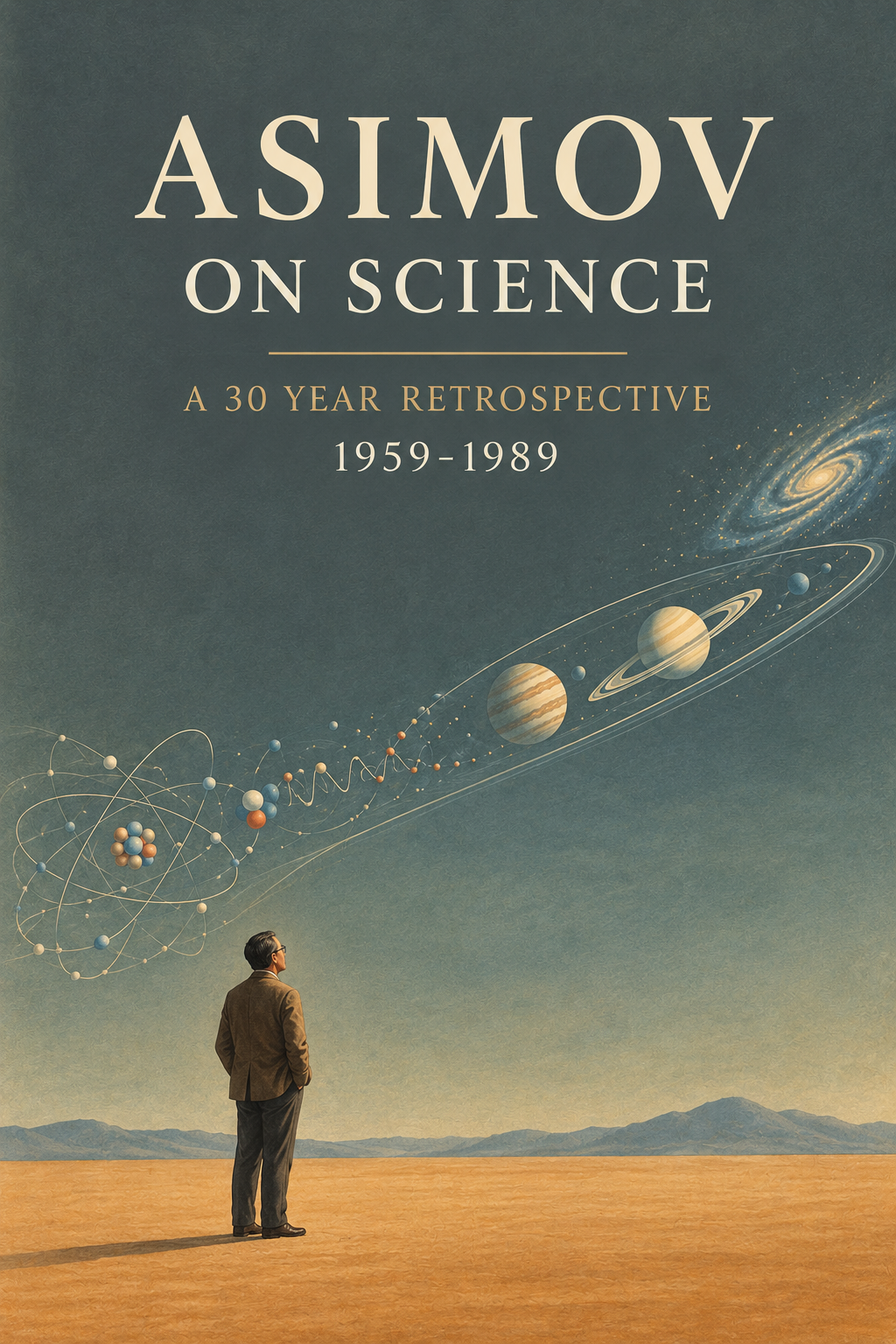
Isaac Asimov’s Asimov on Science: A 30 Year Retrospective, 1959–1989 unfolds not as a dry compilation of static facts, but as an intellectual adventure story tracking thirty years of human curiosity. The origin of this retrospective dates back to 1958, when editor Robert P. Mills invited Asimov to write a monthly column for The Magazine of Fantasy and Science Fiction on any scientific subject that caught his interest, completely free from editorial interference. Published in 1989, the collection selects thirty-one essays from these columns across three decades, crafting a unique scientific autobiography told through the evolution of ideas rather than personal memoirs. Rather than revealing a single dramatic climax or plot secret, the overarching narrative shows where human inquiry begins, in ordinary observations of numbers, words, and particles, and where it inevitably leads: outward toward the origin, structure, and ultimate fate of the universe.
The story begins at the smallest possible scales, demonstrating how humanity uses reasoning to make sense of the microscopic world. In “The Ultimate Split of the Second,” Asimov opens the journey by exploring subatomic particle physics through the lens of unimaginably brief time intervals, showing how human intuition struggles with scales far beyond daily experience. He then transitions to mathematics in “A Piece of Pi,” revealing how a single familiar constant, pi, unlocks vast questions regarding geometry, measurement, and infinity. Turning toward the heavens in “Heaven on Earth,” he reconsiders traditional concepts of "heaven" through the lens of modern astronomical discovery. In “The Egg and Wee” and “You, Too, Can Speak Gaelic,” Asimov illustrates that scientific principles are often embedded directly within everyday human language, word origins, and cultural terminology.
As the narrative gathers momentum, the focus shifts toward physical laws, chance, and matter. In “The Slowly Moving Finger,” he examines the mechanics of motion and physical measurement, while “Exclamation Point!” uses mathematical notation and punctuation as a doorway into scientific communication. Probability and chance take center stage in “I’m Looking Over a Four-Leaf Clover,” where he proves that rare events are natural occurrences given sufficient opportunities rather than miracles. Numerical relationships become living characters in “Twelve Point Three Six Nine,” showing how patterns in numbers conceal physical meaning. He explores materials science in “Knock Plastic!” before entering quantum physics with “Uncertain, Coy, and Hard to Please,” demonstrating that uncertainty is an inherent property of nature rather than a mere gap in human knowledge.
The grand narrative then expands into theoretical physics, human history, and biology. In “The Luxon Wall,” Asimov frames relativity and the speed of light as a fundamental cosmic boundary shaping space and time. In “Pompey and Circumstance,” he traces the historical development of science within human civilization, followed by “Lost in Non-Translation,” which highlights the difficulties of translating universal scientific concepts across human languages. He connects ancient scientific inquiries with modern theoretical models in “The Ancient and the Ultimate,” showing that despite vast differences in technology, both eras are driven by identical questions about reality. In “Look Long upon a Monkey,” he turns to evolutionary biology, placing humanity within its broader biological history.
In the middle chapters, science examines the very instrument conducting the investigation: the human mind. “Thinking About Thinking” and its companion “More Thinking About Thinking” explore intelligence, logic, and how the brain reaches conclusions, illustrating that scientific questions often remain open across decades. “Best Foot Backward” returns to evolutionary mechanics, while “The Subtlest Difference” demonstrates how tiny distinctions at the atomic or biological level produce macroscopic consequences. In “The Floating Crystal Palace,” he explores crystallography and organized molecular arrangements. He reflects on biological sensory limits in “Alas, All Human,” bridges science with literature in “Milton! Thou Shouldst Be Living at This Hour,” and confronts theoretical physics in “And After Many a Summer Dies the Proton,” which examines proton decay and the cosmic impermanence of matter itself.
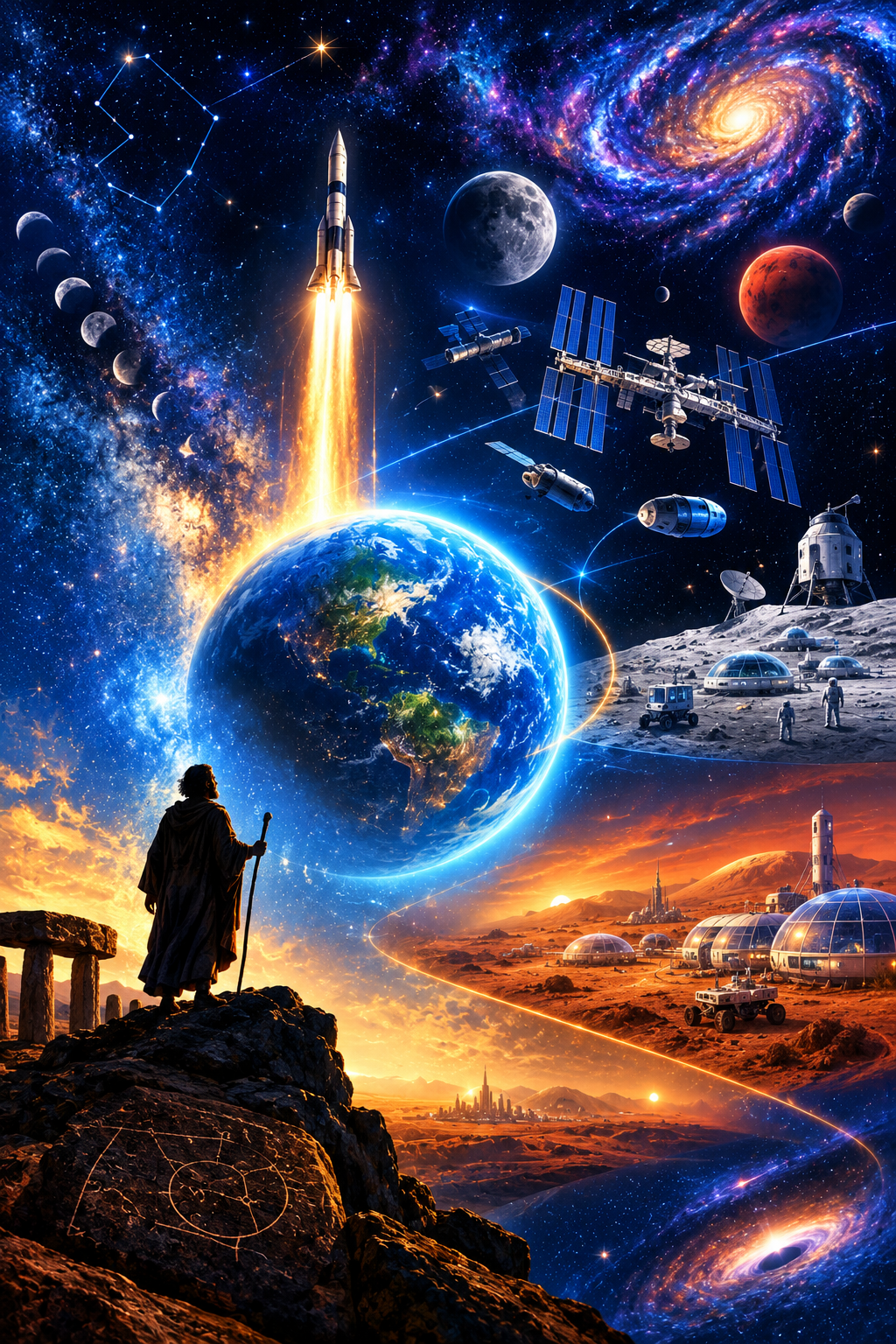
In its final arc, the story widens to cosmic proportions while reflecting on the nature of scientific progress. “The Circle of the Earth” traces how Earth shifted in human thought from the central hub of creation to one planet among billions. In “What Truck?”, Asimov demonstrates how profound scientific principles emerge from mundane observations. “Far as Human Eye Could See” pushes human vision outward to the limits of astronomical observation and cosmic history. In his famous essay “The Relativity of Wrong,” he refutes the idea that older scientific theories were simply incorrect, arguing that science progresses by refining previous models rather than destroying them. He bridges science and poetry in “A Sacred Poet,” examines geographical definitions in “The Longest River,” and brings the retrospective to its destination in “The Secret of the Universe,” originally published in March 1989, where thirty years of inquiry unite to view the cosmos as a coherent whole.
Ultimately, Asimov on Science stands as a portrait of scientific thinking itself, presenting science not as a finished book of static answers, but as a continuing conversation between ignorance and understanding. By demonstrating that nothing is too ordinary to investigate, Asimov shows that every reliable answer creates a better question, celebrating the human mind's eternal willingness to ask why.