Asimov's Galaxy Reflections on Science Fiction
In Asimov’s Galaxy, Isaac Asimov explores science fiction as a disciplined, logical framework for examining scientific possibilities, the writing craft, genre history, and human curiosity.
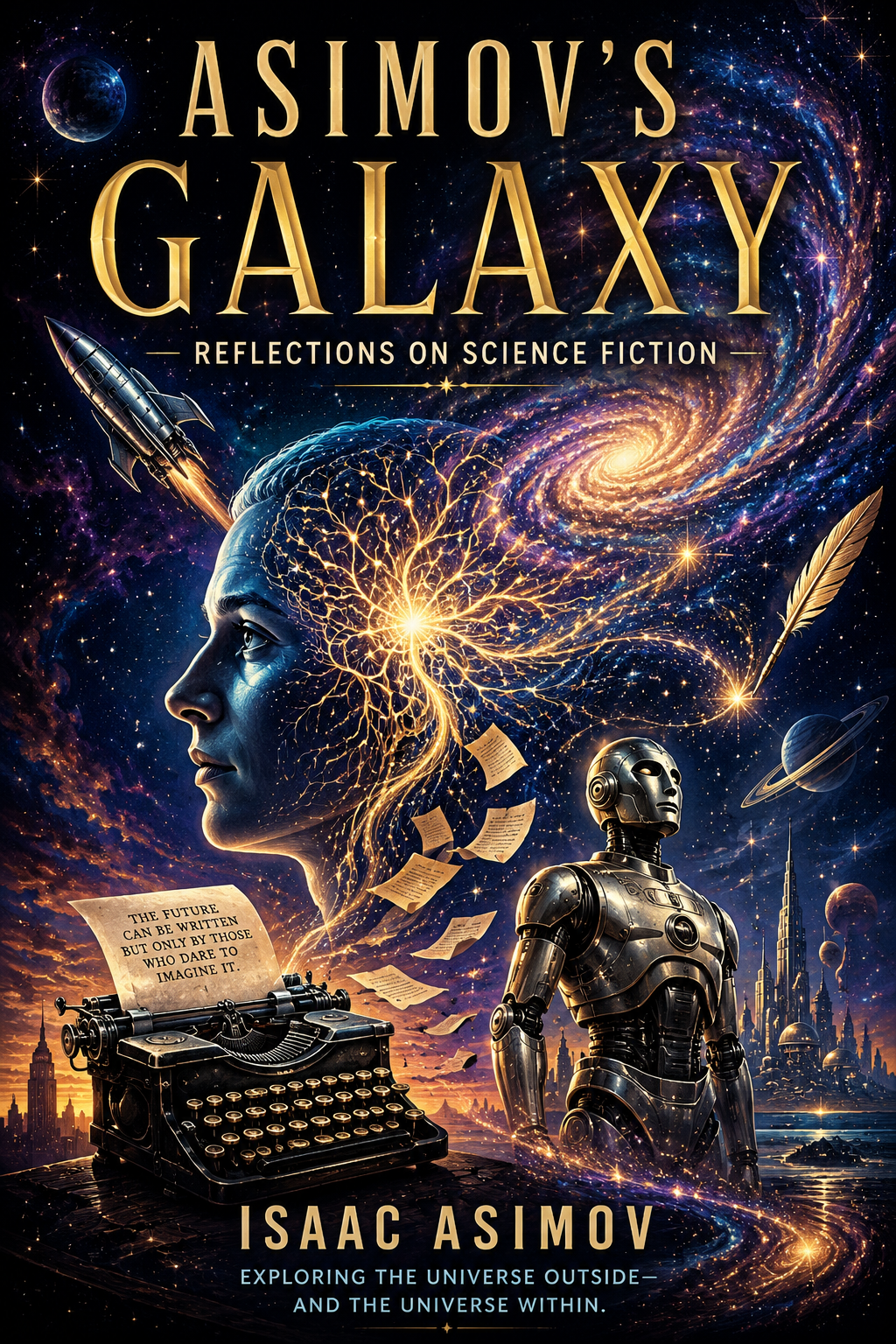
Science fiction is frequently mistaken for a mere literature of rockets, robots, monsters, and distant planets, but Isaac Asimov recognizes that it is fundamentally a method of human thought. In Asimov’s Galaxy: Reflections on Science Fiction, published by Doubleday in 1989, Asimov guides the reader through his own mind and the literary universe he helped shape, treating speculative fiction as a logical framework for asking what happens when the conditions of human life or technology change. Rather than a traditional narrative novel or a collection of fictional stories with plot twists to spoil, this book consists of nonfiction essays, reflections, arguments, and autobiographical fragments organized across thematic sections.
The journey opens with the section examining The Influence of Science Fiction, where Asimov explores how imaginative literature alters the way readers envision tomorrow. He points out that individuals raised on stories of space travel, computers, robots, and alien civilizations learn to stretch their imagination before reality catches up. In Our Obsolete World, he turns to the instability of the present, demonstrating how ideas that once seemed permanent can quickly become obsolete even before the future officially arrives. Asimov expands this inquiry in Women and Science Fiction, reflecting on the evolving role of women in a field historically dominated by men, while Schools and Science Fiction advocates for the educational power of imaginative writing. In Religion and Science Fiction, he considers how human beings react when scientific speculation challenges deeply held religious beliefs. With a humorous and argumentative touch in The Kiss of Death?, Shrugging It Off, and Watch Out!, he takes common criticisms directed at science fiction, exposes the hidden assumptions inside them, and logically dismantles them.
Transitioning from the reader to the craftsman, the section on Science Fiction Writing dissects the practical mechanics of storytelling. In The Unforgivable Sin, Asimov identifies fatal writing errors, while Satire and Irony demonstrate how writers communicate subtle truths beneath literal text. Through essays including Revisions, Plagiarism, Originality, Names, Dialog, Symbolism, Serials, Nowhere!, Science Fiction Poetry, and Science Fiction Anthologies, he presents writing as a continuous accumulation of practical decisions. He emphasizes that character names must be chosen thoughtfully, dialogue must accomplish constructive work, and overused symbolism risks making an author appear desperate to prove importance. Furthermore, he notes that absolute originality is impossible because writers inevitably borrow from everything they read; the true creative act lies in transforming inherited ideas into something personal.
In What Writers Go Through, The Writer’s Plight, and Editors, Asimov strips away romantic mythology to expose the commercial realities of publishing, including deadlines, contracts, rejection slips, and editorial negotiations. He then examines the social dynamics of authors in Pseudonyms, considering why writers adopt pen names, and celebrates the field's commercial growth in We’re Doing Well . In Outsiders, Insiders and Civil War, he portrays science fiction as an energetic, divided community filled with rivalries, generational conflicts, and ongoing debates over its future direction.
The section on Science Fiction and Science brings Asimov onto familiar ground, linking imaginative concepts to physical reality. In Catastrophes, Moonshine, Household Robots, The Sun and Moon, and The Solar System, he connects astronomical bodies and technological concepts, including the domestic robotics familiar from his own fictional works, to clear scientific context. The perspective widens dramatically in What’s a Galaxy? and Our Own Galaxy, where human vanity shrinks as Earth is shown to be one tiny planet within a solar system, which itself is merely a small component of the Milky Way. In Star Wars!, The New York Times Laughs Again, Faster Than Light, and Time Travel, Asimov insists that scientific wonder must coexist with scientific discipline, requiring writers who bend the laws of physics to understand the underlying principles they are breaking.
Addressing speculative boundaries, Asimov draws a clear line between science fiction and fantasy in essays like Fantasy, Wish Fulfillment, Sword and Sorcery, Fairy Tales, and Magic . He explains that while science fiction poses a logical what if question and constructs a cause and effect chain of consequences, fantasy operates by declaration, accepting the impossible as its baseline premise. Moving into Science Fiction Magazines, Asimov chronicles the vital role of magazine culture in essays like Opinion, Controversy, Magazine Covers, Unreasonable!, and Slush! . He details the arguments of a living literary movement, the contrast between sensational cover art and serious prose, and the editorial effort required to read slush piles. In Book Reviews and Integrity, he articulates the ethical responsibilities that reviewers, editors, and authors owe to their audience and to truthfulness.
The book turns deeply personal in Science Fiction and I, as Asimov reflects on his own career and identity. In Nostalgia, he revisits the youthful reading and pulp magazines that shaped him, while Susan Calvin explores his connection to the legendary robopsychologist from his robot stories. Through Not an Expert, Violence and Incompetence, Family Matters, Persona, and My Name, he examines how public celebrity transforms an author into a fictional character in the minds of readers. In Bestseller, My Projects, My Autobiography, What Makes Isaac Run?, and More Asimov?, he explains his extraordinary literary output not as mystical talent, but as the product of disciplined habit, curiosity, and an innate need to think by writing. He concludes the collection with Superstupidity, Autographs, and Irritations, offering humorous reflections on the minor annoyances and human realities of a literary life.
As a comprehensive review, the primary strength of Asimov’s Galaxy lies in its wide ranging, conversational structure. By jumping between scientific principles, editorial logistics, writing advice, and personal memories, Asimov constructs a vivid portrait of both science fiction and his own mind. Published in 1989, the volume serves as a historic bridge, looking back at the Golden Age of science fiction while assessing the late twentieth century literary landscape. Written in clear, straightforward, logical prose, the collection leaves the reader with a profound core message: science fiction matters because human beings must continually imagine alternatives for the future. The spaceship is merely the vehicle for exploration, but the ultimate destination of Asimov's galaxy remains the human mind.