Norby and Yobo's Great Adventure
Space cadet Jeff Wells, his quirky robot Norby, and Admiral Yobo travel back to prehistoric Africa to research the origin of an ancient family heirloom.
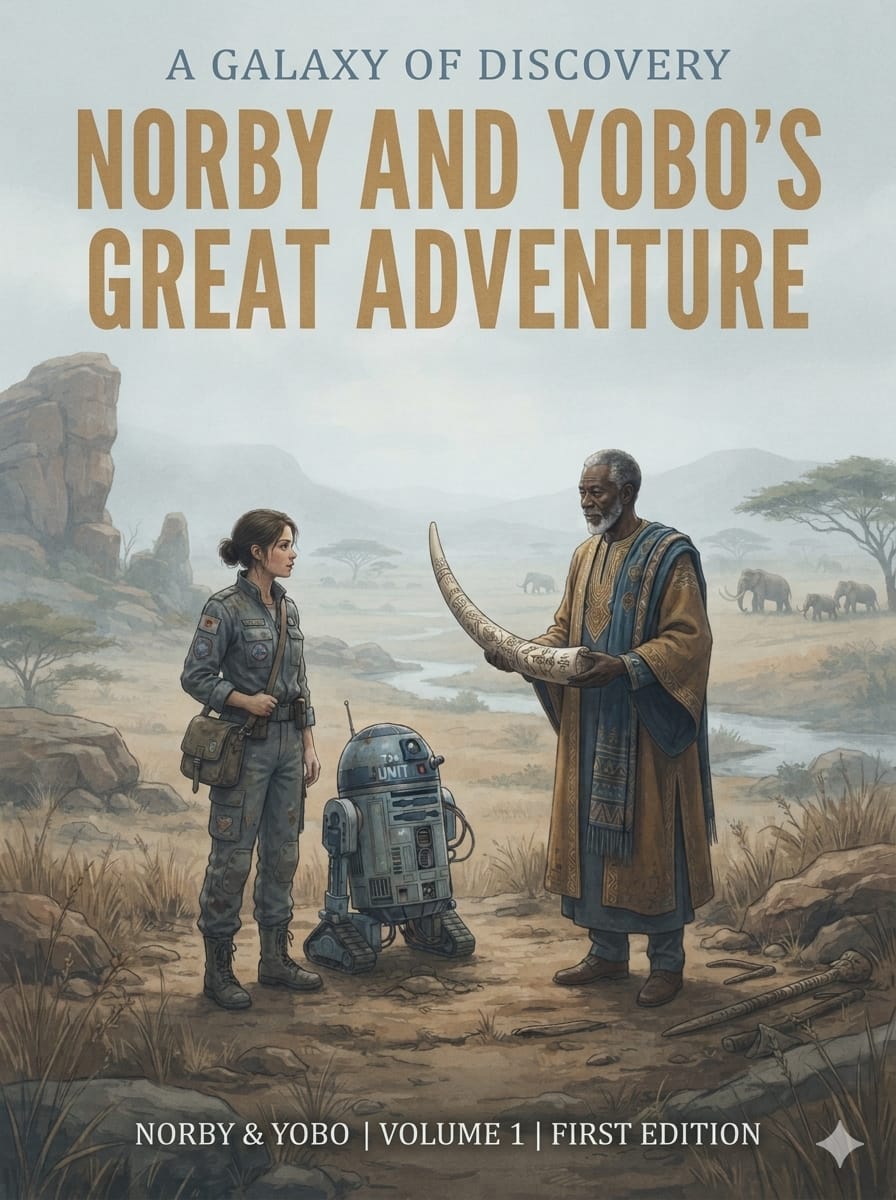
In the long arc of Isaac Asimov’s literary legacy, science fiction serves above all as a tool for logical inquiry. Whether examining the vast galactic machinery of the Foundation series, the temporal engineering of The End of Eternity, or the juvenile space-faring adventures of the Lucky Starr novels published under the pseudonym Paul French, Asimov consistently framed story-telling as a rational puzzle where reason triumphs over chaotic emotion. The Norby Chronicles, co-authored with his wife Janet Asimov, extend this grand tradition directly to younger minds. Published in 1989 as the eighth installment in the series, Norby and Yobo’s Great Adventure builds upon these foundational Asimovian principles, pairing futuristic robotics with temporal physics to explore the timeless human urge to understand one's origin.
The narrative builds from a deceptively modest premise grounded in the daily life of the mid-twenty-first century Space Academy. Jefferson "Jeff" Wells, a young space cadet, relies on his unusual companion robot, Norby, to navigate academic pressures and cosmic misunderstandings. Unlike the standardized positronic automata of Asimov’s classic robot stories, Norby is a mixed-up creation assembled from antique and alien components, endowing him with an unpredictable personality alongside a miniaturized hyper-spatial drive capable of leaping through space and time. The quiet routine of the Academy is upended by Admiral Boris Yobo, a distinguished, history-obsessed officer who possesses a prized family heirloom, a carved tusk handed down through generations. Refusing to accept incomplete historical records or unverified family lore, Yobo decides to use scientific means to seek direct empirical proof of the object's origin. In true Asimovian fashion, where every grand discovery begins with an insistence on clear evidence, Admiral Yobo enlists Jeff and Norby to take him on what is intended to be a simple, observation-only weekend trip into Earth's distant past.
What starts as a brief historical investigation quickly evolves into a high-stakes adventure as the journey carries the trio deep into ancient Africa during prehistoric times. Upon arriving in an era dominated by roaming mastodons and early human communities, the travelers are confronted with the stark reality of primitive nature. Here, the story highlights a classic Asimovian theme: advanced technology does not grant automatic invincibility. Displaced from the technological safety nets of the future, Jeff, Norby, and Admiral Yobo must rely on practical thinking, mutual trust, and diplomatic tact to navigate encounters with local tribes and prehistoric hazards. The narrative contrasts Admiral Yobo’s academic enthusiasm with the immediate, unpredictable demands of living history, illustrating that observing the past from afar is vastly different from experiencing it firsthand.
As the expedition unfolds, the narrative leads toward a profound exploration of temporal responsibility and human adaptability. The central danger shifts from physical survival in ancient Africa to the looming threat of becoming stranded across time or inadvertently altering the fragile historical continuum. Norby’s anti-gravitational and temporal mechanisms provide the structural bridge between eras, but it is Jeff’s pragmatic judgment and Yobo’s growing appreciation for cultural heritage that drive their survival. Without revealing specific plot resolutions or twists, the story leads toward a crucial understanding: technology is merely an instrument, and true resolution requires human empathy, clear logic, and an respect for the cultures that laid the foundation for the future.
As a critical review, Norby and Yobo’s Great Adventure stands as a charming, lighthearted contribution to the juvenile science fiction genre. Janet Asimov’s lively narrative pacing, combined with Isaac Asimov’s trademark clarity and logical structure, produces a story that is both accessible and intellectually stimulating for young readers. The book embeds vital social lessons regarding diversity, inclusion, and the value of historical curiosity without sacrificing the playful energy of a time-travel adventure. While seasoned readers of Asimov’s complex adult masterpieces may find the plotting straightforward, the novel succeeds admirably in its primary mission: teaching young minds that scientific power must always be balanced by ethical responsibility and logical foresight.
Because this volume is frequently collected in omnibus editions alongside companion novellas in the series, it is worth examining the adjacent mini-story, Norby and the Oldest Dragon, which expands upon the same central characters and world. In this companion tale, Jeff Wells finds himself reluctant to leave the Space Academy for the weekend, feeling out of sorts and wishing for a quiet break. However, his bossy robot Norby insists that they pack for a trip to the planet Jamyn to attend the grand birthday celebration of the Oldest Dragon. What Jeff anticipates will be a boring ceremonial duty rapidly turns into an unexpected crisis. In this story, the narrative builds from Jeff's youthful reluctance and leads into a creative test of diplomatic problem-solving across alien cultures, reinforcing the series' overarching message that unexpected adventures often yield the deepest lessons in understanding others.
Together, these stories reflect the enduring appeal of the Asimov universe. By using simple words, clear logical sequences, and engaging story-driven paragraphs, Janet and Isaac Asimov demonstrate that the greatest scientific adventure of all is the unending quest to ask questions, examine evidence, and understand our place in the vast flow of time.