Nemesis
When space colony Rotor flees to star Nemesis, scientists discover it threatens Earth, while a highly perceptive girl communicates with an alien planetary collective mind.
The Spark of Interstellar Awakening
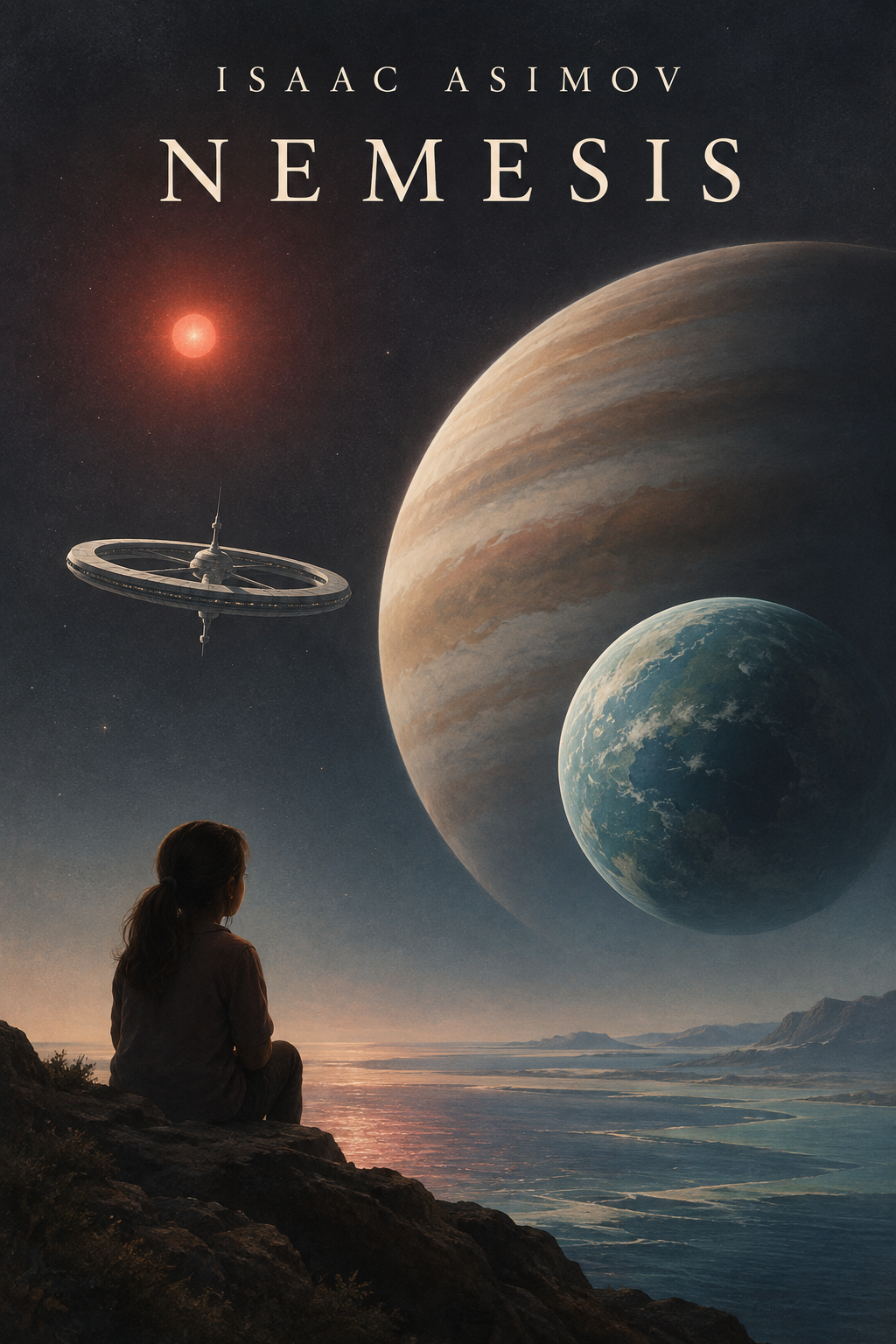
Isaac Asimov's Nemesis opens in the twenty third century, a time when humanity resides in artificial space settlements scattered across the Solar System. One small, ambitious colony named Rotor decides to undertake a radical departure by abandoning the Solar System entirely in search of a new home. This exodus is made possible by the discovery of a faint red dwarf star located roughly two light years from Earth, named Nemesis by the astronomer Eugenia Insigna. Rotor utilizes a secret sublight propulsion technology known as hyper assistance to make its journey across interstellar space. For Rotor's political leader, Commissioner Janus Pitt, this voyage represents an opportunity to establish an isolated society free from the crowded and complicated civilization of Earth. In true Asimovian fashion, this setup echoes the recurring ideological divide found across his grand universe, most notably the historical tension between planet bound Earthmen and forward looking Spacer pioneers who seek self determination among distant stars.
The Human Atom: Family and Fracture
While Rotor's departure is heralded as a triumph of human engineering, Asimov immediately anchors this grand voyage in personal heartbreak. The migration breaks apart a single family: Eugenia Insigna's husband, Crile Fisher, is an Earthman who refuses to abandon his home world. Unable to resolve their deep disagreement, Crile chooses to return to Earth, while Eugenia takes their young daughter, Marlene, aboard Rotor. Through this tragic separation, the narrative establishes a core emotional theme: no matter how advanced human technology becomes, it cannot prevent people from hurting one another. Asimov reminds us that the vastness of space does not erase human frailty, setting up a personal dimension that mirrors the larger geopolitical divide between Earth and its breakaway colony.
A Cosmic Dilemma and The Hidden Peril
As Rotor journeys toward its destination, Eugenia makes a second, terrifying astronomical discovery. Nemesis is not merely a quiet destination; its motion indicates that thousands of years in the future, it will pass sufficiently close to the Solar System to disrupt Earth's orbit. Though the threat operates on a cosmic timescale, Nemesis could alter Earth's orbit enough to render the planet completely uninhabitable. This realization creates an agonizing dilemma for Eugenia. She recognizes that Earth must eventually be warned about this danger, but Commissioner Janus Pitt enforces political secrecy to preserve Rotor's isolation and independence. This conflict highlights a central tension in the novel between scientific knowledge and political control, demonstrating that discovering facts is distinct from deciding what society will do with that knowledge.
Dual Timelines and Interstellar Breakthroughs
Structurally, Asimov constructs the narrative by weaving together two converging timeline threads. As Rotor travels toward Nemesis, the story moves backward in time to follow Crile Fisher on Earth. Crile becomes involved in Earth's attempts to uncover Rotor's secrets and collaborates with Tessa Wendel, a brilliant physicist studying superluminal travel. Earth's scientists realize that near light speed travel will not suffice, and that reaching Rotor requires developing faster than light capabilities. This dual narrative device creates mounting tension as the reader watches Rotor establish itself while Earth races to achieve its scientific breakthrough, eventually enabling humanity to cross interstellar distances in a fundamentally new way.
The Living World of Erythro
Upon reaching the Nemesis system, Rotor settles near Erythro, a large moon orbiting the giant gas planet Megas. Erythro appears to be a viable new home, possessing an atmosphere and liquid water. However, initial scientific surveys reveal only simple microscopic organisms, with no obvious civilization or animal life. Yet beneath this quiet exterior, Erythro contains a profound mystery: its microscopic organisms are not isolated bacteria, but collectively form a planetary scale consciousness. This revelation transforms Erythro from an empty colony site into a living environment that already possesses its own form of alien intelligence. The concept of a planetary mind directly connects Nemesis to Asimov's broader philosophical fascination with unified consciousness, echoing themes seen in his Foundation universe.
The Perception of Marlene Fisher
At the center of this mystery is Marlene Fisher, now a fifteen year old girl living on Rotor. Marlene possesses an extraordinary nonsupernatural ability to read human physical reactions, body language, facial gestures, and posture. Her unusual sensitivity allows her to feel an inexplicable attraction to Erythro and perceive the planetary intelligence far more directly than the adults around her. Marlene ceases to be merely a child caught between separated parents, becoming the crucial conduit through which different forms of intelligence communicate. Asimov uses Marlene to champion a different form of intellect, one rooted in quiet observation, empathy, and intuitive awareness rather than mechanical equations.
Where the Story Builds From: Asimovian Roots
Examining where Nemesis builds from, the novel grows out of Asimov's traditional science fiction foundations: sublight interstellar colonization, political friction between Earth and remote colonies, relativistic physics, and the mystery of extraterrestrial biology. Asimov takes these scientific premises and expands them into philosophical puzzles regarding the nature of civilization, intelligence, and scientific responsibility. Like his Robot and Foundation sagas, Nemesis builds upon the belief that physical and biological puzzles yield to clear logical inquiry when unburdened by prejudice.
How the Story Leads Forward: Philosophical Convergence
Looking toward how the story leads forward, Asimov avoids leading the reader into a standard disaster story or violent space confrontation. Instead, the narrative leads toward a convergence of four distinct elements: Earth's search, Rotor's desire to hide, Nemesis's impending orbit toward the Solar System, and Erythro's alien consciousness. The story builds toward asking whether intelligence can recognize and understand other intelligence before fear, political secrecy, and self interest destroy the possibility of cooperation. The novel moves away from a basic threat and rescue plot, steering instead toward mutual understanding across every level of existence.
Review: Ideas Over Action in Classic Style
In reviewing the novel, its greatest strength lies in its conceptual depth rather than conventional physical action. Asimov constructs a narrative built around real scientific principles, astronomy, relativistic travel, xenobiology, and collective intelligence, and elevates them into philosophical questions. Written in Asimov's characteristic style, the prose is plain, direct, and unpretentious, relying on clear logical progression and articulate dialogue to drive the story forward. Marlene's character highlights Asimov's belief that understanding comes not only from machines and mathematical equations, but from extraordinary attention to living beings and careful observation.
The Multi-Layered Symbolism of Nemesis
The title Nemesis functions as both the name of a star and a symbol of consequences, illustrating that technological achievements create possibilities that inevitably bring new responsibilities. Rotor seeks to escape the problems of Earth, only to discover that true isolation in an interconnected universe is impossible. Earth seeks to keep pace with its fledglings, driving scientific breakthroughs that forever alter humanity's place in the cosmos. The star serves as a constant reminder that technological progress without moral wisdom carries severe cosmic consequences.
Concluding Reflection: Humanity and the Stars
Ultimately, Nemesis demonstrates that in an interstellar age, isolation is an illusion, and scientific advancement must be accompanied by communication, honesty, and human wisdom. Whether between separated parents and their child, between Earth and its distant colonies, or between human beings and an alien collective mind, the novel asserts that understanding one another is humanity's greatest hurdle. Asimov maintains his signature optimism regarding scientific progress, but tempers it with a clear warning: conquering interstellar distances is meaningless if we remain trapped by fear and secrecy. Before humanity can truly inhabit the galaxy, it must first learn the art of understanding.