Astronomy Today
Isaac Asimov explores observational astronomy, demonstrating how optical telescopes, radio dishes, and dedicated observers analyze electromagnetic radiation across space to systematically unlock deep cosmic secrets.
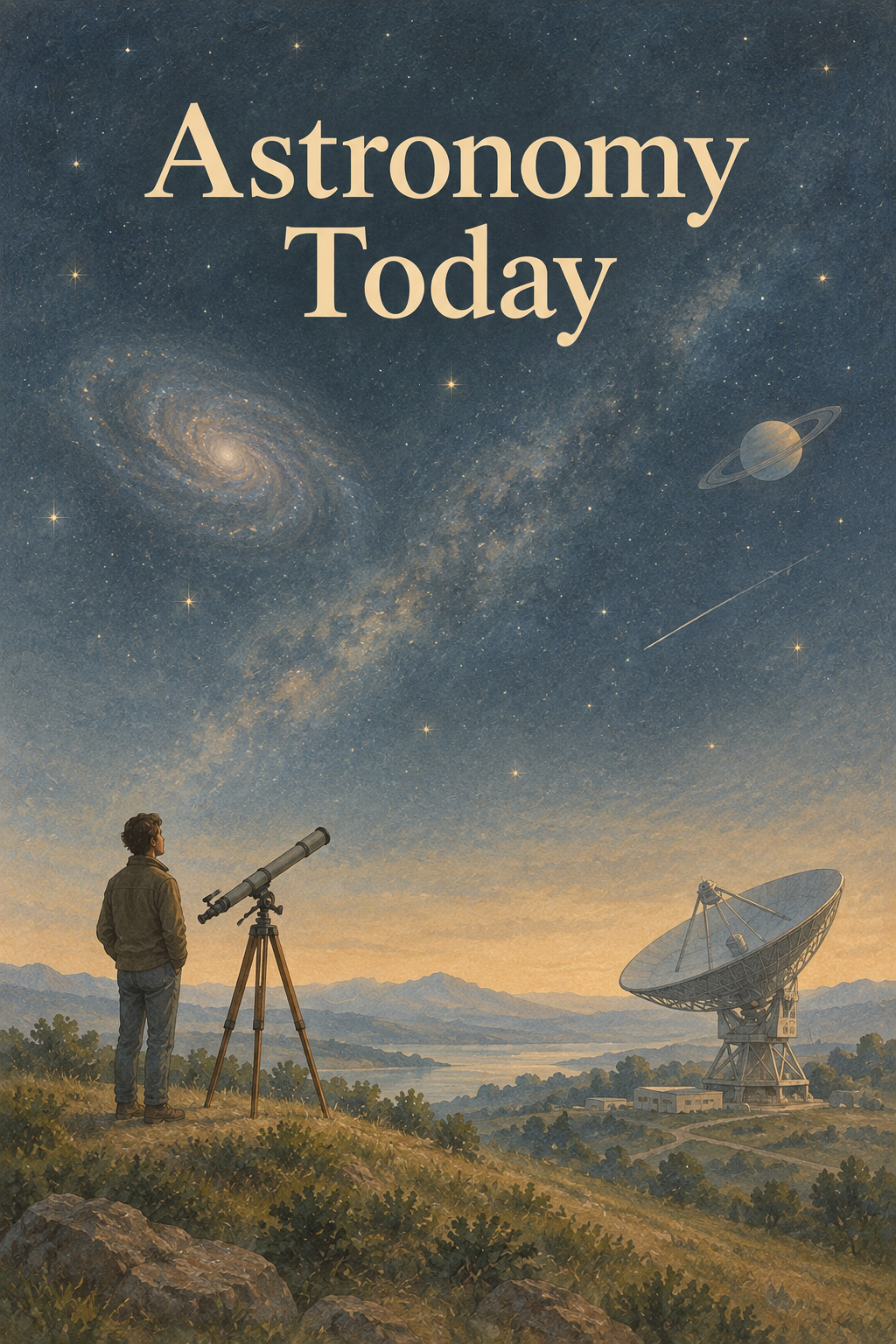
Isaac Asimov’s Astronomy Today is a short, thirty two page popular science work first published in 1989 as part of Isaac Asimov’s Library of the Universe series by Gareth Stevens Children’s Books. Rather than presenting a fictional story with a narrative plot, the book tells the real world story of human curiosity and the logical methods through which humanity uncovers the secrets of the cosmos. Asimov approaches astronomy not merely as a list of celestial facts to memorize, but as an unfolding process of observational science. In his signature clear and accessible style, Asimov builds his presentation around how people acquire knowledge across vast cosmic distances through patience, specialized tools, and evidence based reasoning. Because the work is organized into distinct thematic sections that function as mini narratives of discovery, a complete understanding of the book requires following each of these thematic chapters in turn.
The narrative journey begins with What Is Astronomy?, setting the stage under a clear night sky where an ordinary observer sees familiar star patterns while an astronomer sees a vast field of investigation. Asimov grounds this science in human history, showing how astronomy originated from practical human needs such as tracking the Sun and Moon, measuring time, recognizing seasons, and navigating across the globe. The presentation then highlights the fundamental challenge astronomers face: because humans cannot physically travel to distant stars, they must collect light and other electromagnetic radiation traveling across space. From these distant signals alone, scientists logically deduce an object’s brightness, temperature, chemical composition, motion, and age. This opening section establishes that through disciplined observation and careful interpretation, human beings can understand environments they can never physically visit.
The story expands in Seeing by Radio, which explores how technology extends human perception beyond the visible spectrum. For centuries, astronomers relied exclusively on visible light gathered by optical telescopes, which captured only a tiny fragment of cosmic radiation. Asimov traces how the development of radio astronomy opened an entirely new window onto the universe. Using large dish antennas and sensitive electronic receivers, radio astronomers began detecting signals from faint gas clouds and high energy cosmic sources invisible to standard optical lenses. This technological leap illustrates how scientific fields transform when new tools reveal that the universe communicates across many different wavelengths, turning a seemingly static sky into a dynamic landscape of radiation, energy, and structure.
In The People Who Keep Watch, the focus shifts from mechanical instruments to the human observers behind them. Asimov emphasizes that sophisticated telescopes cannot make discoveries on their own; scientific progress requires dedicated watchers who decide where to look, check data reliability, and interpret results. This section describes the daily reality of astronomical research, where observers work patiently at observatories, sifting faint signals out of background noise and comparing measurements taken over time. Asimov portrays modern astronomy as both an individual intellectual search and a collaborative global enterprise where research teams use computers to process massive datasets. The astronomer emerges as a watcher who must also be a thinker, going beyond simply spotting an unusual light to determine whether the evidence truly supports a new explanation.
The narrative then examines the human community of science in Amateur and Professional: The Fuzzy Line, highlighting a feature unique to astronomy. Asimov explores how ordinary citizens using personal telescopes can make meaningful contributions alongside career scientists operating advanced observatories. While professionals possess specialized facilities and complex theoretical models, amateurs provide vital time and widespread geographic coverage, tracking changes in star brightness, monitoring planets, and recording transient events. Asimov demonstrates that the line between these two groups is remarkably fluid because both are driven by the same curiosity and rely on identical principles of careful observation. The underlying lesson is that scientific discovery is defined not by professional job titles, but by the accuracy, care, and honesty with which evidence is recorded.
The book concludes with More Books About Astronomy Today, pointing readers toward further literature and continued learning. Asimov presents an introductory text not as a set of final answers, but as a doorway that prompts deeper questions regarding planets, galaxies, and cosmology. In review, Astronomy Today succeeds because it focuses on the living process of scientific inquiry rather than static facts. It demonstrates how human knowledge grows when people learn to ask better questions and build instruments to test their ideas. By showing that every improvement in observation exposes new mysteries, Asimov delivers a lasting invitation to look closely at the night sky, distinguish assumption from evidence, and participate in humanity’s shared investigation of the cosmos.