The Birth and Death of Stars
Isaac Asimov reveals how stellar mass dictates a star's lifecycle, from birth in gas clouds to white dwarfs, supernovae, and black holes, endlessly recycling matter
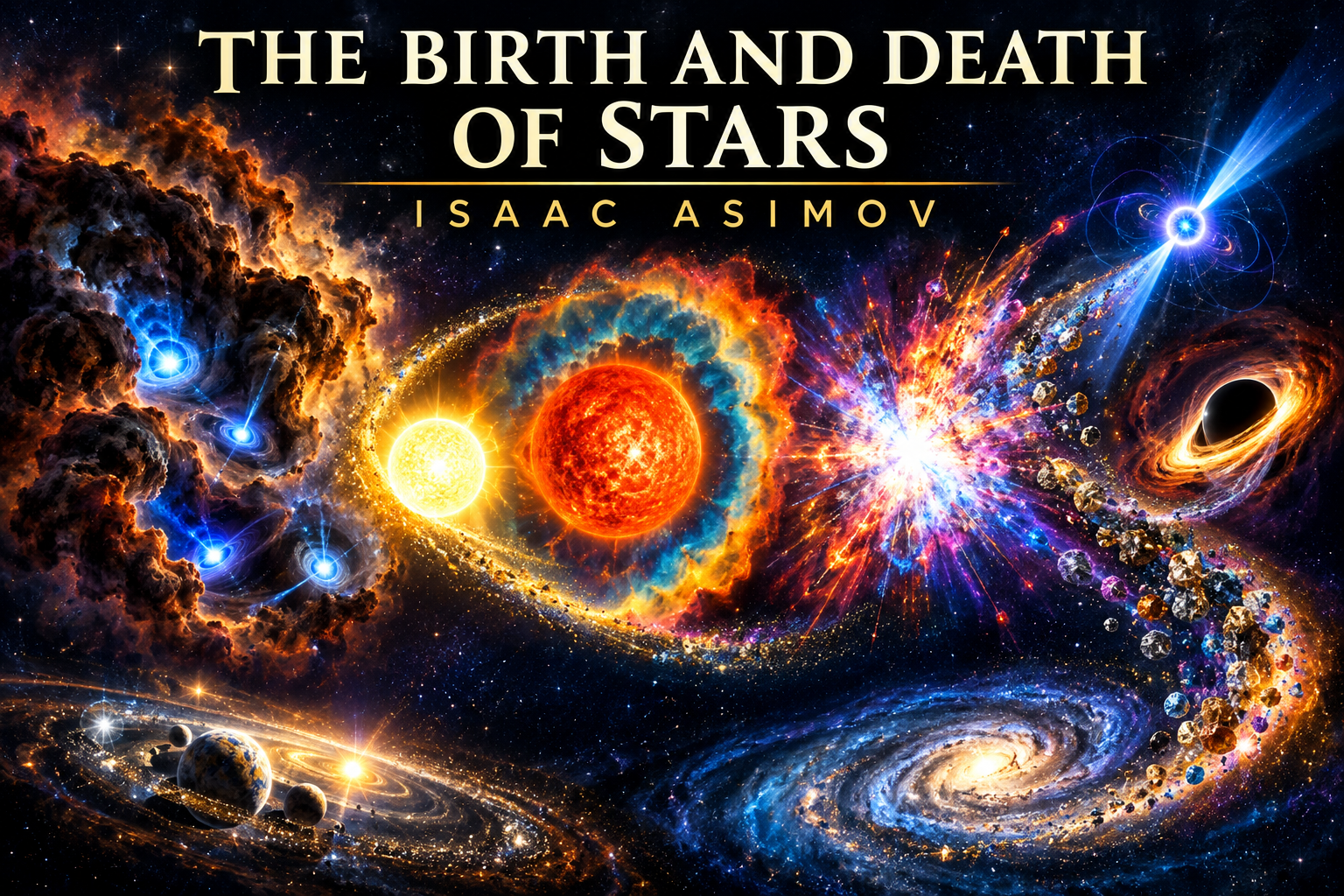
The narrative of The Birth and Death of Stars, published in 1989 as part of Isaac Asimov’s Library of the Universe, opens with a quiet yet revolutionary truth: the stars above us are not timeless monuments. To human perception, the night sky appears unchanging, but Asimov unveils a universe in constant, dynamic transformation, where stellar bodies are born, grow old, and eventually die over millions or billions of years. True to Asimov’s signature approach across his extensive popular science writings, the book constructs its foundation by translating complex astrophysics into a lucid, logical story. The narrative builds from absolute darkness, drawing the reader into vast, quiet clouds of interstellar gas and dust drifting through space. As gravity slowly pulls these loose particles together, density and heat accumulate in the central core. Once central temperatures reach a critical threshold, hydrogen nuclei fuse into helium, releasing incredible energy that counters gravity's inward pull and ignites a brand new star. By beginning with these fundamental physical forces, Asimov grounds the entire cosmic tale in simple, undeniable principles of nature.
In reviewing Asimov’s literary execution, his greatest achievement lies in how he personifies astrophysics without sacrificing scientific precision. Rather than presenting stars as sterile, distant objects, he treats each star as a character whose destiny is dictated by a single controlling factor: its initial mass. This mass acts as an internal, hidden clock that governs the star's color, surface temperature, brightness, and lifetime. Using his famously direct prose, Asimov compares familiar celestial anchors, such as the Sun, Sirius, Betelgeuse, and Aldebaran, to make stellar classification intuitive. He demonstrates that a star's brilliance is not a symbol of youth or permanence, but often a sign of wasteful extravagance. A small star conserves its nuclear fuel slowly and lives for an extraordinarily long duration, whereas a massive giant burns through its resources rapidly, living a brief but spectacular life.
While the book contains no fictional subplots, Asimov structures his non-fiction presentation through distinct thematic movements that function as individual stories within the broader cosmic epic. The first of these stories traces the formation and ordinary life of a main sequence star. It begins in the quiet nurseries of space, where contracting protostars convert gravitational energy into thermal heat before triggering sustained hydrogen fusion. Once ignited, the star enters its long adult life, maintaining a delicate balance between the inward pull of gravity and the outward expansion of nuclear energy. Asimov carefully explains that stars shine not because they burn like earthly fires, but because nuclear reactions deep within their interiors release radiation that eventually radiates out into the universe. Throughout this peaceful adulthood, however, the star silently converts hydrogen into helium, preparing the internal conditions for its eventual aging.
The narrative then shifts to its second distinct episode, “Giants in the Night,” which explores the dramatic middle age and death of Sun like stars. When core hydrogen becomes exhausted, the star’s internal equilibrium breaks down, causing its outer layers to swell enormously while its central core contracts and heats up. The star expands into a red giant, proving that stellar aging is not a process of fading away, but one of dramatic expansion and heightened luminosity. For a star similar in mass to our Sun, the ultimate conclusion is surprisingly gentle. The swollen outer gas layers drift softly into space, forming a glowing planetary nebula, while the dense, compact core remains behind as a white dwarf. This white dwarf generates no new fusion energy, slowly cooling over vast spans of cosmic time.
The third story, “The Case of Supernova 1987A,” contrasts this gentle passing with the catastrophic end of massive stars. Massive stars possess the internal pressure needed to fuse heavier elements, progressing through increasingly violent nuclear stages until their cores can no longer sustain gravitational weight. Asimov turns a real world astronomical event into a thrilling scientific detective story. In 1987, astronomers observed a brilliant explosion in the Large Magellanic Cloud, providing an unprecedented opportunity to study a supernova in close detail. Asimov emphasizes a profound temporal insight: because the supernova occurred 160,000 light years away, humanity was actually witnessing an event that occurred deep in prehistory, demonstrating that looking into space means looking back in time. The explosion released massive bursts of neutrinos and scattered synthesized elements across space, serving as an active laboratory for modern physics.
The fourth story explores “The Final Remnants,” exang the extreme physical endpoints left in the wake of massive stellar collapses. When a giant star explodes, its compressed core can yield a neutron star, an object no larger than a city yet containing more mass than the Sun, sometimes spinning rapidly to emit rhythmic beams of radiation as a pulsar. If the collapsing mass is even greater, gravity overcomes all known physical forces, collapsing the core into a black hole whose event horizon traps even light. Asimov presents these exotic remnants not as bizarre anomalies, but as the logical, mathematical outcomes of initial mass and gravitational law.
Ultimately, the entire narrative leads toward a grand conclusion: the cosmic cycle of renewal. Asimov demonstrates that stellar death is not a final ending, but the essential prerequisite for new creation. The heavy elements forged inside massive stars and expelled during supernovae enrich interstellar gas clouds, providing the raw chemical materials required for future generations of stars, planetary systems, and life itself. Our own Solar System, along with the iron in our rocks, the oxygen in our water, and the carbon in our bodies, was assembled from the remnants of stars that died long ago. In this elegant review and summary, Asimov leaves the reader with a humbling revelation: we are intimately connected to the history of matter, and to understand the life cycle of stars is to discover our own cosmic origin and future.