Mercury The Quick Planet
Isaac Asimov presents Mercury as a scientific detective story, revealing how observations of its extreme temperatures, slow rotation, iron core, and craters unlock planetary history.
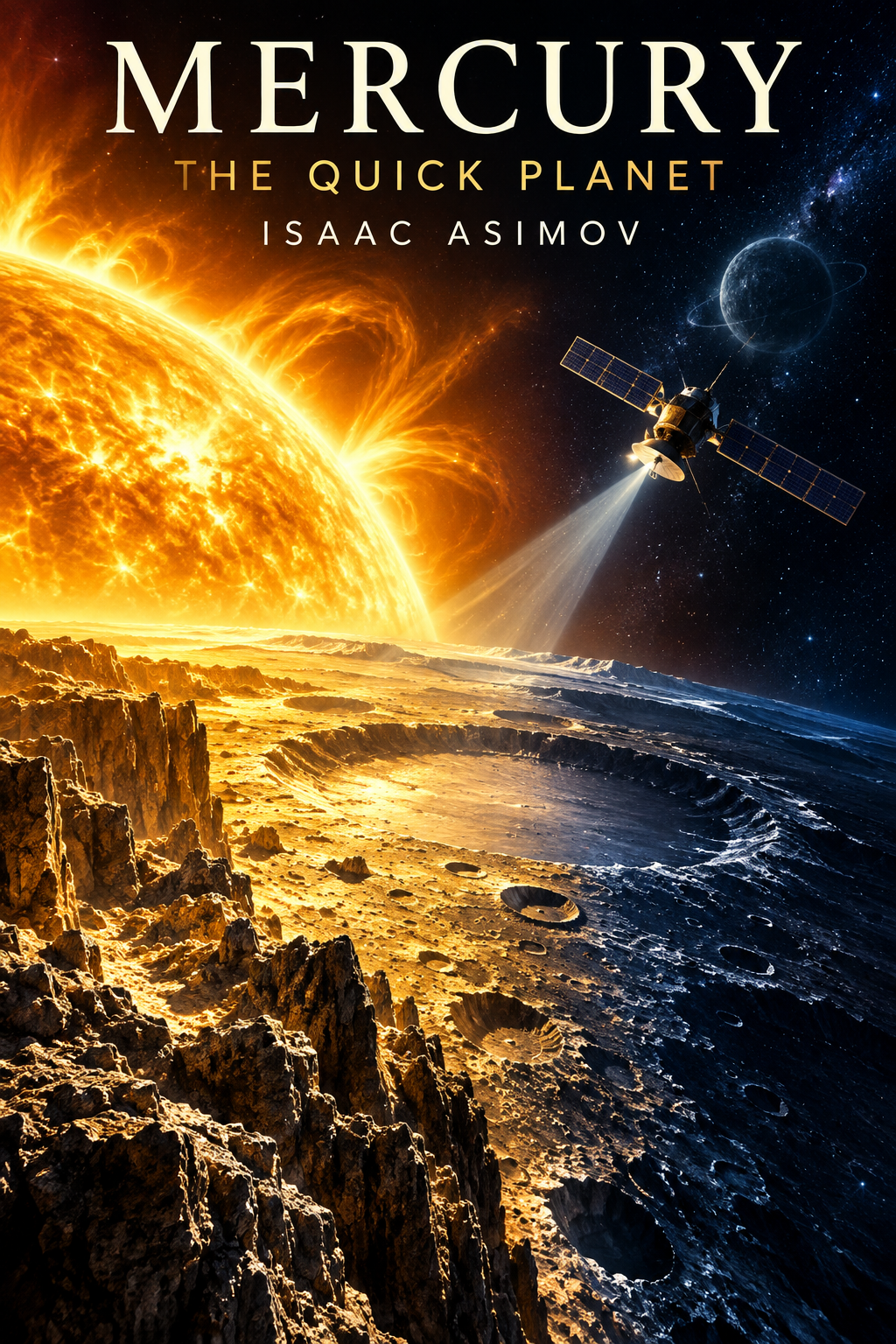
Isaac Asimov’s Mercury: The Quick Planet, published by Gareth Stevens in 1989 as part of his Library of the Universe series, is a concise work of popular science written for younger readers. Although it is a non fiction scientific text rather than a fictional story, Asimov structures the discovery of Mercury as an unfolding, logical narrative. There are no fictional mini stories within the book; instead, Asimov turns the history of astronomical exploration into a real world detective story where astronomers act as investigators, spacecraft serve as instruments, and the planet itself provides the physical evidence. His signature method begins with an everyday observational mystery, asks how human curiosity gradually uncovered the truth, and leads the reader to a deeper understanding of how planetary bodies operate.
The book opens with a striking astronomical paradox: Mercury is the planet closest to the Sun, yet for centuries it remained one of the most difficult worlds to observe. Because of the Sun’s overwhelming glare, astronomers on Earth could only view Mercury during brief windows near sunrise or sunset, where it appeared as nothing more than a tiny, shifting disk. Asimov connects this physical reality to human culture, noting that ancient observers named the planet after the rapid Roman messenger god Mercury and his Greek equivalent Hermes due to its swift travel across the twilight sky. Astronomically, the planet completes an orbit around the Sun in just 88 Earth days. However, Asimov reveals a surprising orbital property: Mercury rotates on its axis very slowly, taking about 58.6 Earth days to turn once. This motion creates a 3:2 spin orbit resonance, resulting in a solar day from sunrise to sunrise that lasts roughly 176 Earth days, twice as long as its planetary year. Through this clear presentation, Asimov illustrates that familiar concepts like day and year are not fixed cosmic constants, but the direct mathematical results of planetary motion.
As the narrative moves inward, Asimov explores Mercury’s extreme physical environment and unusual internal structure. Measuring approximately 4,875 kilometers in diameter, about 38 percent of Earth’s diameter, Mercury is a small world with weak surface gravity and no substantial atmosphere. The lack of an atmospheric blanket creates a dramatic contradiction: Mercury is simultaneously an intensely hot and intensely cold world. Sunlight bakes the side facing the Sun to extreme temperatures, while the dark side drops into frozen cold because there is no air to redistribute thermal energy. Looking below the surface, Asimov presents the mystery of Mercury's density, which is surprisingly high for such a small world and suggests a disproportionately large iron rich core. The discovery that Mercury retains a weak magnetic field further indicates that its interior contains electrically conducting material and is not a completely dead rock, prompting scientists to formulate competing hypotheses regarding its early formation.
The journey shifts from ground observations to direct cosmic exploration with the arrival of space probes. Images returned by Mariner 10 transformed Mercury from an elusive dot of light into a clearly defined world of craters, plains, and geological scars. Unlike Earth, where wind, water, and plate tectonics continuously erase geological history, Mercury's airless surface preserves an ancient record of planetary collisions. Mariner 10 revealed a surface dominated by massive impact structures, including the giant Caloris Basin, created by a colossal collision in the early Solar System. The landscape also features immense cliffs and escarpments, formed as the planet’s interior cooled and shrank over time, causing the rocky crust to buckle. Asimov demonstrates that every crater and scarp serves as a page in a vast planetary history book.
One of the most fascinating historical episodes in Asimov's account involves Vulcan, the hypothetical planet once thought to orbit even closer to the Sun. When classical Newtonian physics failed to fully account for small irregularities in Mercury’s elongated orbit, nineteenth century astronomers proposed that an undiscovered inner planet was gravitationally pulling on Mercury. However, Albert Einstein’s general theory of relativity eventually explained Mercury’s orbital behavior without needing another planet. Asimov highlights the story of Vulcan to show how science self corrects: a reasonable hypothesis can be thoroughly tested, disproven, and replaced by a superior understanding of physical laws. Looking toward the future, Asimov addresses the challenges of human spaceflight, noting that intense radiation, extreme thermal conditions, and gravitational mechanics make piloted missions to Mercury immensely difficult. Nevertheless, he maintains that the true reward of exploring Mercury is not human settlement, but gaining a crucial key to understanding how rocky worlds formed and evolved across our Solar System.
In review, Mercury: The Quick Planet exemplifies Asimov’s mastery of popular science narrative. Rather than presenting astronomy as a list of facts to be memorized, Asimov weaves data points such as orbital ratios, iron cores, and surface scarps into interconnected clues in an ongoing investigation. His writing is logical, accessible, and grounded in simple language, guiding readers through complex ideas like general relativity and spin orbit resonances without losing clarity. While spacecraft like Mariner 10 provided revolutionary insights, Asimov maintains an important sense of scientific humility, reminding readers that Mariner 10 mapped only part of the surface and that every scientific answer opens new questions. Ultimately, the book succeeds because it transforms a distant celestial object into a historical document, showing that by reading the ancient landscape of Mercury, humanity uncovers vital chapters in the story of our own planetary system.