Space Spotter's Guide
Isaac Asimov’s practical guide demystifies astronomy, teaching ordinary observers to navigate the night sky's celestial landmarks, planets, and galaxies using naked eyes and basic telescopes.
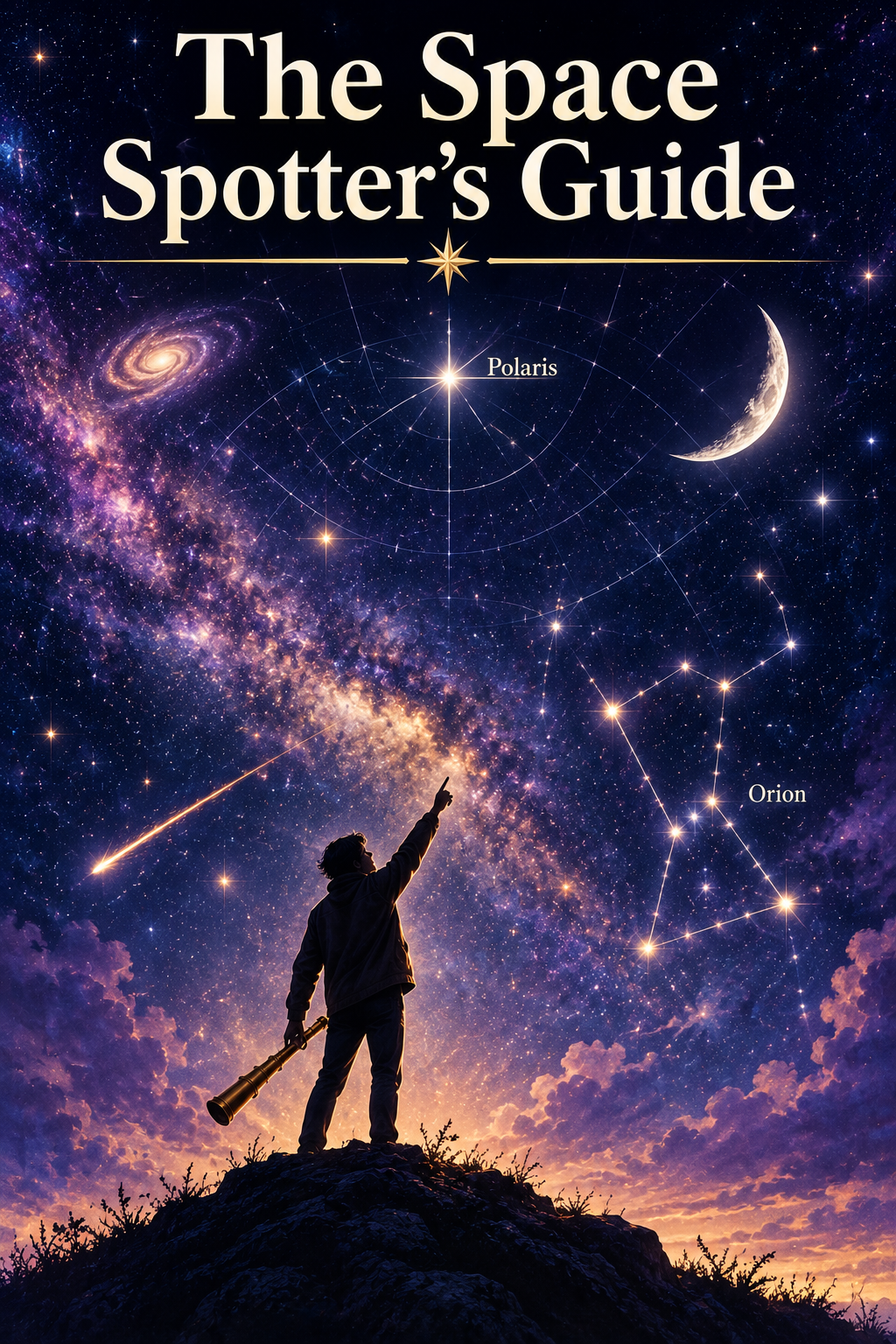
Imagine a quiet evening. A person steps outside, escaping the warm artificial light of the house, and stands beneath a vast, dark sky. Looking up, they see what initially appears to be a chaotic, meaningless scattering of tiny points of light. In this quiet moment, the journey of Isaac Asimov's The Space Spotter's Guide begins. Originally published in 1988 by Gareth Stevens as part of Isaac Asimov’s Library of the Universe, this slender book spans only thirty two pages, yet it acts as a gentle, inviting guide to the heavens. Asimov's writing does not present astronomy as a remote discipline reserved solely for professional scientists in massive observatories. Instead, he begins with a simple, democratic invitation: look upward, learn to recognize what you are seeing, and discover how much of the vast universe can be found with nothing more than your eyes. It is a journey of sight and mind, structured as an elegant story of discovery that guides the ordinary observer from the familiar sights of Earth to the edge of the visible cosmos.
The story of this astronomical exploration is built around two principal narrative arcs, or sections: “Our Changing Sky” and “Sky Wanderers”. Although the book contains no conventional fictional stories, these two sections function as distinct observational adventures. In the first adventure, the observer learns to read the seemingly permanent, fixed features of the heavens. In the second adventure, the focus shifts to the dramatic movement of the objects that refuse to stay still, culminating in the introduction of the telescope as a tool for deeper exploration. Together, they build a logical and beautifully simple ladder of understanding, allowing the sky watcher to transform a chaotic dome of light into a clear, navigable map of the universe.
Our story begins under "Our Changing Sky" with the simplest and most accessible astronomical instrument we possess: the human eye. As the observer stands in the darkness, they begin to notice that the stars are not uniform; some are brilliant, some are faint, and some group together in familiar shapes. This is where the ancient concept of the constellation becomes an essential tool. Asimov explains with trademark clarity that a constellation is not a physical family of stars bound closely together in space. In truth, the stars forming these shapes may be separated by enormous distances, appearing close only because of our specific viewpoint from Earth. To make sense of this cosmic canvas, the observer starts with the Big Dipper, one of the easiest celestial landmarks to spot in the Northern Hemisphere. By tracing its stars, the observer easily locates Polaris, the North Star. Because Polaris lies almost directly above Earth's north celestial pole, it remains nearly stationary in the sky while all other stars appear to circle around it as the Earth rotates. Polaris thus becomes a fixed guide to direction, grounding the observer in the physical reality of a rotating planet.
With one landmark established, the observer's confidence grows, and the sky begins to feel less like an alien wilderness and more like a structured landscape. Asimov compares this process to entering an unfamiliar city. At first, every street and building seems confusing and identical, but once you recognize a few major landmarks, the rest of the city becomes easy to navigate. In the sky, the constellation Orion stands out as the next major landmark, easily recognized by the three bright stars of its belt. Near this belt, the observer learns to spot Betelgeuse and Rigel, which stand out as exceptionally bright stars, as well as the region around Orion's sword containing the famous Orion Nebula, which is a vast cloud of gas and dust associated with star formation. The story of the sky also changes with the seasons. Because Earth revolves around the Sun, the nighttime side of our planet faces different directions in space at different times of the year. As a result, different constellations rise and fall with the seasons, acting as a natural clock and calendar that ancient humans used to mark seasons and organize calendars. This seasonal path of the Sun brings the observer to the zodiac, a specific belt of constellations that traces our solar system's flat plane in space, which also dictates where the planets appear to move.
As this first adventure draws to a close, the observer realizes that the night sky holds treasures far beyond individual stars. On a sufficiently dark night, a pale, glowing band of light can be seen crossing the sky. To the naked eye, this Milky Way might look almost like a faint cloud, but it is actually the collective light of countless stars within our own galaxy, viewed from our position inside it. Looking even further into the darkness, the observer's imagination stretches beyond our galactic boundaries. Under dark skies, the Andromeda Galaxy appears as a faint, fuzzy patch of light, which is a huge neighboring galaxy visible without any optical aid. In the southern skies, the Large Magellanic Cloud and Small Magellanic Cloud offer similar reminders of the outer universe. Thus, starting with nothing more than their own eyes and a few simple patterns, the observer has traveled in imagination from a local star to the vast, extragalactic deep.
The second adventure, "Sky Wanderers," introduces a dynamic twist to the story. While the stars seem to maintain their positions relative to one another over a human lifetime, other bright objects slowly drift across the background of fixed stars. The ancient Greeks called these objects "wanderers," from which we derive the word planets. The observer now watches these celestial visitors. Venus is the most spectacular of all, sometimes shining so brightly that it is visible in the early evening or morning sky, earning it the names Evening Star and Morning Star. Mars stands out with its distinct reddish color, Jupiter dominates with its steady, brilliant glow, and Saturn offers a quieter but deeply rewarding target. Along with these planets, the Moon is another great wanderer, dramatically changing its appearance from a thin crescent to a glowing full circle. Asimov explains that these phases are not the Moon changing its physical shape, but rather the shifting angle from which we see its sunlit half as the Moon travels around Earth, reflecting sunlight instead of producing its own.
To explore these wanderers further, the narrative introduces the telescope. Asimov demystifies this tool with logical precision, explaining that a telescope’s essential function is not simply to magnify, but to collect more light than the human eye can gather. By concentrating this light, the instrument reveals faint details that are otherwise invisible and shows details that the eye cannot resolve. The observer learns about the two primary designs: those that use lenses to concentrate light, and those that use mirrors. Crucially, Asimov emphasizes that a larger or more complex telescope is not inherently better; the usefulness of the instrument depends on the observer's specific goals and how easily the telescope can actually be used. A simple, properly used telescope completely transforms the observer's experience. Suddenly, the smooth face of the Moon is revealed to be covered with craters and mountains, Jupiter's moons can be observed, Saturn's rings become visible, and bright nebulae show their true structures.
In reviewing The Space Spotter's Guide, its greatest triumph lies not in exhaustive scientific cataloging, but in its profound philosophy of observation. By keeping the book brief at thirty two pages, Asimov ensures that the reader is never overwhelmed by complex equations or dry technical data. While the 1988 publication date means that the book predates many modern astronomical discoveries and telescope technologies, its core message remains completely timeless. The book does not give away the ultimate "plot" of the cosmos; instead, it provides the observer with the tools, the vocabulary, and the logical confidence to discover that plot for themselves. It takes a sky that once seemed chaotic and converts it into a familiar map of identifiable places, moving visitors, and distant galactic homes.
Ultimately, the story of The Space Spotter's Guide is a story about the act of looking. It is a quiet, profound adventure that does not require the reader to leave the surface of the Earth or possess a professional observatory. It simply asks them to stand still under the night sky, look upward with curiosity, and realize that the entire universe is already waiting to be discovered. In Asimov's characteristic style, the grandest journey of scientific understanding begins with the simplest possible instrument: the human eye.