Frontiers new discoveries about man and his planet, outer space and the universe
saac Asimov explores human evolution, subatomic physics, planetary geology, and cosmic space, crafting a clear, logical journey across the expanding frontiers of modern scientific discovery.
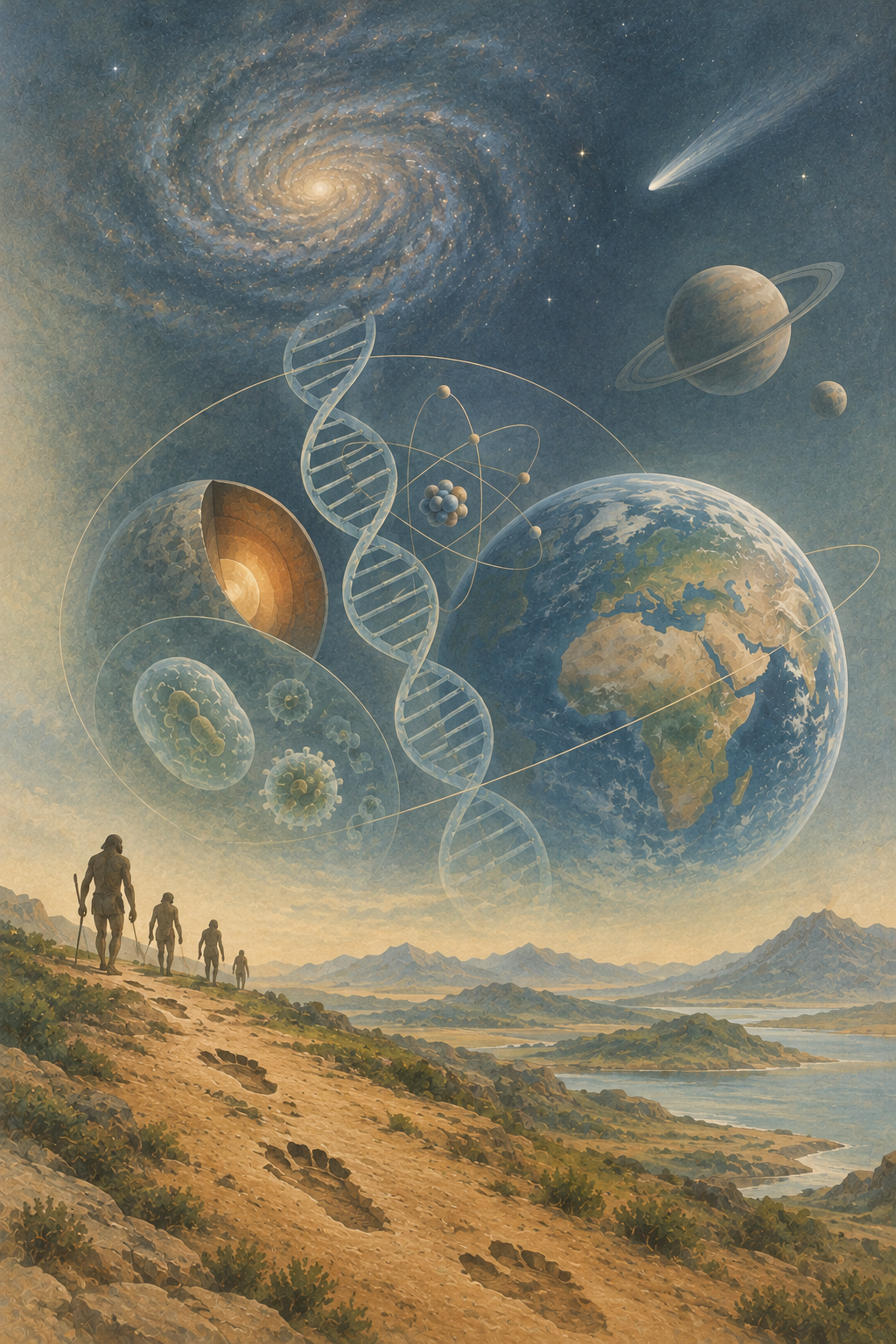
Isaac Asimov’s non-fiction collection Frontiers presents a grand, real world narrative of human discovery rather than a single fictional story. Across four major thematic sections: Frontiers of Early Man, Frontiers of Science, Frontiers of Earth, and Frontiers of Space, Asimov constructs a logical intellectual journey that builds from humanity’s biological origins, moves through the microscopic structure of matter and the history of our planet, and leads ultimately to the edge of the cosmos. Written in his signature style of clear, accessible, and direct prose, the book functions as a guided exploration where each brief essay explores how a specific discovery or scientific question reshapes our understanding of nature.
The narrative begins in Frontiers of Early Man by tracing humanity’s distant biological roots. In "Our Ancient Ancestors," "How Old Are We?," "On Your Hind Legs," and "Hands at Last," Asimov examines how skeletal evidence and comparisons with other primates reveal the gradual development of upright posture and manual dexterity, setting the stage for tool use. "A Bone Speaks Volumes" illustrates how fossil remains enable scientists to deduce an organism’s size, age, and evolutionary ties in the absence of written history. Moving to human culture, "Man's First Language" and "Man's First Discovery" explain how spoken communication and pattern recognition transformed information sharing across generations. In "Fueling the Fires," the mastery of fire provides warmth, protection, and cooked food, fundamentally altering human life. Expanding the evolutionary view, "Our Cousin the Coelacanth" highlights living fossils that preserve ancient biological clues, while "The Relentless Population Rise" turns to our growing demographic footprint, establishing that humanity’s present condition is best understood against the immense timeline of biological evolution.
In the second section, Frontiers of Science, the journey shifts inward from human origins to the fundamental forces and physical processes governing reality. In "The Brightest X Rays" and "Reward Delayed," Asimov highlights the vital role of advanced laboratory instruments in revealing phenomena invisible to human eyes. Essays such as "The Noblest Element," "Raising the Temperature," and "Atom Smasher Supreme" explore chemical elements, thermal extremes, and particle accelerators that uncover atomic structures. Asimov clarifies technical distinctions in "The Two Nothings," "Supercritical," and "A Question of Priorities," showing how abstract scientific concepts relate to broader physical laws. Moving into particle physics, "The Elusive Quark" and "How Many Particles?" trace how subatomic discoveries continuously refine our picture of matter, while "Taming Antimatter" examines opposing electrical charges and mass to energy conversion. Turning to practical materials and energy, "Improving on the Diamond," "Cold, Cold Fusion," and "Tritium, Why It's Crucial" demonstrate how basic physics research influences potential technology. Finally, biological mysteries are explored in "The Dangerous Microorganism," "The Genome Project," "First Look at the DNA Molecule," and "Our Biological Clock," laying out genetics, heredity, and internal biological timing to demonstrate how science continually expands the boundary between knowledge and uncertainty.
The third section, Frontiers of Earth, brings the focus back to our home planet, showing that Earth is an active, evolving system rather than a static platform. In "The Shifting Earth," "The Wobbling Earth," "Those Oceanic Hot Spots," and "The Big Crack," Asimov explores continental drift, axial motion, and geological forces that reshape the terrestrial surface over millions of years. "The Central Heat" peers into the interior thermal energy driving these geological changes. The story of terrestrial life develops through "The First Cell," "The Conquest of the Land," and "How Green Plants Began," which describe how early biological forms colonized land and altered the atmosphere. Prehistoric life comes alive in "Dinosaurs Everywhere," "Death of the Dinosaurs: A New Clue," "More Evidence of Feathered Fliers," and "The Biggest Flyer," showing how paleontology continuously updates our understanding of ancient creatures. Turning to ecological adaptations, "The Most Successful Life Form," "The Homing Turtles," and "The Oddest Mammal" highlight diverse biological survival mechanisms. Environmental chemistry and modern planetary challenges are addressed in "The Ozone Hole," "The Last Clean Place," and "Wetter and Warmer," before concluding with "Ice Ages and the Plateau Effect" and "Moon Mysteries, Earth's History," which frame Earth as an interconnected system of oceans, atmosphere, geology, and astronomical influences.
In the final and largest section, Frontiers of Space, the narrative expands outward into the solar system and the wider universe. Beginning locally, "The Cracked Crust," "Blast over Siberia," and the study of "Halley's Comet" in "Halley's Comet" and "More About Halley's Comet" show how orbital calculations transform celestial omens into predictable astronomical events. "Space Rocks," "Close Call with an Asteroid," and "Diamonds from Space" evaluate cosmic debris and collision risks. Planetary environments are compared in "Our Identical Twin," which contrasts Venus’s harsh surface with Earth, while "The Elusive Tenth," "Pluto and Charon: The Dumbbell Worlds," and "The Case of the Missing 'Planet'" illustrate how astronomical classifications must adapt to new findings. The search for life turns to Mars in "The Falling Moon of Mars" and "Life on Mars Revisited," approaching extraterrestrial questions through empirical evidence rather than speculation. Practical concerns regarding space exploration appear in "Space Pollution," "Where Do We Go from Here?," and "Are We Alone?". Stellar lifecycles are detailed in "The Supernova Next Door," "The Neutron Surprise," "The White Dwarf Clock," and "The Force that Can Swallow a Star," while observational instruments are explained in "The Weakest Wave," "The Relativity Test," "Neutrinos from Afar," and "The Gamma Giveaway". Reaching deep space, "Galaxies in Collision," "Ten Billion Light Years Away," "Seeing the Past," and "The Oldest Birthday" show that looking across cosmic distances means observing the past, leading to the limits of cosmology in "Beyond the Beyond," "Why Are Things as They Are?," and "Where the Universe Ends," ending precisely at the edge of human understanding.
Reviewing the collection as a whole, Frontiers stands as a classic demonstration of Asimov’s skill in science communication. By connecting four distinct scales: human evolution, subatomic physics, planetary history, and astrophysics, he crafts an expanding narrative that demonstrates why evidence matters and how every scientific answer uncovers deeper questions. His hallmark use of plain language, logical progression, and direct explanations makes intricate physical and biological concepts accessible to any reader. Although the short essay format provides introductory summaries rather than exhaustive technical detail, it maintains a brisk, engaging pace across a vast landscape of topics. While reflecting the specific scientific state and debates of the late twentieth century, Frontiers remains an inspiring celebration of human curiosity, replacing unexamined mystery with informed wonder and inviting readers to view scientific discovery as an endless, ongoing the adventure.