Unidentified Flying Objects
Isaac Asimov applies rational skepticism to aerial mysteries, showing how human perception and language transform ordinary sky phenomena into extraordinary myths requiring verifiable scientific proof.
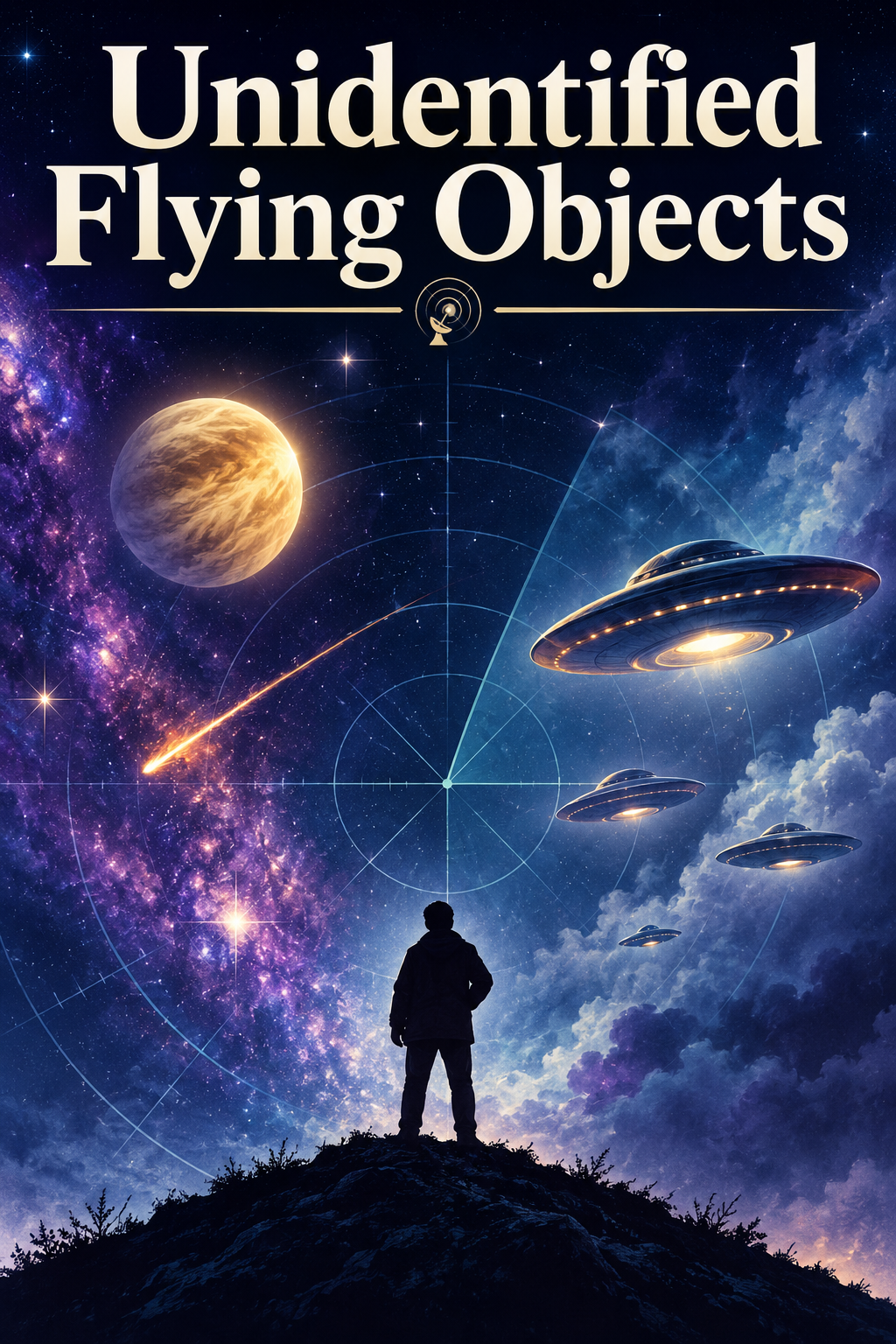
The journey into the unknown begins with a simple, daily act: millions of human beings looking up at the sky and wondering what lies beyond. Isaac Asimov’s Unidentified Flying Objects, written alongside Frank Reddy in 1988 as part of Isaac Asimov’s Library of the Universe, does not seek to prove or disprove the existence of alien visitors. Instead, it unfolds as a careful, scientific exploration of one of the most captivating modern mysteries: why so many people believe they have witnessed extraordinary spacecraft in the skies. For Asimov, who approached all scientific puzzles with curiosity, skepticism, and a logical mind, the goal was not to ridicule these reports but to investigate them with scientific rigor. The book is designed for younger readers, yet the clarity of the language and the depth of the logic make it an enduring lesson in scientific thinking for all ages. Rather than presenting a single fictional plot, the narrative of this book acts as an intellectual journey, tracing how human perception, language, and culture transform simple observations into grand mysteries.
To understand where this intellectual journey leads, Asimov begins by establishing a fundamental distinction about what a UFO actually is. In the story of human observation, an unidentified flying object is not automatically an alien spacecraft; it is simply an object in the sky whose identity is unknown to the observer at the moment of sighting. This modest distinction forms the bedrock of Asimov's investigation, reminding observers that while human curiosity is vast, human perception is highly imperfect. The sky is a deceptive canvas where distances are difficult to gauge, bright lights appear deceptively close, and stationary objects seem to move due to atmospheric conditions. Before leaping to extraordinary conclusions, Asimov suggests that the limitations of human eyes and minds must be examined.
This brings the focus to the first mini story within the book, which is titled Lights in the Sky. This segment details how the most common UFO sightings are actually ordinary, earthly, or astronomical phenomena that have been deeply misunderstood. Asimov explains how the brilliant planet Venus is frequently mistaken for a hovering, mysterious craft because of its intense brightness near the horizon. He describes how meteors flash suddenly, high altitude aircraft reflect light strangely, weather balloons drift silently, and even clouds shape themselves into visual illusions that deceive the honest observer. The core of this mini story is that while witnesses are sincere and genuinely report what they believe they saw, they often fail to separate direct observation from subsequent interpretation.
The next chapter in this history is the mini story of The Flying Saucer Era, which began in the summer of 1947. Asimov recounts the famous incident involving pilot Kenneth Arnold, who reported seeing several unusual objects moving rapidly near Mount Rainier. Arnold described their movement as resembling saucers skipping across water. Crucially, Arnold did not state that the objects were disc shaped, but journalists seized upon the description and coined the phrase flying saucers. This linguistic shift had immediate, massive consequences. Once the image of flying discs entered public consciousness, reports of similar sightings exploded across the nation, illustrating how language can unconsciously shape and dictate human perception.
Following this cultural explosion, the book explores the famous legend of The Roswell Incident, which occurred near Roswell, New Mexico, in 1947. The story began with confused reports that military personnel had recovered a flying disc in the desert, though officials quickly clarified that the wreckage was actually a weather balloon. However, the story did not die; instead, it transformed into a central legend of UFO culture. As Asimov carefully traces this event, he demonstrates how memories change over time, how new witnesses emerge decades later, and how books and documentaries can expand a single unexplained incident into an elaborate, enduring myth. Asimov advises that historical investigators must always prioritize the evidence closest to the actual event, warning of how easily stories evolve when excitement and time distort human recollection.
As the investigation deepens, the book presents the mini story of Pilots and Radar, addressing cases where the observers are highly trained professionals. Military and commercial pilots are experts at identifying aerial objects, and their testimonies carry significant weight. Furthermore, radar records seem to provide objective, non human proof of mysterious objects. Yet, Asimov, with his characteristic logic, explains that even radar is subject to error. Radar screens can display false returns, radio waves can bend due to atmospheric conditions, and equipment can malfunction. When a pilot's sighting and a radar detection happen simultaneously, the case becomes truly fascinating and deserves serious investigation, but Asimov cautions that unexplained is not a synonym for alien. An unresolved case simply means there is not enough information to make a final conclusion.
By the late twentieth century, the UFO narrative took a darker, more personal turn, leading to the mini story of Close Encounters and Abductions. People began reporting direct physical contact with extraterrestrial beings, claiming they were taken aboard spaceships and subjected to examinations. Asimov evaluates these emotionally intense accounts with deep empathy but scientific caution. While the author does not accuse these individuals of lying, the text notes that sincerity is not the same as factual accuracy. Human memory is incredibly complex and easily influenced by dreams, fears, psychological stress, and the prevalent images of little alien beings popularized by movies and television. Without independently verifiable physical evidence, these dramatic stories remain within the realm of human psychology rather than extraterrestrial physics.
The narrative continues with the mini story of Could Visitors Come From Space? where Asimov the science fiction writer meets Asimov the scientist. As a visionary, Asimov readily acknowledges that the universe is unimaginably vast, with countless stars and planets that could easily harbor intelligent life. The assumption that Earth is the only home of intelligence is presented as arrogant. However, Asimov the scientist immediately steps in to address the practical, physical boundaries of the cosmos. The distances between stars are so immense that even traveling at extreme speeds would take decades, centuries, or even millennia. While an advanced civilization might possess the technology to cross these gulfs, Asimov logically asks why visits would only produce blurry photographs and ambiguous stories rather than undeniable, physical proof.
To resolve these mysteries, the book outlines the mini story of Investigating UFOs and Government Investigations. When faced with a sighting, scientists and military investigators do not begin by choosing an exciting conclusion. Instead, they act as detectives, asking precise questions about the time, direction, duration, weather conditions, and surrounding aircraft or celestial bodies. Through this systematic process, the overwhelming majority of cases are resolved as ordinary occurrences, such as satellites, balloons, hoaxes, or planetary alignments. The remaining unexplained cases are valuable to science not because they prove alien visits, but because they highlight the boundaries of current knowledge.
Compounding the difficulty of these scientific investigations is the mini story of Hoaxes and Mistakes. Throughout history, some individuals have deliberately fabricated UFO reports, staged evidence, or produced fake photographs for fame, money, or simple amusement. Asimov discusses how easily photography can be manipulated through double exposures, reflections, lens flares, or intentional tricks, creating noise that makes it even harder for scientists to identify genuine, unusual atmospheric phenomena.
In its final movement, the book reaches a beautiful, philosophical climax that Asimov calls The Meaning of Mystery. Asimov observes that humans have always looked to the heavens to find meaning, once imagining gods descending from above, and now imagining advanced starships. This persistent desire is driven by a deep, emotional longing to know that humanity is not alone in the vast cosmos. Yet, Asimov gently reminds readers that wanting something to be true does not make it true. Science does not reject mysteries; indeed, science thrives on them, as comets and lightning were once terrifying supernatural signs before they were understood through empirical study. An unexplained event is an invitation to investigate and keep thinking, not permission to stop analyzing and accept easy answers.
In reviewing this work, Unidentified Flying Objects stands as a classic demonstration of Asimov’s calm, logical, and rational mind. The book is not really about finding aliens; rather, it is a brilliant handbook on scientific literacy and how to evaluate evidence. Its greatest triumph is its tone: Asimov never ridicules or mocks those who report unusual sightings, showing instead a deep respect for human curiosity. The text teaches that admitting uncertainty is not a weakness, but a fundamental scientific honesty. Even though the public terminology has shifted from flying saucers to UAPs (unidentified anomalous phenomena) since the book's publication, Asimov's core lesson remains remarkably modern and necessary. It serves as a reminder to keep minds open to the immense possibilities of the universe, while keeping feet firmly grounded in rigorous, verifiable evidence. The most scientific response to the unknown is neither blind belief nor hostile disbelief, but a commitment to careful, honest investigation.