Cosmic Critiques How & Why Ten Science Fiction Stories Work
Cosmic Critiques explores ten classic science fiction stories through narrative craft, scientific reasoning, and meaningful human stakes.
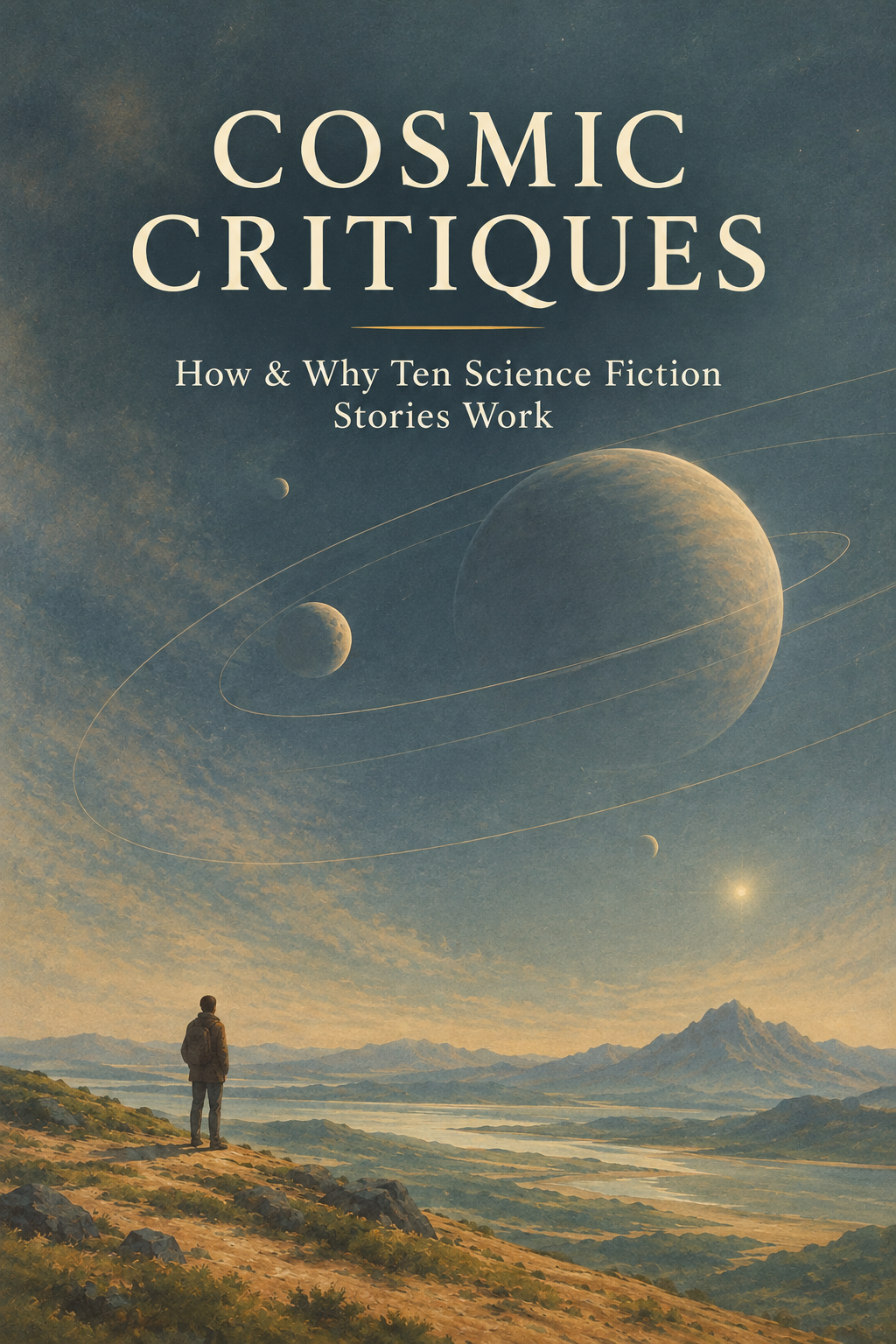
The journey through Cosmic Critiques: How & Why Ten Science Fiction Stories Work, edited by Isaac Asimov and Martin H. Greenberg in 1990, unfolds not as a standard fiction anthology, but as a guided narrative exploring the craft of imaginative writing. The book begins with Asimov’s introductory essay, “Advice,” which establishes the foundational lesson that science fiction is a logical craft requiring discipline, structured thinking, and analytical reading rather than simple inspiration. Asimov explains that a speculative narrative opens by introducing a single fundamental change to the world, whether a new invention, an unfamiliar alien planet, or a shift in social structure, and the writer's duty is to trace how that single premise logically influences human choices and leads to inescapable consequences.
The anthology’s first fictional lesson begins with Larry Niven's “Neutron Star,” representing hard science fiction centered on scientific reasoning and physical laws. The narrative follows protagonist Beowulf Shaeffer, who is dispatched on a dangerous investigative trip near an insanely dense stellar object following a previous fatal disaster. Rather than relying on physical strength or courage to defeat an adversary, the story builds a puzzle where survival depends on observing physical forces and deducing environmental clues. Niven demonstrates how an abstract astronomical concept can be turned into an immediate personal threat, forcing the reader to reason alongside the main character without giving away the plot's resolution.
Shifting from outer space to human society, Pat Cadigan's “Rock On” moves the narrative into a cyberpunk future where technology alters human expression, culture, and personal identity through music. Music is both a technical system and a personal emotional experience, making it an effective foundation for examining what happens when advanced machinery merges with artistic creation. Cadigan shows that speculative fiction does not require distant planets or spacecraft to be compelling; changing a familiar cultural habit can be just as speculative. Through social detail and mood, the story illustrates how technological systems become integrated into everyday life and reshape human identity.
The journey continues into space exploration with Raymond E. Banks's “Transstar,” which uses the framework of a futuristic transportation network to examine human decision making across a vast society. Banks demonstrates the craft principle of economy in explanation. Rather than pausing the narrative to explain every aspect of the fictional world, the writer carefully selects key technical procedures and institutional rules that suggest a massive, living universe in the background. This approach maintains narrative pacing while building a believable sense of scale.
The narrative then moves into dystopian social extrapolation with J. G. Ballard's “Billenium,” which extends the real world problem of overpopulation into a claustrophobic future. Living in a world where extreme population density makes physical space scarce, protagonists Ward and Rossiter struggle in an environment where personal privacy has become an unobtainable luxury. Ballard builds tension not by inventing exotic machines, but by taking a recognizable social trend to its logical extreme. The story explores how overcrowding impacts human psychology, alters personal relationships, and creates a tragic paradox where individuals who escape confinement are tempted to exclude others to protect their own small space.
Turning toward alien frontiers, James H. Schmitz's “Grandpa” examines the challenge of encountering an unfamiliar living intelligence. The story applies a familiar human title to a strange alien organism, creating a bridge between ordinary human experience and a nonhuman form of life. Suspense is built through careful observation and shifting perspectives as characters interact with the creature. Schmitz illustrates how an alien presence becomes dramatically effective when characters must learn to navigate its internal rules to survive in their environment.
At the center of the book's philosophical exploration is Isaac Asimov's “The Last Question,” which demonstrates how a simple question can sustain a narrative across immense cosmic timescales. The story opens in the year 2061 with two technicians, Alexander Adell and Bertram Lupov, asking the powerful Multivac computer whether the universe's ultimate decline into entropy can ever be reversed. When the machine answers that there is insufficient data, the narrative steps across billions of years as human civilizations expand and advanced computers evolve. Asimov demonstrates how a single, focused logical idea can be followed through repeated cycles across cosmic history to explore intelligence, time, and the universe without spoiling its famous conclusion.
Turning to narrative puzzles, Irving E. Cox, Jr.'s “In the Circle of Nowhere” places its characters in an isolating environment where familiar directions and locations no longer apply. The setting itself acts as a mystery that the characters must investigate. Cox maintains tension by carefully controlling the release of information, balancing uncertainty with gradual comprehension as characters test their surroundings. The narrative shows how an unfamiliar setting can test character decisions and force readers to think logically about space and confinement.
In Charles L. Fontenay's “The Silk and the Song,” the narrative blends adventure with alien cultural traditions. The story connects a physical crafted object and an oral performance, demonstrating how physical items and customs carry deep meaning within a speculative society. Fontenay shows how invented traditions and cultural obligations can create obstacles and drive character conflicts, illustrating how social details make an imagined world feel historically grounded.
The technological narrative moves to global communication infrastructure in Arthur C. Clarke's “Dial F for Frankenstein,” which examines the worldwide telephone network as it grows increasingly complex and interconnected. Clarke adapts the core anxiety of Mary Shelley's classic monster story to modern technology, exploring the possibility that a vast communications network might develop emergent behavior beyond human control. By starting with an everyday technology, Clarke generates suspense around complex systems and the unexpected consequences of human invention.
The final fictional selection, Norman Spinrad's “Carcinoma Angels,” introduces a darker speculative atmosphere. The story contrasts promises of technological transcendence with disturbing psychological outcomes, using tone and striking imagery to challenge the assumption that technological advancement automatically brings human progress. Spinrad demonstrates how speculative fiction can reflect deep societal anxieties by examining how systems reshape individual identity.
In its final review and overall synthesis, Cosmic Critiques proves to be both a rich reader's collection and a practical workshop in literary construction. By placing hard scientific problem solving alongside social extrapolation, alien ecologies, and cosmic meditations, the book demonstrates that an intriguing premise is only a starting point. A successful science fiction story demands clear rules, logical progression, and human stakes. Ultimately, the anthology shows how imagination, scientific reasoning, and clear narrative craft work together to turn speculative ideas into memorable stories