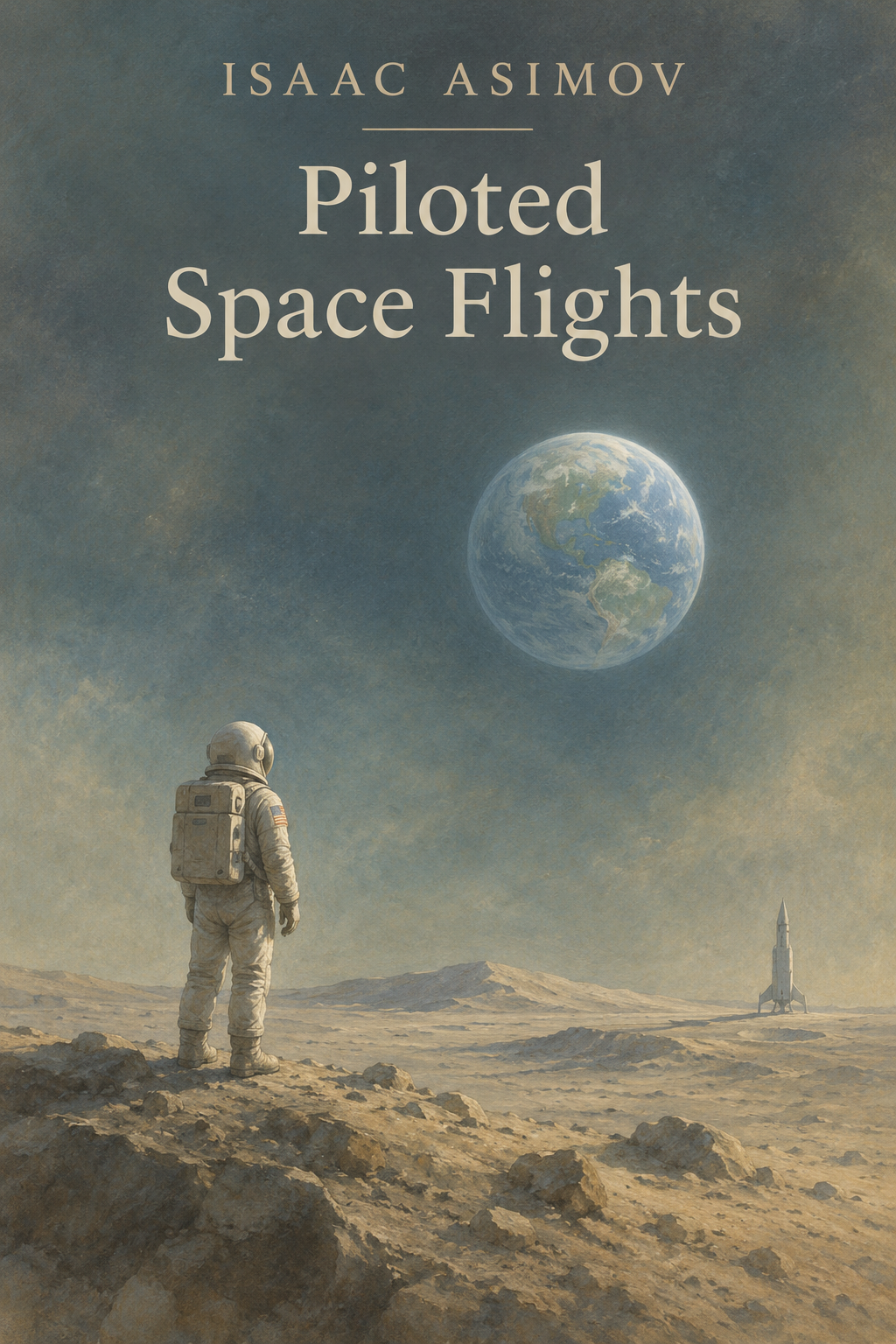
Piloted Space Flights
Isaac Asimov systematically traces human spaceflight from early rocketry and orbital mechanics to lunar landings, space stations, and future planetary exploration with clear, logical precision.
Humanity spent centuries looking up at the night sky, contemplating the Moon and distant planets as objects of wonder that lay forever beyond physical reach. The great transition in human history began when space travel transformed from a speculative dream into a precise engineering problem. The foundational breakthrough was the rocket, a unique device capable of operating in a complete vacuum because it expels gases backward at high speeds to propel itself forward without needing atmospheric air to push against. Escaping Earth's atmosphere was merely the first hurdle, as a piloted spacecraft required breathable air, precise temperature control, constant communication, and a reliable re-entry mechanism. Isaac Asimov frames this entire historical trajectory not as a single miraculous invention, but as a systematic harmony of rocketry, guidance systems, life-support technology, and human courage working in unison.
Once a spacecraft reaches orbit, the everyday physical rules that govern life on Earth give way to new and unintuitive realities. Astronauts floating inside a cabin do not escape gravity; rather, both the craft and its passengers exist in a state of continuous free fall around the planet. This delicate balance between forward velocity and gravitational pull defines orbit itself. The operational challenge deepens when an astronaut steps outside the cabin into the vacuum of space, protected only by a pressurized suit that supplies oxygen, regulates temperature, and shields against cosmic hazards. Spacewalks highlight a fundamental truth about human exploration: while human beings are remarkably adaptable, survival beyond Earth requires artificial support systems designed with total scientific precision.
The logical progression of spaceflight reached its next grand stage when missions pushed past Earth orbit toward the Moon. The Apollo program proved that human beings could navigate to another celestial body, land on its barren surface, conduct research, and return safely. A lunar mission demanded a complex sequence of maneuvers, culminating in a powered descent because the Moon lacks a substantial atmosphere for parachute braking. On the lunar surface, astronauts moved in reduced gravity and gathered geological samples that preserved an unaltered record of the early Solar System. While the first lunar landing stood as a monumental symbolic leap for humanity, it was fundamentally the practical result of thousands of technicians, scientists, and engineers working together. Yet, every such journey requires balancing scientific returns against high economic costs and human hazards.
Following the lunar landings, the focus shifted toward making space travel reusable and sustainable through the Space Shuttle. Designed to carry crews and cargo, orbit Earth, and land like an aircraft, the Shuttle aimed to lower the barrier to space operations. It deployed satellites, retrieved hardware, and enabled the construction of orbital facilities. However, reusability introduced complex maintenance requirements and trade-offs among cost, safety, and reliability. This technological stepping stone naturally led to orbital space stations—permanent habitats where crews could live for months at a time. A space station must function as an artificial ecosystem, continually recycling air and water, generating power, and managing waste, while providing a stable laboratory for studying microgravity and long-duration human physiology.
Beyond the hardware lies the human element, where courage alone is insufficient without discipline, sound judgement, and deep technical competence. Candidates undergo rigorous medical and psychological testing to ensure they can perform under intense isolation and pressure. Ground simulations are vital, enabling astronauts to rehearse emergency procedures and equipment failures repeatedly until their responses become second nature. Life inside a spacecraft presents daily physical challenges, as microgravity weakens muscles, reduces bone density, and alters fluid movement, requiring strict routines of exercise, specialized hygiene, and health monitoring. Managing interpersonal dynamics in confined spaces is equally vital to mission success. Ultimately, an astronaut is a trained professional who combines human judgment with machine capabilities.
Looking forward, Mars represents the next logical destination in human planetary exploration. A Martian voyage poses far greater difficulties than a lunar trip due to prolonged travel times, significant communication delays, radiation hazards, and the necessity of complete self-sufficiency. Mars holds profound scientific value, offering clues about planetary history and whether life could ever have existed there. Pushing even further into the outer Solar System demands revolutionary propulsion, advanced resource recycling, and orbital construction. This evolving endeavor is no longer restricted to individual superpowers; as demonstrated by international contributions such as Japan's space program, spaceflight has expanded into a global collaborative effort. Shared international goals transform space from an arena of national rivalry into a unified human pursuit.
At the heart of the journey stands a fundamental philosophical question: why do human beings leave their home planet at all? The answers extend far beyond excitement or national prestige. Spaceflight yields immediate benefits by expanding scientific knowledge, improving terrestrial technology, and providing satellite perspectives to monitor Earth's weather, oceans, and changing climate. Furthermore, human missions inspire future generations to pursue science and engineering. The most compelling argument for piloted spaceflight is that curiosity, utility, and the relentless drive to comprehend our place in the cosmic order are enduring hallmarks of human civilization.
In review, Piloted Space Flights serves as an exceptionally clear and logical exposition of humanity's journey into the cosmos. Isaac Asimov masterfully connects mechanical systems with the human beings who rely on them for survival, showing how rocketry provides motion, life support preserves life, and rigorous training enables scientific work. The book's strength lies in its step-by-step educational structure, which traces an unbroken arc from early rocketry and orbital dynamics to lunar exploration, reusable shuttles, space stations, and distant planetary destinations. Each milestone is presented not as an isolated miracle, but as a foundation that enables the next advancement.
The book is structured strictly as a topical nonfiction science volume rather than a collection of fictional tales or narrative mini-stories. Viewed as a historical document from 1989, it offers a fascinating snapshot of spaceflight expectations at the tail end of the Cold War era. Although specific technological roadmaps have evolved, the core scientific principles regarding human biology, engineering constraints, and ethical responsibilities remain entirely relevant today. Asimov avoids treating spaceflight as magic or effortless triumph, emphasizing that every breakthrough is earned through accumulated knowledge, meticulous planning, and disciplined teamwork.
Ultimately, Piloted Space Flights reminds us that Earth remains our primary home, yet exploring space allows us to understand our home world with far greater clarity. The narrative arc demonstrates where space exploration built its foundation and how it logically leads toward a future of interplanetary discovery. Every journey away from Earth begins as a technical problem, unfolds through scientific understanding, and ends by opening expansive new questions about the destiny of human civilization.