Futuredays A Nineteenth Century Vision of the Year 2000
Asimov analyzes nineteenth-century predictions for the year 2000, illustrating how past generations used logic and hope to imagine their future technological progress and social change.
To understand the heart of Isaac Asimov’s work in Futuredays, one must first understand the man himself. Asimov was often called the Great Explainer, a writer who believed that the most complex scientific principles could be made clear through logic and simple language. In this book, he applies that same clarity to a collection of nineteenth century visions of the year 2000. It is a peculiar kind of story. It is not a tale of heroes and villains, but a story of the human mind attempting to leap over the horizon of time.
The story of Futuredays begins in an age of miracles. To a person living in the late nineteenth century, the world was transforming at a speed that felt impossible. Steam power had already conquered the land and sea, and electricity was beginning to turn night into day. Asimov builds his narrative from this foundation of overwhelming progress. He suggests that if you want to know where a society is going, you must look at what they are currently building. These nineteenth century dreamers were not guessing blindly; they were extending the lines of their own reality into the future.
Asimov guides us through this museum of expectations with a quiet intelligence. He is less concerned with whether these people were right or wrong and more interested in the chain of reasoning they used. The book is structured as a series of thematic meditations, which we can view as mini stories of human ambition. Each one shows a different facet of how we once imagined our present day would look.
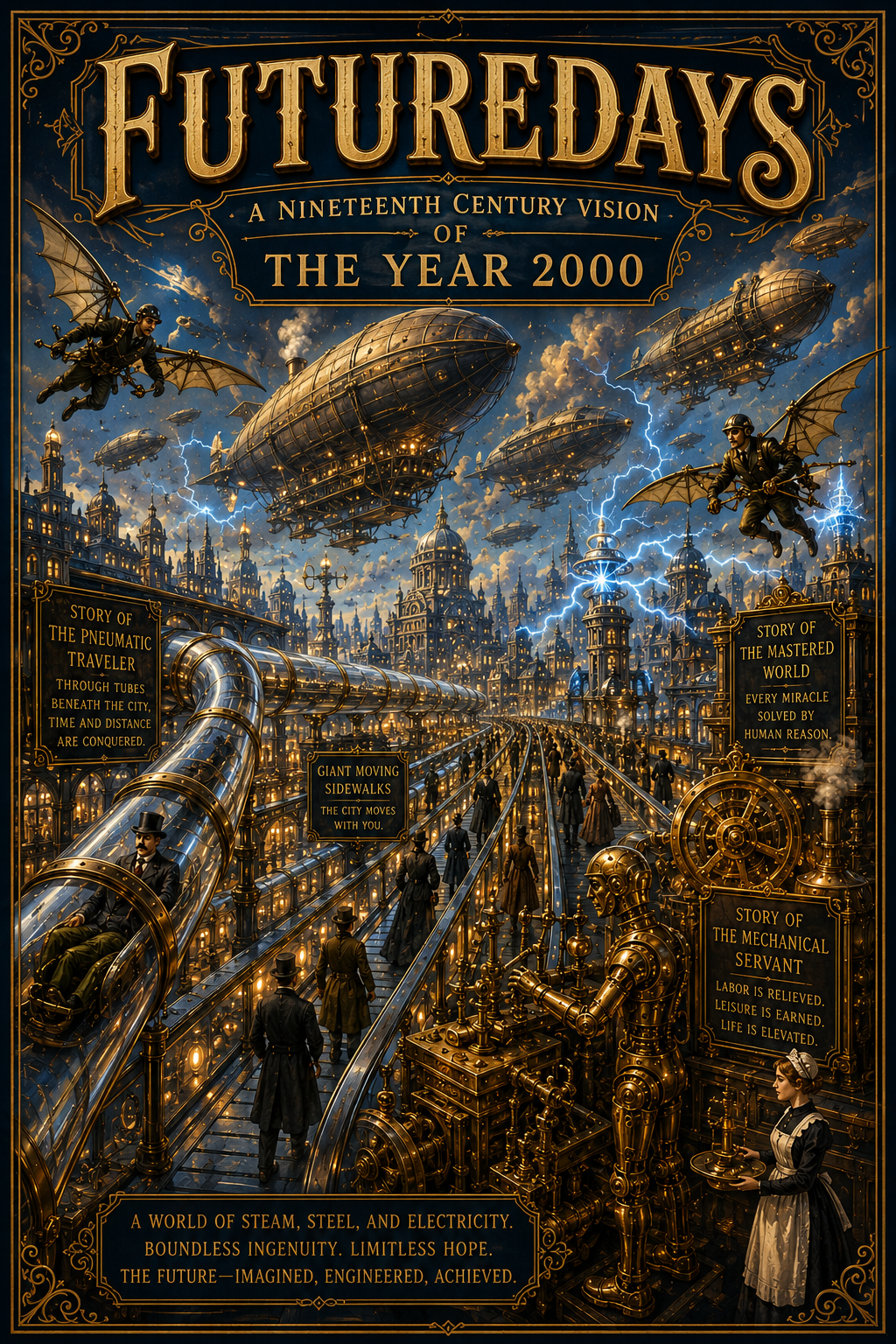
The Story of the Endless Journey In the nineteenth century, transportation was the ultimate symbol of what it meant to be modern. This section of the book describes a world where distance itself has been defeated. The visionaries imagined a sky filled with immense airships and personal flying machines that looked like mechanical birds. Asimov explains the logic here with his usual clarity: because steam had already made the world smaller, people assumed that the next century would simply increase speed until time and space were no longer obstacles. They saw giant moving sidewalks and trains traveling at velocities that would have terrified their grandfathers. It was a vision of a world in constant, fluid motion.
The Story of the Pneumatic Traveler One of the most fascinating mini stories involves the dream of the pneumatic tube. Since engineers of the time had successfully built systems to shoot letters and small packages through tubes using compressed air, they applied a very Asimovian logic to the problem of human travel: why not shoot people too? They envisioned vast networks of underground pneumatics connecting every district of a city. While this specific dream did not materialize as they expected, Asimov treats the idea with respect. To the nineteenth century mind, compressed air was as revolutionary as the digital signals we use today. It was a logical, if impractical, extension of a proven technology.
The Story of the Invisible Web When it came to telecommunications, the nineteenth century was eerily perceptive. This part of the book tells a story of a world where human voices and faces could cross oceans in an instant. Having already seen the telegraph conquer time, these thinkers imagined portable devices kept in pockets and networks that connected every home to the sum of human knowledge in libraries and theaters. Asimov delights in showing how close these dreamers came to our reality simply by following the existing trends of the telephone and telegraph to their ultimate conclusion.
The Story of the Mechanical Servant The vision of domestic life in the year 2000 was a story of liberation from drudgery. Futurists imagined homes where every task, from cooking to cleaning, was handled by a machine. However, because they lived in an age of heavy industry, they imagined these servants as noisy, metallic, and filled with visible gears and levers. Asimov points out a profound irony here: while the nineteenth century correctly predicted that machines would do our work, they could not imagine the invisible world of electronics and miniaturization. Their future was a place of giant engines, whereas our reality is a place of hidden circuits.
The Story of the Alchemical Chef The nineteenth century vision of food was a story of engineering applied to the dinner table. Some thinkers believed that science would become so advanced that we would no longer need traditional agriculture. They imagined meals reduced to concentrated chemical tablets or produced in enormous centralized kitchens that would feed entire cities with industrial efficiency. For them, food was not just nourishment; it was a problem to be solved by the same logic that built factories.
The Story of the Final Peace Perhaps the darkest mini story in the book concerns the future of warfare. Inventors predicted the creation of explosives so powerful they could devastate entire cities in a single blow. Many of these dreamers believed, with a tragic sort of hope, that such weapons would make war so terrible that humanity would finally stop fighting forever. Asimov notes with his characteristic restraint that this is an assumption humanity makes in every generation, only to be proven wrong again and again.
The Story of the Mastered World The final chapters of this vision deal with the ultimate triumph of science over nature. Futurists imagined a time when humanity would control the weather, communicate with residents of Mars, and even find a medical cure for death itself. This was the Golden Age of confidence, where every mystery was seen as merely a temporary problem waiting for a scientific solution. Asimov expresses a genuine admiration for this spirit. Even when their predictions were absurd, they were ambitious, reflecting a deep faith in human intelligence and the power of reason.
Reviewing this work as a whole, Asimov leads the reader toward a very specific realization. The book is not actually about the year 2000; it is about the eternal human habit of looking forward. We see ourselves in these nineteenth century dreamers. Just as they looked at steam and imagined flying cities, we look at our own technologies and try to guess what our children will see. Asimov’s review of these visions is filled with warmth and humility. He reminds us that while we might smile at their mechanical future, someone in the twenty first century will eventually look back at our own predictions with the same amused affection.
Ultimately, Futuredays is a study of civilization imagining itself into existence. It shows that every great invention begins as a fantasy and that the act of dreaming is, in itself, a sign of confidence in the future. Asimov, with his clear and logical presentation, leaves us not with a sense of superiority over the past, but with a sense of connection to it. We are all, as he was, travelers standing at the edge of a new age, trying to catch a glimpse of the miracles to come.