Ancient Astronomy
Asimov chronicles humanity's intellectual evolution from using the sky as a practical calendar to applying logic, geometry, and telescopes to unveil the true heliocentric universe.
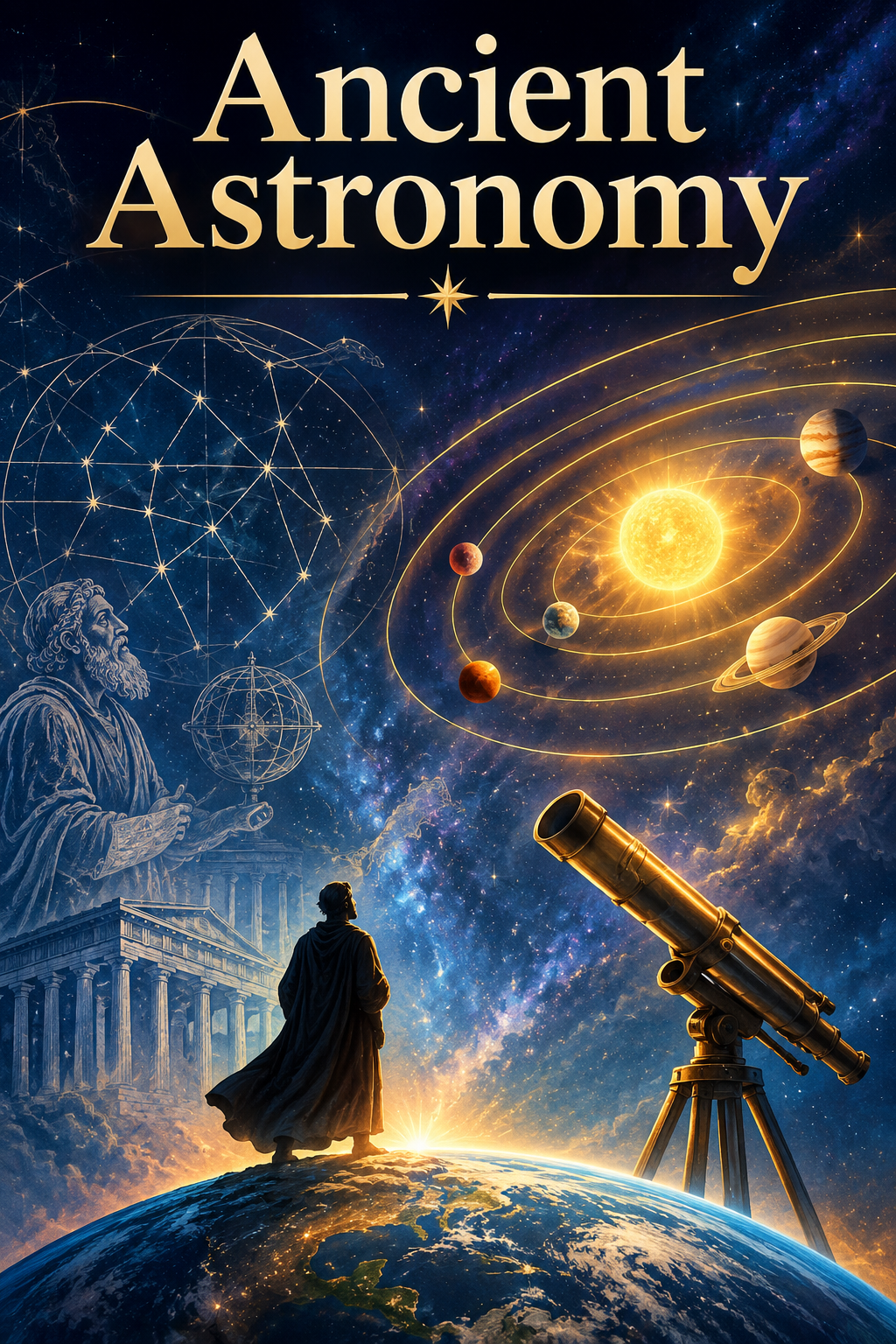
Isaac Asimov's Ancient Astronomy represents a compelling chapter in his extensive lifework of explaining the universe to humanity. Published by Gareth Stevens in 1988 as part of Isaac Asimov's Library of the Universe, this brief thirty-two-page book is designed for younger readers but holds a timeless appeal for anyone interested in the history of science. In a manner reminiscent of his classic science fiction and popular science essays, Asimov writes with an elegant, logical clarity that makes complex historical ideas feel like a grand detective story. Rather than treating the history of science as a dry list of dates, Asimov frames it as a continuous, heroic narrative of human curiosity overcoming the limits of perception. The story begins on a clear night with nothing but the naked eye looking upward, and it moves systematically to the year 1609, when Galileo's telescopic observations fundamentally changed our place in the cosmos. By understanding where this story builds from and where it is leading, we can appreciate Asimov's brilliance in showing how humanity gradually learned to look beyond superficial appearances to discover the deeper laws of the universe.
To understand the beginning of this journey, Asimov takes us back to a clear night when the sky seemed to be a gigantic clock spread above the Earth. Long before anyone understood what the stars really were, early humans noticed that the heavens followed precise, reliable patterns. The Sun rose in the east and set in the west, the Moon shifted its shape from night to night, and while most stars moved together in unison, a few bright wandering objects, which we now call planets, behaved differently. For ancient peoples, watching these movements was not just an exercise in curiosity, it was a matter of survival. The sky was their natural calendar, helping them predict the changing seasons for agriculture and measure the months for their societal organization. Thus, astronomy was born from a beautiful mixture of practical necessity and profound mystery, setting the stage for a long intellectual quest.
The first mini story of systematic observation begins with the Babylonians, who understood that scientific knowledge requires preservation. Generation after generation, Babylonian observers carefully recorded the exact positions and movements of the heavenly bodies. By refusing to let these observations be forgotten, they accumulated a massive body of records that allowed them to recognize regular astronomical patterns. They studied eclipses, tracked the paths of the planets, and developed highly accurate calendars and time-measurement systems. Asimov highlights the Babylonians not just for their specific achievements, but for demonstrating the fundamental scientific principle that progress depends on keeping records and building upon the work of those who came before.
In a parallel development, the Egyptians built an astronomical tradition deeply tied to the natural world around them. Their entire civilization depended on the seasonal flooding of the Nile River, and they realized that the movement of the stars could help them predict this life-giving event. Because of this, the Egyptians developed sophisticated calendars to organize their agricultural and civic lives. Asimov notes that at this early stage in human history, astronomy was not a separate, isolated subject called science. Instead, it was thoroughly integrated into the fabric of daily life, religion, government, and agriculture, showing how deeply connected our early civilizations were to the rhythms of the cosmos.
The narrative undergoes a dramatic transformation when Asimov turns his attention to the ancient Greeks, who began asking what these celestial patterns actually meant. While earlier civilizations were content with recording what happened, the Greeks wanted to understand the underlying physical reality. They began debating the physical shape of the Earth, the causes of planetary motions, and the structure of the universe. One of their most profound achievements was demonstrating that the Earth is a sphere. This was not a random philosophical guess, but a conclusion built on logical observation. They noticed that during a lunar eclipse, the shadow cast by Earth onto the Moon was always curved, and they observed that ships sailing away disappeared gradually below the horizon rather than simply shrinking in size.
This realization led to one of the most elegant scientific episodes in history: Eratosthenes' measurement of the Earth. Armed with nothing more than geometry, sunlight, measurements, and a powerful imagination, Eratosthenes realized he could calculate the entire circumference of the Earth. By comparing the shadow angles cast by the Sun at two different geographic locations and knowing the distance between them, he estimated the size of the sphere. Asimov uses this episode to show that the universe is fundamentally orderly and mathematical. Eratosthenes did not need advanced technology to measure the world; he only needed to understand that nature follows mathematical relationships that human reason can decode.
The story then builds toward a massive intellectual conflict regarding the motion of the Earth itself. To any normal observer, the Earth feels perfectly still, and it seems obvious that the Sun and stars revolve around us. However, the Greek thinker Aristarchus of Samos proposed a revolutionary and startling alternative: that the Earth rotated on its axis and traveled around the Sun. Although this heliocentric model offered a much simpler explanation for many celestial movements, it was widely rejected. Without an understanding of physical inertia to explain why we do not feel the Earth spin, and without instruments precise enough to detect the tiny shifts in stellar positions known as parallax, the ancient world chose to believe their everyday senses over Aristarchus's radical theory.
Instead of heliocentrism, the ancient world chose mathematical precision through the work of Hipparchus. Hipparchus brought astronomical observation to an unprecedented level of rigor, systematically measuring and cataloging the exact positions of the stars and planets. By replacing general impressions with hard mathematical data, Hipparchus established the scientific practice of precise measurement. This focus on data set the stage for Ptolemy, who would synthesize ancient astronomy into a geocentric system that dominated human thought for more than a thousand years.
Ptolemy solved this problem by designing an incredibly complex geocentric system of circles upon circles, known as epicycles. In his model, a planet moved along a small circle that itself traveled along a larger circle around the stationary Earth. Although we now know his physical picture of the universe was completely wrong, his mathematical model was highly successful at predicting where planets would appear in the sky. Asimov uses this episode to illustrate a vital lesson about the scientific method: a mathematical model can be incredibly useful and predictive even if its underlying physical assumptions are eventually proven false. Ptolemy's system was so effective that it remained the unchallenged intellectual foundation of astronomy for centuries, aligning perfectly with both ordinary human experience and theological traditions.
The inevitable breakthrough came when Nicolaus Copernicus revived Aristarchus's long-dormant heliocentric model. Copernicus proposed that the Earth was not the center of everything, but simply one planet among several orbiting the Sun while rotating on its own axis. Although Copernicus's model still relied on circular orbits and was not mathematically perfect, it completely changed the nature of scientific inquiry. Instead of trying to calculate how the entire sky moved around an immovable Earth, astronomers were forced to ask a new, simpler question: what do the movements of the planets look like when observed from a moving platform? Copernicus shifted the physical and intellectual center of our universe.
The climax of Asimov's historical narrative arrives in the year 1609 with Galileo Galilei. Galileo turned the newly improved telescope toward the night sky, and what he observed shattered the old geocentric worldview forever. His observations revealed details that could not be reconciled with the idea of perfect, unchanging heavens revolving around a stationary Earth. Asimov emphasizes that the telescope did more than just discover new objects; it fundamentally changed the relationship between human beings and the cosmos. For the first time, human vision was extended by technology, allowing us to see details that had been invisible since the dawn of time.
In reviewing Asimov's work, its greatest strength lies in its profound empathy for the ancient mind and its insistence on clarity. Asimov does not look down on ancient astronomers for being wrong; instead, he shows how deeply reasonable their geocentric theories were based on their limited observations. The genius of astronomy, as Asimov presents it, is the slow, painful process of learning that appearances can be highly misleading. He presents the history of astronomy as a series of steps in changing perspective: first watching, then recording, then measuring, then mathematical modeling, and finally instrument-aided observation. While the book is necessarily selective due to its brevity, it succeeds in delivering a powerful scientific lesson. Ultimately, Ancient Astronomy is not just a story about stars, but a story of human curiosity overcoming human certainty, proving that our willingness to look upward and ask what is really happening up there? is the true foundation of all modern science.