Young Ghosts
Young Ghosts methodically explores how the human mind investigates the unknown, transforming supernatural mysteries into logical problems of perception, memory, and unrecognized patterns of understanding.
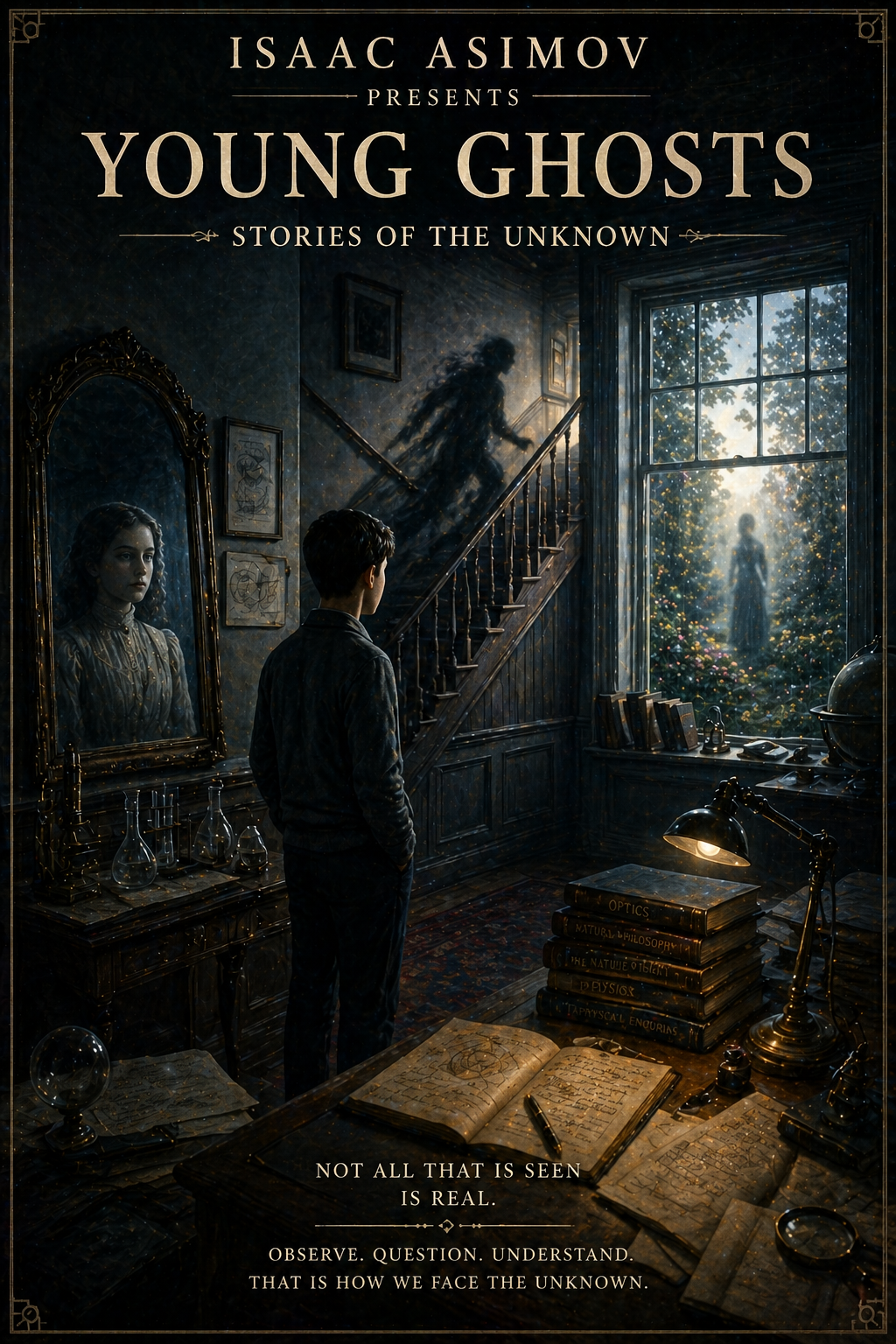
The study of the unknown often begins with a single, rational step. In the collection titled Young Ghosts, we find ourselves in a laboratory of the mind, where the supernatural is treated not with the frantic screams of a gothic novel, but with the measured curiosity of a scientist. This is a progression Isaac Asimov would have admired: a journey from the familiar comfort of the ordinary into the unsettling territory of the unexplained, moving steadily from simple observation toward deep implication through the scientific method. The structure is not a series of random scares; it is an inquiry into how we impose order on a world that refuses to behave according to our established laws.
Our journey through this laboratory begins in The Haunted Room. Here, the narrative establishes its baseline in the mundane. A quiet, unremarkable room becomes the focus of our attention, not because of a sudden apparition, but because of a shift in the atmosphere, a sound or a feeling that cannot be confirmed. It is a story that refuses to rush. Instead, it builds a careful pattern of observation, where small details accumulate until the reader realizes that fear is not born of what we know, but of the ambiguity of what we might know.
Moving deeper into the structure, we encounter The Whispering Hallway. Here, the focus shifts from the physical environment to the reliability of human perception. When a young person hears voices in an empty space, the mind immediately seeks safety in the rational: echoes, imagination, or simple coincidence. The story is effective because of its restraint; it does not force a supernatural conclusion but allows multiple possibilities to coexist. The ghost is presented not as a creature of flesh or spirit, but as a persistent, unanswered question.
The tension increases in The Shadow on the Staircase, where the presence begins to take on a more defined, though still impossible, form. A shadow moves across a staircase despite there being no object to cast it. This marks a recurring pattern in the collection: the escalation from a mere suggestion to a visible manifestation. Yet even as the shadow becomes real to the observer, the narrative maintains a logical tension. We are forced to wonder if this shadow exists in the hallway or if it is a projection cast by the observer’s own mind, a tension the story carefully preserves rather than resolves.
Logic and reflection meet in The Mirror That Remembered. This story examines the literal and figurative nature of what we see. A mirror begins to show images, faces and moments that do not belong to the present. The narrative proceeds with a quiet logic: if a mirror reflects what is before it, then a mirror reflecting the absent must mean something else entirely. It suggests that objects might carry the weight of the past, acting as containers for memory that lingers like physical impressions.
The approach becomes almost mathematical in The Figure by the Window. We observe a shape that is always distant and always indistinct. Every time the protagonist attempts to approach it, the figure vanishes. The story follows a strict protocol: observation leads to hypothesis, which leads to experiment, which inevitably leads to inconclusive results. By resisting complete understanding, the figure maintains its power, proving that the unknown is most potent when it survives the rigors of investigation.
Isolation and the drive for discovery define The Voice in the Garden. The setting expands into the open air, yet the feeling of being alone intensifies. A voice calls out from an empty garden, and the protagonist follows it, not because they are brave, but because they are curious. This marks a shift in the collection's method; the impulse for discovery, the same one that drives science, is what leads the character toward the unknown. The search does not lead to clarity, but it changes the searcher forever.
In The Dream That Stayed, the haunting moves from the external world into the internal landscape. A recurring dream begins to seep into the waking life of the protagonist, blurring the boundaries of reality. It explores the fragility of how the mind constructs the world around it, suggesting that the most persistent ghosts are those that originate within our own thoughts, making them impossible to dismiss.
The theme of absence is then perfected in The Visitor Who Wasn’t There. This story is an inversion of the typical ghost tale. There is no visible figure, yet there are clear, physical effects: objects are moved and doors are opened by an invisible hand. Here, the reader is presented with a clear effect but no visible cause, leaving them to reconcile the two and participate in the logical puzzle of the haunting.
As we look back at these individual cases, a pattern emerges. The later stories in the collection begin to echo the earlier ones, creating a cumulative effect. The ghost is revealed to be many things: a presence, a memory, a trick of perception, or simply a gap in our understanding. The collection’s strength lies in this methodical approach. It does not rely on sudden shocks but allows the reader to follow each logical step of the inquiry.
The final story, The Light That Didn’t Fade, brings the journey to a reflective conclusion. A presence remains, but the fear has been stripped away. The ghost is no longer an enemy to be defeated or a monster to be fled; it is a boundary to be acknowledged. The collection ends where it began, with uncertainty, but it is a structured uncertainty. The reader has been guided through possibilities that are logical yet incomplete.
In summary, Young Ghosts achieves a subtle transformation of the genre. It moves the ghost out of the realm of superstition and into the realm of understanding. It suggests that what we perceive as spirits may be patterns we have not yet recognized or memories that have found a way to persist. The world is not necessarily haunted by the dead, but it is certainly filled with questions that take a personal, haunting form.
This collection serves as a reminder that to confront the unknown is not to banish it, but to examine it with a clear mind. Each story is an observation, and together they form a comprehensive inquiry into the liminal space between what we know and what we feel. The ghosts remain at the end, but they are no longer entirely unknowable; they are simply part of the larger process of the human mind reaching for what lies just beyond its grasp.